

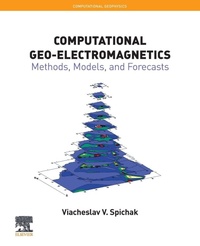
Computational Geo-Electromagnetics: Volume 5
Methods, Models, and Forecasts
Published on 4. February 2020
Book
Paperback/Softback
462 pages
978-0-12-819631-1 (ISBN)
Description
Computational Geo-Electromagnetics: Methods, Models, and Forecasts, Volume Five in the Computational Geophysics series, is devoted to techniques for building of geoelectrical models from electromagnetic data, featuring Bayesian statistical analysis and neural network algorithms. These models are applied to studying the geoelectrical structure of famous volcanoes (i.e., Vesuvio, Kilauea, Elbrus, Komagatake, Hengill) and geothermal zones (i.e., Travale, Italy; Soultz-sous-Forets, Elsace). Methodological recommendations are given on electromagnetic sounding of faults as well as geothermal and hydrocarbon reservoirs. Techniques for forecasting of petrophysical properties from the electrical resistivity as proxy parameter are also considered.
Computational Geo-Electromagnetics: Methods, Models, and Forecasts offers techniques and algorithms for building geoelectrical models under conditions of rare or irregularly distributed EM data and/or lack of prior geological and geophysical information. This volume also includes methodological guidelines on interpretation of electromagnetic sounding data depending on goals of the study. Finally, it details computational algorithms for using electrical resistivity for properties beyond boreholes.
Computational Geo-Electromagnetics: Methods, Models, and Forecasts offers techniques and algorithms for building geoelectrical models under conditions of rare or irregularly distributed EM data and/or lack of prior geological and geophysical information. This volume also includes methodological guidelines on interpretation of electromagnetic sounding data depending on goals of the study. Finally, it details computational algorithms for using electrical resistivity for properties beyond boreholes.
More details
Series
Language
English
Place of publication
United States
Target group
Professional and scholarly
Researchers working in electromagnetic sounding of the Earth, applied geophysics and computational electrodynamics
Product notice
Paperback (trade)
Illustrations
Approx. 140 illustrations (70 in full color)
Dimensions
Height: 235 mm
Width: 191 mm
Thickness: 24 mm
Weight
792 gr
ISBN-13
978-0-12-819631-1 (9780128196311)
Copyright in bibliographic data and cover images is held by Nielsen Book Services Limited or by the publishers or by their respective licensors: all rights reserved.
Schweitzer Classification
Other editions
Additional editions
E-Book
02/2020
Elsevier
€131.00
Available for download
Person
With over 30 years' geophysics experience, Dr. Spichak's main research interests include joint interpretation of electromagnetic and other geophysical data, indirect estimation of the Earth's physical properties from the ground electromagnetic data, and computational electromagnetics. Spichak has authored and edited 8 books with Elsevier, including Electromagnetic Sounding of the Earth's Interior (2015). He is the winner of the Gamburtsev award for the monograph "Magnetotelluric fields in three-dimensional models of geoelectrics? (1999) and the Schmidt medal for outstanding achievements in Geophysics (2010).
Content
1. 3-D EM forward modeling techniques2. Three dimensional Bayesian statistical inversion3. Methodology of the neural network estimation of the model macro-parameters4. Building of 3-D geoelectrical models at the lack of magnetotelluric data5. Methods for joint inversion and analysis of EM and other geophysical data6. Electromagnetic study of geothermal areas7. 3-D magnetotelluric sounding of volcanic interiors: methodological aspects8. A conceptual model of the Earth's crust of Icelandic type9. Conceptual model of the lens in the upper crust (Northern Tien Shan case study)10. Conceptual model of the copper - porphyry ore formation (Sorskoe copper-molybdenum ore deposit case study)11. Electromagnetic sounding of hydrocarbon reservoirs12. Temperature forecasting from electromagnetic data13. Recovering seismic velocities and electrical resistivity from the EM sounding data and seismic tomography14. Porosity forecast from EM sounding data and resistivity logs