

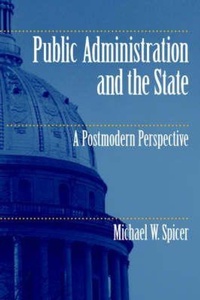
Public Administration and the State
A Postmodern Perspective
Will be published approx. on 30. July 2005
Book
Paperback/Softback
176 pages
978-0-8173-5239-4 (ISBN)
Description
In this critical examination of public administration's pervasive vision of a powerful state, Spicer thoughtfully reconsiders the relationship between activities of governance and concepts of the state.
Woodrow Wilson argued for a state led by a powerful government, guided by science and enlightened experts, for the accomplishment of a set of collective purposes-in other words, a purposive state. Michael Spicer contends that though Wilson and those who followed him have not typically explored questions of political and constitutional theory in their writing, a clear and strong vision of the state has emerged in their work nonetheless.
Building upon the work of Dwight Waldo and others who have sought to explore and reveal the political theory behind the seemingly neutral language of administration, Spicer explores the roots-both historical and philosophical-of the purposive state. He considers the administrative experience of 18th-century Prussia and its relationship to the vision of the purposive state, and examines the ways this idea has been expressed in the 20th century. He then looks at the practical problems such a vision creates for public policy in a fragmented postmodern political culture. Finally, Spicer explores an alternative view of public administration-one based on a civil association model appropriate to our constitutional traditions and contemporary culture.
Woodrow Wilson argued for a state led by a powerful government, guided by science and enlightened experts, for the accomplishment of a set of collective purposes-in other words, a purposive state. Michael Spicer contends that though Wilson and those who followed him have not typically explored questions of political and constitutional theory in their writing, a clear and strong vision of the state has emerged in their work nonetheless.
Building upon the work of Dwight Waldo and others who have sought to explore and reveal the political theory behind the seemingly neutral language of administration, Spicer explores the roots-both historical and philosophical-of the purposive state. He considers the administrative experience of 18th-century Prussia and its relationship to the vision of the purposive state, and examines the ways this idea has been expressed in the 20th century. He then looks at the practical problems such a vision creates for public policy in a fragmented postmodern political culture. Finally, Spicer explores an alternative view of public administration-one based on a civil association model appropriate to our constitutional traditions and contemporary culture.
Reviews / Votes
This short and well-written volume provides a framework for understanding the role of the state in contemporary public administration. - Political Science Quarterly; ""As theorizing about the state is taken by public administration scholars to be a job for political scientists, Spicer makes a valuable contribution by bringing this topic into the realm of public administration.... Spicer does a brilliant job of making his case.... [His] argument is carefully and credibly constructed and sustained throughout. This book is a first-rate contribution to the theoretical literature in public administration and one that I would highly recommend."" - Administrative Theory and PraxisMore details
Language
English
Place of publication
Alabama
United States
Target group
College/higher education
Professional and scholarly
Product notice
Paperback (trade)
Unsewn / adhesive bound
Dimensions
Height: 229 mm
Width: 155 mm
Thickness: 11 mm
Weight
263 gr
ISBN-13
978-0-8173-5239-4 (9780817352394)
Copyright in bibliographic data and cover images is held by Nielsen Book Services Limited or by the publishers or by their respective licensors: all rights reserved.
Schweitzer Classification
Person
Michael Spicer is Professor of Public Administration and Urban Affairs at Cleveland State University and the author of The Founders, The Constitution, and Public Administration: A Conflict of World Views.