

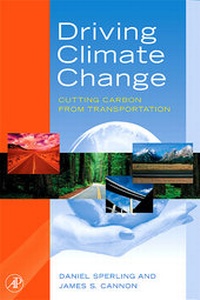
Driving Climate Change
Cutting Carbon from Transportation
Published on 17. October 2006
Book
Hardback
312 pages
978-0-12-369495-9 (ISBN)
Description
Climate change is one of the greatest challenges facing global society. The debate over what to do is confounded by the uncertain relationship between increasing greenhouse gas emissions and climate change, and the impact of those changes on nature and human civilization.
Driving Climate Change will provide professionals and students alike with the latest information regarding greenhouse emissions while presenting the most up-to-date techniques for reducing these emissions. It will investigate three broad strategies for reducing greenhouse gas emissions: 1) reducing motorized travel, 2) shifting to less energy intensive modes, and 3) changing fuel and propulsion technologies. Findings will be presented by the leaders in the field with contributions from professors, researchers, consultants and engineers at the most prominent institutions - commercial, academic and federal - dealing with environmental research and policy.
Driving Climate Change will provide professionals and students alike with the latest information regarding greenhouse emissions while presenting the most up-to-date techniques for reducing these emissions. It will investigate three broad strategies for reducing greenhouse gas emissions: 1) reducing motorized travel, 2) shifting to less energy intensive modes, and 3) changing fuel and propulsion technologies. Findings will be presented by the leaders in the field with contributions from professors, researchers, consultants and engineers at the most prominent institutions - commercial, academic and federal - dealing with environmental research and policy.
More details
Language
English
Place of publication
San Diego
United States
Publishing group
Elsevier Science Publishing Co Inc
Target group
Professional and scholarly
Environmental professionals, engineers, scientists, policy-makers; energy and transportation professionals - researchers and managers.
Illustrations
Illustrated
Dimensions
Height: 229 mm
Width: 152 mm
Weight
600 gr
ISBN-13
978-0-12-369495-9 (9780123694959)
Copyright in bibliographic data and cover images is held by Nielsen Book Services Limited or by the publishers or by their respective licensors: all rights reserved.
Schweitzer Classification
Other editions
Additional editions
E-Book
05/2014
Academic Press
€50.95
Available for download
Persons
Professor of Civil Engineering and Environmental Science founding Director of the Institute of Transportation Studies (ITS - Davis) at UC Davis. He is also co-director of UC Davis' Fuel Cell Vehicle Center and specializes in transportation technology and environmental impacts and travel behavior.Dr. Sperling is recognized as a leading international expert on transportation technology assessment, energy and environmental aspects of transportation, and transportation policy. In the past 20 years, he has authored or co-authored over 140 technical papers and six books. Associate Editor of Transportation Research D (Environment)
Content
Acknowledgements; Preface; Introduction and Overview; Peaking of World Oil Production and Its Mitigation; Toward A Policy Agenda For Climate Change: Changing Technologies and Fuels and the Changing Value of Energy; Coordinated Policy Measures for Reducing the Fuel Use of the U.S. Light Duty Vehicle Fleet; Carbon Burdens from New Car Sales in the United States; Reducing Vehicle Emissions through Cap-and-Trade Schemes; North American Feebate Analysis Model; Reducing Growth in Vehicle Miles Traveled: Can We Really Pull It Off; International Comparison of Policies to Reduce Greenhouse Gas Emissions from Passenger Vehicles; Reducing Transport-Related Greenhouse Gas Emissions in Developing Countries: The Role of the Global Environmental Facility; What Multilateral Banks (And Other Donors) Can Do To Reduce Greenhouse Gas Emissions: A Case Study of Latin America and the Caribbean; From Public Understanding to Public Policy: Public Views on Energy, Technology & Climate Science in the United States; Narrative Self-Identity and Societal Goals: Automotive Fuel Economy and Global Warming Policy; Lost in Option Space: Risk Partitioning to Guide Climate and Energy Policy; Towards a Transportation Policy Agenda for Climate Change;Appendix A: About the Editors and Authors; Appendix B: Asilomar Attendees List for 2005