

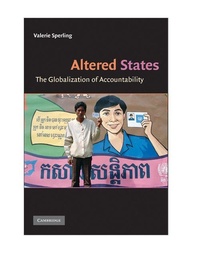
Altered States
The Globalization of Accountability
Published on 25. May 2009
Book
Paperback/Softback
396 pages
978-0-521-54181-7 (ISBN)
Description
Is globalization good for democracy? Or has it made our governing institutions less accountable to citizens? Located at the intersection of international relations and comparative politics, this book explores the effects of globalization on national governance. Under what circumstances do the transnational forces that embody globalization encourage or discourage political accountability? Among the transnational forces discussed in the book are the International Monetary Fund, the World Bank, multinational corporations, the United Nations, private military contractors, peacekeepers, the European Court of Human Rights, and several transnational social movements. Using in-depth case studies of situations in which these transnational institutions interact with national governments and citizens, Valerie Sperling traces the impact of economic, political, military, judicial, and civic globalization on state accountability and investigates the degree to which transnational institutions are themselves responsible to the people whose lives they alter.
Reviews / Votes
'Altered States is an excellent book that is broad ranging and provides a rich store of insights on crucial aspects of globalization that are rarely addressed in depth with this level of flair. It is gracefully written and full of incisive points on the big issues it tackles. The book is timely and will find a wide audience in political science, sociology, and the broader attentive public outside academia.' Steven Fish, University of California, Berkeley 'Valerie Sperling tackles a question which lies at the heart of contemporary concerns about globalization in its various political, economic, military, and cultural guises: namely, just how can elites be held accountable for their actions in a world where the locus of authority seems to have shifted away from nation-states toward a shifting array of international agencies, INGOs, and other non-state actors? If accountability cannot be defined or defended in an increasingly globalized world, then the recent gains for global democracy may also be eroded or reversed. Sperling not only brings this crucial problem to the forefront of attention, but she also conducts careful empirical, comparative social science research into the circumstances under which various aspects of globalization facilitate or undermine accountability. The result is a book that will profoundly reshape multiple intellectual debates.' Stephen Hanson, University of Washington 'At a time of world crisis, policymakers and scholars are perplexed about accountability in globalization. To grasp sources of global democracy, they should turn to Valerie Sperling's meticulously researched and lucidly presented book.' James H. Mittelman, University Professor at American University and author of Hyperconflict: Globalization and Insecurity (2010) 'Sperling should be applauded for her detailed research and for refusing to reduce the phenomena to simple theories or sound bites.' The Review of PoliticsMore details
Language
English
Place of publication
Cambridge
United Kingdom
Target group
College/higher education
Product notice
Paperback (trade)
Dimensions
Height: 234 mm
Width: 156 mm
Thickness: 22 mm
Weight
603 gr
ISBN-13
978-0-521-54181-7 (9780521541817)
Copyright in bibliographic data and cover images is held by Nielsen Book Services Limited or by the publishers or by their respective licensors: all rights reserved.
Schweitzer Classification
Other editions
Additional editions
E-Book
07/2009
1st Edition
Cambridge University Press
€20.49
Available for download
Book
05/2009
Cambridge University Press
€120.10
Shipment within 15-20 days
Person
Valerie Sperling is Associate Professor of Government and International Relations at Clark University. She is the author of Organizing Women in Contemporary Russia: Engendering Transition (Cambridge University Press, 1999) and the editor of Building the Russian State (2000). Her research on the Russian women's movement, as well as on militarism and patriotism in Russia, has been published in Nations & Nationalism, Women & Politics, Signs: Journal of Women in Culture and Society, and numerous edited volumes.
Content
1. Transnational institutions and accountability; 2. For richer, for poorer: economic globalization; 3. Democracy from abroad? Political globalization; 4. Army for hire: transnational military forces; 5. Trials and tribulations: transnational judicial institutions; 6. My country is the whole world: transnational civil society; 7. Conclusion: altered states and altered citizens.