

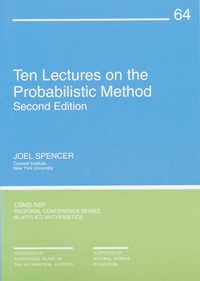
Ten Lectures on the Probabilistic Method
2nd Edition
Will be published approx. on 1. January 1994
Book
Paperback/Softback
98 pages
978-0-89871-325-1 (ISBN)
Description
This update of the 1987 title of the same name is an examination of what is currently known about the probabilistic method, written by one of its principal developers. Based on the notes from Spencer's 1986 series of ten lectures, this new edition contains an additional lecture: The Janson Inequalities. These inequalities allow accurate approximation of extremely small probabilities. A new algorithmic approach to the Lovasz Local Lemma, attributed to Jozsef Beck, has been added to Lecture 8, as well.
Throughout the monograph, Spencer retains the informal style of his original lecture notes and emphasizes the methodology, shunning the more technical ""best possible"" results in favour of clearer exposition. The book is not encyclopaedic - it contains only those examples that clearly display the methodology.
The probabilistic method is a powerful tool in graph theory, combinatorics, and theoretical computer science. It allows one to prove the existence of objects with certain properties (e.g., colourings) by showing that an appropriately defined random object has positive probability of having those properties.
Spencer retains the informal style of his original lecture notes and emphasizes the methodology, shunning the more technical ""best possible"" results in favor of clearer exposition. Topics include: A description via examples of the basic Probabilistic Method and its refinements; Random Graphs; The Lovasz Local Lemma and its recent algorithmic implementations; Discrepancy; Derandomization; Large Deviation Estimates; Martingales; and the recent Janson Inequalities.
Throughout the monograph, Spencer retains the informal style of his original lecture notes and emphasizes the methodology, shunning the more technical ""best possible"" results in favour of clearer exposition. The book is not encyclopaedic - it contains only those examples that clearly display the methodology.
The probabilistic method is a powerful tool in graph theory, combinatorics, and theoretical computer science. It allows one to prove the existence of objects with certain properties (e.g., colourings) by showing that an appropriately defined random object has positive probability of having those properties.
Spencer retains the informal style of his original lecture notes and emphasizes the methodology, shunning the more technical ""best possible"" results in favor of clearer exposition. Topics include: A description via examples of the basic Probabilistic Method and its refinements; Random Graphs; The Lovasz Local Lemma and its recent algorithmic implementations; Discrepancy; Derandomization; Large Deviation Estimates; Martingales; and the recent Janson Inequalities.
More details
Series
Edition
Second Edition
Language
English
Place of publication
New York
United States
Target group
College/higher education
Edition type
New edition
Product notice
Paperback (trade)
Dimensions
Height: 252 mm
Width: 172 mm
Thickness: 9 mm
Weight
176 gr
ISBN-13
978-0-89871-325-1 (9780898713251)
Copyright in bibliographic data and cover images is held by Nielsen Book Services Limited or by the publishers or by their respective licensors: all rights reserved.
Schweitzer Classification
Content
Preface to the Second Edition
The Probabilistic Method
The Deletion Method and Other Refinements
Random Graphs I
Large Deviations and Nonprobabilistic Algorithms
Discrepancy I
Chaos from Order
Random Graphs II
The Lovasz Local Lemma
Discrepancy II
Six Standard Deviations Suffice
The Janson Inequalities
Index.
The Probabilistic Method
The Deletion Method and Other Refinements
Random Graphs I
Large Deviations and Nonprobabilistic Algorithms
Discrepancy I
Chaos from Order
Random Graphs II
The Lovasz Local Lemma
Discrepancy II
Six Standard Deviations Suffice
The Janson Inequalities
Index.