

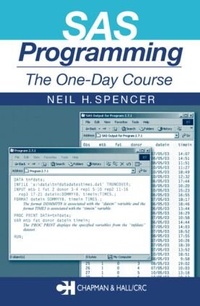
SAS Programming
The One-Day Course
1st Edition
Published on 26. September 2003
Book
Paperback/Softback
208 pages
978-1-58488-409-5 (ISBN)
Description
Aimed at researchers and students , SAS Programming: The One-Day Course provides an introduction to the SAS programming language. It gives the reader a start in SAS programming and the basic data manipulations and statistical summaries that are available through SAS. The book has its origins in material prepared by the author for a one-day course in SAS programming, and the fact that it has been developed from a training course is reflected in the concise nature of the presentation.
Unlike other introductory competitors on the market, this is a pocket-sized reference that does not clutter the programming techniques presented by trying to teach statistical techniques at the same time. Strong on explanations of how to carry out data manipulations that real-life data often call for, each programming technique is supported by tasks to develop skills and confidence. It also contains "tasks" for the reader, complete with solutions. Datasets and the programming code are available to download from www.crcpress.com/e_products/downloads.
Once readers have mastered the topics covered in the book, they will be well placed to learn further aspects of SAS programming.
Unlike other introductory competitors on the market, this is a pocket-sized reference that does not clutter the programming techniques presented by trying to teach statistical techniques at the same time. Strong on explanations of how to carry out data manipulations that real-life data often call for, each programming technique is supported by tasks to develop skills and confidence. It also contains "tasks" for the reader, complete with solutions. Datasets and the programming code are available to download from www.crcpress.com/e_products/downloads.
Once readers have mastered the topics covered in the book, they will be well placed to learn further aspects of SAS programming.
Reviews / Votes
"If you know little about SAS and desire a brief but detailed task-oriented overview of basic SAS commands, this is the book for you...this book is an excellent introduction to SAS. Many new SAS users will appreciate the wealth of SAS program files and data sets. Spencer has clearly documented every one of his programs, it is up to the diligent student to simply follow along."Journal of Statistical Software, Vol. 11, 2004
"...beginning (and more experienced) users of SAS will still find this book very valuable as the issues it addresses are precisely those likely to be found most difficult with the language...The style of the text is concise but clear; example programs, with accompanying explanations, are included throughout the text and sets of exercises, with full solutions, are provided...it's small size and systematic coverage of the basics make it a useful brief reference book. I shall have it close to hand when using SAS in the future."
Significance, Vol. 1(2)
More details
Language
English
Place of publication
Oxford
United States
Publishing group
Taylor & Francis Inc
Target group
Professional and scholarly
Professional
Illustrations
22 s/w Abbildungen, 10 s/w Tabellen
10 Tables, black and white; 22 Illustrations, black and white
Dimensions
Height: 165 mm
Width: 114 mm
Weight
380 gr
ISBN-13
978-1-58488-409-5 (9781584884095)
Copyright in bibliographic data and cover images is held by Nielsen Book Services Limited or by the publishers or by their respective licensors: all rights reserved.
Schweitzer Classification
Other editions
Additional editions
Book
08/2017
1st Edition
CRC Press
€282.26
Shipment within 10-20 days
E-Book
08/2017
Chapman and Hall
€67.49
Available for download
E-Book
08/2017
Chapman and Hall
€67.49
Available for download
Person
Neil H. Spencer
Content
Introducing SAS. Reading Data into SAS. Saving and Output of SAS Datasets. Manipulating Datasets. Restructuring Datasets. Summarising Data. Tabulating Data. Format and Saving of SAS Output. Graphics in SAS. An Introduction to Macros. Appendices.