

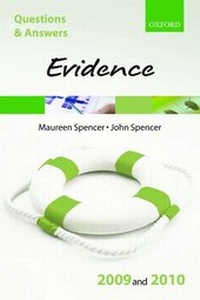
Questions and Answers Evidence 2009 And 2010
6th Edition
Published on 8. January 2009
Book
Paperback/Softback
344 pages
978-0-19-955957-2 (ISBN)
Description
No matter how good your research and study skills, the ultimate test for the law student is the exam. This book explains how to tackle successfully the sort of problems and essay questions typically found in exam papers. The authors clearly guide students through the process of planning and structuring answers, providing advice on what to include, and on what to leave out. The book contains 50 questions and model answers divided into chapters covering all major topics. Each chapter begins with an introduction focusing on important points and ends with suggestions for further reading. Each question is supported by clear commentary indicating exactly what examiners are looking for, followed by an answer plan listing the key points to cover. Online Resource Centre An Online Resource Centre accompanies the book, providing revision and exam advice, links to useful websites, and a glossary to develop students' understanding of subject-specific terms.
More details
Edition
6th edition
Language
English
Place of publication
Oxford
United Kingdom
Target group
College/higher education
Dimensions
Height: 234 mm
Width: 156 mm
ISBN-13
978-0-19-955957-2 (9780199559572)
Copyright in bibliographic data and cover images is held by Nielsen Book Services Limited or by the publishers or by their respective licensors: all rights reserved.
Schweitzer Classification
Other editions
New editions
Maureen Spencer | John Spencer
Q & A Revision Guide: Evidence 2011-2012
Book
01/2011
7th Edition
Oxford University Press
€16.08
Article is exhausted; no reprint
Content
1. Introduction; 2. Burden and standard of proof; presumptions; 3. Character evidence; 4. Hearsay; 5. Confessions; 6. The defendant's silence; 7. Improperly obtained evidence; 8. Competence and compellability; 9. Identification and lies; 10. Expert opinion; 11. Issues in the course of trial; 12. Privilege and public policy; 13. Mixed questions