

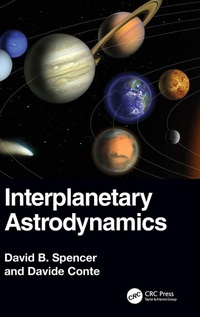
Interplanetary Astrodynamics
1st Edition
Published on 15. May 2023
Book
Hardback
386 pages
978-0-367-75970-4 (ISBN)
Description
Focusing on the orbital mechanics tools and techniques necessary to design, predict, and guide a trajectory of a spacecraft traveling between two or more bodies in a Solar System, this book covers the dynamical theory necessary for describing the motion of bodies in space, examines the N-body problem, and shows applications using this theory for designing interplanetary missions. While most orbital mechanics books focus primarily on Earth-orbiting spacecraft, with a brief discussion of interplanetary missions, this book reverses the focus and emphasizes the interplanetary aspects of space missions. Written for instructors, graduate students, and advanced undergraduate students in Aerospace and Mechanical Engineering, this book provides advanced details of interplanetary trajectory design, navigation, and targeting.
Reviews / Votes
"This book is especially timely given the renewed interested in lunar mission and our focus on getting humans to Mars. We know that students are really interested in "new space" and space exploration. This book fills a need to prepare students for missions beyond earth orbit." - Ron Madler, Embry-Riddle Aeronautical University"Spencer and Conte have produced an excellent resource for the interplanetary trajectory designer. The topics covered in this text are appropriate for both the senior undergraduate orbital mechanics student and the advanced space mechanics graduate student. This is a must have reference for any Astrodynamicist." - Julio Cesar Benavides, The University of Texas at Arlington
More details
Language
English
Place of publication
London
United Kingdom
Publishing group
Taylor & Francis Ltd
Target group
College/higher education
Professional and scholarly
Postgraduate and Professional
Illustrations
66 s/w Abbildungen, 112 farbige Abbildungen, 35 s/w Photographien bzw. Rasterbilder, 106 Farbfotos bzw. farbige Rasterbilder, 31 s/w Zeichnungen, 6 farbige Zeichnungen, 51 s/w Tabellen
51 Tables, black and white; 6 Line drawings, color; 31 Line drawings, black and white; 106 Halftones, color; 35 Halftones, black and white; 112 Illustrations, color; 66 Illustrations, black and white
Dimensions
Height: 240 mm
Width: 161 mm
Thickness: 26 mm
Weight
769 gr
ISBN-13
978-0-367-75970-4 (9780367759704)
Copyright in bibliographic data and cover images is held by Nielsen Book Services Limited or by the publishers or by their respective licensors: all rights reserved.
Schweitzer Classification
Other editions
Additional editions
David B. Spencer | Davide Conte
Interplanetary Astrodynamics
Book
approx. 07/2026
1st Edition
CRC Press
€66.00
Not yet published
David B. Spencer | Davide Conte
Interplanetary Astrodynamics
E-Book
04/2023
1st Edition
CRC Press
€132.99
Available for download
David B. Spencer | Davide Conte
Interplanetary Astrodynamics
E-Book
04/2023
1st Edition
CRC Press
€132.99
Available for download
Persons
Dr. David Spencer is a Professor Emeritus in the Department of Aerospace Engineering at The Pennsylvania State University, in State College, Pennsylvania. His research areas include: spacecraft dynamics and controls, trajectory optimization, theoretical and applied astrodynamics, space systems engineering, space traffic management, orbital debris dynamics and space technology development.
He began his career as a Member of the Technical Staff in the Astrodynamics Department at The Aerospace Corporation. He then worked for the Air Force Research Laboratory in various positions in the Space Vehicles Directorate. He joined the faculty at The Pennsylvania State University in 1999 and retired as an emeritus professor in 2021. He is now back at The Aerospace Corporation as a Senior Staff member. He is a Full Member of the International Academy of Astronautics, a Fellow of the American Astronautical Society, an Associate Fellow of the American Institute of Aeronautics and Astronautics and a former Associate Editor for the Journal of Spacecraft and Rockets.
Dr. Spencer received a B.S. in Mechanical Engineering from the University of Kentucky, an M.S. in Aeronautics and Astronautics from Purdue University, an M.B.A. from Penn State, and a Ph.D. in Aerospace Engineering Sciences from the University of Colorado at Boulder.
Dr. Davide Conte is an Assistant Professor at Embry-Riddle Aeronautical University, in Prescott, Arizona. His research areas include: trajectory optimization, theoretical and applied astrodynamics, space systems engineering, space mission design, and proximity operations.
Dr. Conte was born in Genova, Italy, where he lived and attended school until the age of seventeen. He then received a scholarship to attend the Altoona Area High School in Altoona, Pennsylvania, as an American Field Service (AFS) scholar. He later returned to his hometown in Italy to complete his high school diploma at Liceo Scientific S. Maria ad Nives, in Genova Pegli, Italy. Dr. Conte then moved to the United States to attend The Pennsylvania State University, where he received a B.S. in Aerospace Engineering, a B.S. in Mathematics, an M.S. in Aerospace Engineering, and a Ph.D. in Aerospace Engineering. He joined the faculty in the Department of Aerospace Engineering at Embry-Riddle Aeronautical University in 2019, where he has been leading a variety of competition-driven space mission design projects, and where he teaches and does research in astrodynamics and space mission design.
He is a Member of the American Astronautical Society and a Member of the American Institute of Aeronautics and Astronautics.
He began his career as a Member of the Technical Staff in the Astrodynamics Department at The Aerospace Corporation. He then worked for the Air Force Research Laboratory in various positions in the Space Vehicles Directorate. He joined the faculty at The Pennsylvania State University in 1999 and retired as an emeritus professor in 2021. He is now back at The Aerospace Corporation as a Senior Staff member. He is a Full Member of the International Academy of Astronautics, a Fellow of the American Astronautical Society, an Associate Fellow of the American Institute of Aeronautics and Astronautics and a former Associate Editor for the Journal of Spacecraft and Rockets.
Dr. Spencer received a B.S. in Mechanical Engineering from the University of Kentucky, an M.S. in Aeronautics and Astronautics from Purdue University, an M.B.A. from Penn State, and a Ph.D. in Aerospace Engineering Sciences from the University of Colorado at Boulder.
Dr. Davide Conte is an Assistant Professor at Embry-Riddle Aeronautical University, in Prescott, Arizona. His research areas include: trajectory optimization, theoretical and applied astrodynamics, space systems engineering, space mission design, and proximity operations.
Dr. Conte was born in Genova, Italy, where he lived and attended school until the age of seventeen. He then received a scholarship to attend the Altoona Area High School in Altoona, Pennsylvania, as an American Field Service (AFS) scholar. He later returned to his hometown in Italy to complete his high school diploma at Liceo Scientific S. Maria ad Nives, in Genova Pegli, Italy. Dr. Conte then moved to the United States to attend The Pennsylvania State University, where he received a B.S. in Aerospace Engineering, a B.S. in Mathematics, an M.S. in Aerospace Engineering, and a Ph.D. in Aerospace Engineering. He joined the faculty in the Department of Aerospace Engineering at Embry-Riddle Aeronautical University in 2019, where he has been leading a variety of competition-driven space mission design projects, and where he teaches and does research in astrodynamics and space mission design.
He is a Member of the American Astronautical Society and a Member of the American Institute of Aeronautics and Astronautics.
Content
1. Introduction.
2. Kinematics, Dynamics, and Astrodynamics.
3. N-Body Problem.
4. Coordinate Frames, Time, and Planetary Ephemerides.
5. Trajectory Design.
6. Navigation and Targeting.
Appendices.
References.
2. Kinematics, Dynamics, and Astrodynamics.
3. N-Body Problem.
4. Coordinate Frames, Time, and Planetary Ephemerides.
5. Trajectory Design.
6. Navigation and Targeting.
Appendices.
References.