

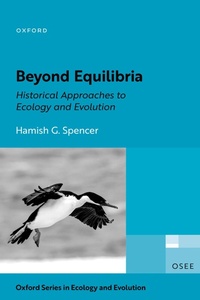
Beyond Equilibria
Historical Approaches to Ecology and Evolution
Published on 20. March 2025
Book
Paperback/Softback
160 pages
978-0-19-285900-6 (ISBN)
Description
Ecologists and evolutionary biologists, especially those with theoretical and mathematical leanings, have tended to dismiss historical approaches as descriptive, smacking of particularities, allowing few generalizations (or even being untestable), and even antithetical to scientific explanation. By contrast, the concept of biological equilibrium pervades every aspect of ecology and evolution, from the popular notion of the 'balance of nature' to sophisticated mathematical analyses of critical points in the state space of scientific models.
This novel book explains the problems associated with an over-reliance on equilibrium-centred explanations, creating a persuasive argument that an explicit consideration of history - i.e. looking beyond the equilibrium - will often lead to a deeper, more nuanced understanding of almost every eco-evolutionary system. The author introduces the concept of 'flavours' of history - the variety of ways in which history can play a critical role in biological processes. Like the flavours of our food, these historical flavours may not always be distinct: they may be blended or overlapping and any number may be present. However, distinguishing between historical flavours is of practical use in explicating ecological and evolutionary phenomena.
Beyond Equilibria: Historical Approaches to Ecology and Evolution is aimed at a broad audience of graduate students and researchers in ecology and evolution. Although there is extensive discussion of mathematical models, the material is presented in such a way that no detailed knowledge is needed. The book will be particularly suitable for a graduate-level discussion course.
This novel book explains the problems associated with an over-reliance on equilibrium-centred explanations, creating a persuasive argument that an explicit consideration of history - i.e. looking beyond the equilibrium - will often lead to a deeper, more nuanced understanding of almost every eco-evolutionary system. The author introduces the concept of 'flavours' of history - the variety of ways in which history can play a critical role in biological processes. Like the flavours of our food, these historical flavours may not always be distinct: they may be blended or overlapping and any number may be present. However, distinguishing between historical flavours is of practical use in explicating ecological and evolutionary phenomena.
Beyond Equilibria: Historical Approaches to Ecology and Evolution is aimed at a broad audience of graduate students and researchers in ecology and evolution. Although there is extensive discussion of mathematical models, the material is presented in such a way that no detailed knowledge is needed. The book will be particularly suitable for a graduate-level discussion course.
More details
Series
Language
English
Place of publication
Oxford
United Kingdom
Target group
College/higher education
Dimensions
Height: 232 mm
Width: 154 mm
Thickness: 11 mm
Weight
295 gr
ISBN-13
978-0-19-285900-6 (9780192859006)
Copyright in bibliographic data and cover images is held by Nielsen Book Services Limited or by the publishers or by their respective licensors: all rights reserved.
Schweitzer Classification
Other editions
Additional editions
Book
03/2025
Oxford University Press
€116.50
Shipment within 15-20 days
Person
Hamish Spencer received his bachelor's degree in mathematics (1982) and his master's degree in zoology (1983) from the University of Auckland. He then studied for his doctorate at Harvard University, supervised by renowned geneticist Richard Lewontin. After graduating in 1988, he moved to the Department of Mathematics & Statistics at the University of Waikato, before taking up a lecturing position at the University of Otago's Department of Zoology, where today he is Sesquicentennial Distinguished Professor. In 2009 he was elected a Fellow of the Royal Society of New Zealand, and in 2023 he became a Fellow of the International Science Council.
Content
1: Introduction 2: The Equilibrium 3: Contingency 4: Constraint 5: History as Template 6: Chance, Chaos and Capriciousness 7: Approach and Turnover 8: Construction Part 1: Explaining Allelic Diversity 9: Construction Part 2: Models Ecosystems & Theoretical Ecology 10: Concluding Remarks