

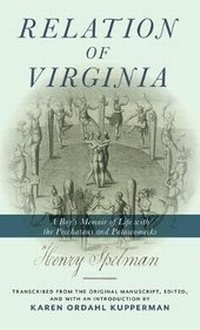
Relation of Virginia
A Boy's Memoir of Life with the Powhatans and the Patawomecks
Book
Paperback/Softback
96 pages
978-1-4798-7221-3 (ISBN)
More details
Language
English
Place of publication
New York
United States
Target group
Professional and scholarly
Product notice
Paperback (trade)
Dimensions
Height: 229 mm
Width: 152 mm
ISBN-13
978-1-4798-7221-3 (9781479872213)
Copyright in bibliographic data and cover images is held by Nielsen Book Services Limited or by the publishers or by their respective licensors: all rights reserved.
Schweitzer Classification
Other editions
New editions
Henry Spelman | Karen Ordahl Kupperman
Relation of Virginia
A Boy's Memoir of Life with the Powhatans and the Patawomecks
Book
03/2019
New York University Press
€17.50
Article not available at the moment
Persons
Henry Spelman was a new arrival in England's Jamestown colony who, at age fourteen, was sent to live with the Powhatans, Pocahontas's people. Henry is unique among boys who lived with Native people because he wrote about his experiences, and his memoir is a major source on Chesapeake Algonquian life in the early days of English colonization. As he matured, he was caught between loyalties. Colonial authorities put him on trial for informing Opechancanough, the Powhatan chief, about changes in Jamestown, and he died at the age of twenty-eight in fighting between Natives and English.
Karen Ordahl Kupperman is Silver Professor of History Emerita at New York University. Her books include The Atlantic in World History (Oxford University Press), The Jamestown Project (Belknap Press), and Indians and English (Cornell University Press), Winner of the AHA Prize in Atlantic History.
Karen Ordahl Kupperman is Silver Professor of History Emerita at New York University. Her books include The Atlantic in World History (Oxford University Press), The Jamestown Project (Belknap Press), and Indians and English (Cornell University Press), Winner of the AHA Prize in Atlantic History.