

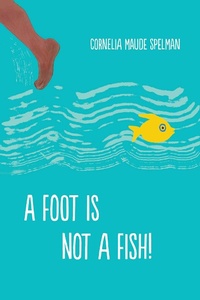
A Foot Is Not a Fish!
Published on 13. February 2024
Book
Paperback/Softback
24 pages
978-1-62726-137-1 (ISBN)
Description
In a time of alternative facts and the loss of a shared sense of reality, A Foot is Not a Fish playfully illustrates the difference between what is true and what is not through absurd fun comparisons that every child—and parent—will instantly understand.
One of our important responsibilities as parents, grandparents, and teachers is to reinforce and support our children’s perceptions of reality, and to strengthen their ability to distinguish what is real, true, and provable from what is belief or opinion or wish. They do learn, naturally, as they grow from babyhood, what is real and true; they delight in recognizing that a story or a game is “pretend,” and are quick to object when someone else says something that they recognize is “not true!”
This book aims to playfully illustrate common and observable truths by making absurd comparisons: “a foot is not a fish.” It aims to show that it is not hard to see what is true, and it also tries to establish that, to make sense of our mutual world, agreement about what is true is necessary.
What if some of us thought that a foot was a fish? Children understand that while different people have different beliefs and opinions—such as about religion, or what is good to eat—they also understand that beliefs and opinions are not the same as facts, such as what is “night” or “day.” Reality cannot be changed by simply saying the opposite of what is true: “we can’t just say that red is green.”
Children also understand that there is a difference between a wish and what is true. They understand, once they are past toddlerhood, that we cannot change the truth just by wishing or hoping: “a wish is just a wish.” They know that, although they might wish it to be so, every day cannot be their birthday.
Encouraging children to create their own verses (rhyming or not) can be fun, and can further help them in their understanding of what is real and what is not. They undoubtedly will come up with surprising and funny examples of their own.
A________ is not a _________!
One of our important responsibilities as parents, grandparents, and teachers is to reinforce and support our children’s perceptions of reality, and to strengthen their ability to distinguish what is real, true, and provable from what is belief or opinion or wish. They do learn, naturally, as they grow from babyhood, what is real and true; they delight in recognizing that a story or a game is “pretend,” and are quick to object when someone else says something that they recognize is “not true!”
This book aims to playfully illustrate common and observable truths by making absurd comparisons: “a foot is not a fish.” It aims to show that it is not hard to see what is true, and it also tries to establish that, to make sense of our mutual world, agreement about what is true is necessary.
What if some of us thought that a foot was a fish? Children understand that while different people have different beliefs and opinions—such as about religion, or what is good to eat—they also understand that beliefs and opinions are not the same as facts, such as what is “night” or “day.” Reality cannot be changed by simply saying the opposite of what is true: “we can’t just say that red is green.”
Children also understand that there is a difference between a wish and what is true. They understand, once they are past toddlerhood, that we cannot change the truth just by wishing or hoping: “a wish is just a wish.” They know that, although they might wish it to be so, every day cannot be their birthday.
Encouraging children to create their own verses (rhyming or not) can be fun, and can further help them in their understanding of what is real and what is not. They undoubtedly will come up with surprising and funny examples of their own.
A________ is not a _________!
More details
Language
English
Place of publication
United States
Target group
Children/juvenile
US School Grade: From Kindergarten to Preschool, Interest Age: From 5 to 8 years
Product notice
Paperback (trade)
Dimensions
Height: 224 mm
Width: 148 mm
Thickness: 4 mm
Weight
77 gr
ISBN-13
978-1-62726-137-1 (9781627261371)
Copyright in bibliographic data and cover images is held by Nielsen Book Services Limited or by the publishers or by their respective licensors: all rights reserved.
Schweitzer Classification
Persons
Cornelia Maude Spelman, MSW, was a therapist with children and families before turning full-time to writing and art. She’s written eleven books for children that help them manage emotion and difficult life situations. Her The Way I Feel series of books for young children, described by reviewers as "sensitive" and "compassionate," have sold over four million copies and been translated into Chinese, Korean, Spanish, Greek, Japanese, German, Arabic, Turkish, Danish, and Russian. She is also the author of the best-selling Your Body Belongs to You.