

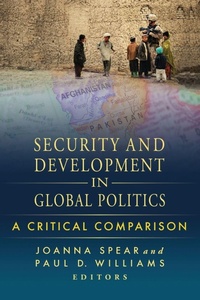
Security and Development in Global Politics
A Critical Comparison
Published on 6. March 2012
Book
Paperback/Softback
288 pages
978-1-58901-886-0 (ISBN)
Description
Security and development matter: they often involve issues of life and death and they determine the allocation of truly staggering amounts of the world's resources. Particularly since the start of the wars in Afghanistan and Iraq, there has been momentum in policy circles to merge the issues of security and development to attempt to end conflicts, create durable peace, strengthen failing states, and promote the conditions necessary for people to lead healthier and more prosperous lives. In many ways this blending of security and development agendas seems admirable and designed to produce positive outcomes all around. However, it is often the case that the two concepts in combination do not receive equal weight, with security issues getting priority over development concerns. This is not desirable and actually undermines security in the longer term. Moreover, there are major challenges in practice when security practitioners and development practitioners are asked to agree on priorities and work together.
"Security and Development in Global Politics" illuminates the common points of interest but also the significant differences between security and development agendas and approaches to problem solving. With insightful chapter pairings - each written by a development expert and a security analyst - the book explores seven core international issues: aid, humanitarian assistance, governance, health, poverty, trade and resources, and demography. Using this comparative structure, the book effectively assesses the extent to which there really is a nexus between security and development and, most importantly, whether the link should be encouraged or resisted.
"Security and Development in Global Politics" illuminates the common points of interest but also the significant differences between security and development agendas and approaches to problem solving. With insightful chapter pairings - each written by a development expert and a security analyst - the book explores seven core international issues: aid, humanitarian assistance, governance, health, poverty, trade and resources, and demography. Using this comparative structure, the book effectively assesses the extent to which there really is a nexus between security and development and, most importantly, whether the link should be encouraged or resisted.
Reviews / Votes
This is a very interesting book. Joanna Spear and Paul Williams have taken a very current and relevant area and taken a different approach in analyzing it ... Overall, I would definitely recommend this book and it is the one that I will certainly use in the classroom. I think the arguments are presented in a very accessible and engaging style, I particularly liked the summary sections within each chapter by the editors and I feel that the innovative structure really provides an excellent way into a set of complex dilemmas. Journal of International Development This thought-provoking volume does not merely promote multifaceted dialogues among academics, practitioners, and policy makers, but also offers us a better conceptualized understanding of the security-development relationship. -- Kai Chen, Zhejiang University, China African AffairsMore details
Language
English
Place of publication
Washington, DC
United States
Target group
Professional and scholarly
US School Grade: College Graduate Student and over
Product notice
Paperback (trade)
Illustrations
Not illustrated
Dimensions
Height: 237 mm
Width: 154 mm
Thickness: 28 mm
Weight
483 gr
ISBN-13
978-1-58901-886-0 (9781589018860)
Copyright in bibliographic data and cover images is held by Nielsen Book Services Limited or by the publishers or by their respective licensors: all rights reserved.
Schweitzer Classification
Other editions
Additional editions
E-Book
03/2012
Georgetown University Press
€58.49
Available for download
Persons
Joanna Spear is director of the Security Policy Studies Program and an associate professor at the Elliott School of International Affairs at The George Washington University. She is also an associate fellow at Chatham House in London. Paul D. Williams is an associate professor at the Elliott School of International Affairs at The George Washington University.
Content
Introduction Joanna Spear and Paul D. Williams 1. Conceptualizing the Security-Development Relationship: An Overview of the Debate Joanna Spear and Paul D. WilliamsPART I: Aid2. Aid: A Security Perspective Bernard Harborne 3. Aid: A Development Perspective Dan Morrow Aid: Editors' CommentsJoanna Spear and Paul D. WilliamsPART II: Humanitarian Assistance4. Humanitarian Assistance: A Security Perspective Robert Maletta and Joanna Spear5. Humanitarian Assistance: A Development Perspective Sabina Dewan Humanitarian Assistance: Editors' CommentsJoanna Spear and Paul D. WilliamsPART III: Governance6. Governance: A Security Perspective Terrence Lyons 7. Governance: A Development Perspective Alasdair BowieGovernance: Editors' CommentsJoanna Spear and Paul D. WilliamsPART IV: Health8. Health: A Security Perspective George C. Fidas 9. Health: A Development Perspective Julie E. Fischer Health: Editors' CommentsJoanna Spear and Paul D. WilliamsPART V: POVERTY10. Poverty: A Security Perspective Paul D. Williams 11. Poverty: A Development Perspective Inder SudPoverty: Editors' CommentsJoanna Spear and Paul D. WilliamsPART VI: TRADE AND RESOURCES12. Trade and Resources: A Security Perspective Joanna Spear 13. Trade and Resources: A Development Perspective Raymond Gilpin Trade and Resources: Editors' CommentsJoanna Spear and Paul D. Williams PART VII: DEMOGRAPHY14. Demography: A Security Perspective Jack A. Goldstone 15. Demography: A Development Perspective Richard P. CincottaDemography: Editors' CommentsJoanna Spear and Paul D. Williams16. Conclusion: The Comparative Conversations between Security and Development Joanna Spear and Paul D. WilliamsContributorsIndex