


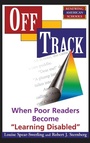
Off Track
When Poor Readers Become ""Learning Disabled""
1st Edition
Published on 8. February 1996
Book
Hardback
352 pages
978-0-8133-8756-7 (ISBN)
Description
The identification of poor readers as learning disabled can be the first of many steps toward consigning students to a lifetime of reading failure. Explaining new research from cognitive psychology, this book shows how reading disability relates to normal reading acquisition and details important new approaches to evaluating and conquering reading problems. The identification of poor readers as learning disabled can be the first of many steps toward consigning students to a lifetime of reading failure. The very label that is meant to help children often becomes a burden that works against effective learning throughout their schooling.In this book, the authors identify the dangers of labeling children as reading or learning disabled, contending that a reading disability is not a unitary phenomenon. In order to diagnose and help children, educators and parents need to understand the multiple sources of reading difficulty before they can choose appropriate means to correct it. Drawing on recent research in cognitive psychology, the authors present a new theoretical model of reading disability that integrates a wide variety of findings across age and grade spans.
Laid out in terms that are readily comprehensible to parents and practitioners, the model outlines the phases that are characteristic of the path to proficient reading, then describes five ways in which disabled readers may stray from this path. The key to the authors work lies in fact that youngsters who stray from the path of normal reading acquisition often are not distinguishable from other children who are classified as poor readers rather than as learning disabled. This model is an especially useful one for practitioners because it both provides a broader view of reading disability than have many previous models and shows how reading disability relates to normal reading acquisition. Using illustrative case studies, the authors describe the five types of reading disabilities, explain how to properly assess them, and suggest ways to conquer them.
Laid out in terms that are readily comprehensible to parents and practitioners, the model outlines the phases that are characteristic of the path to proficient reading, then describes five ways in which disabled readers may stray from this path. The key to the authors work lies in fact that youngsters who stray from the path of normal reading acquisition often are not distinguishable from other children who are classified as poor readers rather than as learning disabled. This model is an especially useful one for practitioners because it both provides a broader view of reading disability than have many previous models and shows how reading disability relates to normal reading acquisition. Using illustrative case studies, the authors describe the five types of reading disabilities, explain how to properly assess them, and suggest ways to conquer them.
More details
Language
English
Place of publication
United States
Publishing group
Taylor & Francis Inc
Target group
College/higher education
Professional and scholarly
ISBN-13
978-0-8133-8756-7 (9780813387567)
Copyright in bibliographic data is held by Nielsen Book Services Limited or its licensors: all rights reserved.
Schweitzer Classification
Other editions
Additional editions
Book
08/2019
1st Edition
Routledge
€207.20
Shipment within 15-20 days
E-Book
03/2018
Routledge
€69.99
Available for download
Book
01/1997
1st Edition
Westview Press Inc
€77.20
Shipment within 10-20 days
Content
What Ails the Field of Learning; Disabilities; The History of LD: Variations on a Theme; What Is Reading Disability? The Road to Proficient Reading; Roads to Reading Disability; Issues; in the Education of Children with Reading Disability; Educational Practices for Children with Reading Disability; Possible Causes of Reading Disability; Abilities, Disabilities, and Reading Disability: How Are They Related? Early Intervention and Prevention; Toward Another Way of Thinking About Reading Difficulties.