

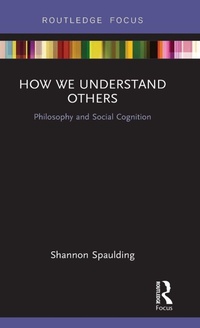
How We Understand Others
Philosophy and Social Cognition
1st Edition
Published on 15. May 2018
Book
Hardback
106 pages
978-1-138-22158-1 (ISBN)
Description
In our everyday social interactions, we try to make sense of what people are thinking, why they act as they do, and what they are likely to do next. This process is called mindreading. Mindreading, Shannon Spaulding argues in this book, is central to our ability to understand and interact with others. Philosophers and cognitive scientists have converged on the idea that mindreading involves theorizing about and simulating others' mental states. She argues that this view of mindreading is limiting and outdated. Most contemporary views of mindreading vastly underrepresent the diversity and complexity of mindreading. She articulates a new theory of mindreading that takes into account cutting edge philosophical and empirical research on in-group/out-group dynamics, social biases, and how our goals and the situational context influence how we interpret others' behavior.
Spaulding's resulting theory of mindreading provides a more accurate, comprehensive, and perhaps pessimistic view of our abilities to understand others, with important epistemological and ethical implications. Deciding who is trustworthy, knowledgeable, and competent are epistemically and ethically fraught judgments: her new theory of mindreading sheds light on how these judgments are made and the conditions under which they are unreliable.
This book will be of great interest to students of philosophy of psychology, philosophy of mind, applied epistemology, cognitive science and moral psychology, as well as those interested in conceptual issues in psychology.
Spaulding's resulting theory of mindreading provides a more accurate, comprehensive, and perhaps pessimistic view of our abilities to understand others, with important epistemological and ethical implications. Deciding who is trustworthy, knowledgeable, and competent are epistemically and ethically fraught judgments: her new theory of mindreading sheds light on how these judgments are made and the conditions under which they are unreliable.
This book will be of great interest to students of philosophy of psychology, philosophy of mind, applied epistemology, cognitive science and moral psychology, as well as those interested in conceptual issues in psychology.
Reviews / Votes
"Shannon Spaulding has written a short, accessible, intriguing book about mindreading. ... Those familiar with Spaulding's work will be unsurprised that throughout the book she displays mastery of the relevant literatures, philosophical and empirical, that her discussion is crisp, and that her ideas are interesting. This book would serve well in an upper-level philosophy course that covers social cognition. Given the close interplay between philosophers and psychologists in this area I think it would be an excellent choice for psychology or cognitive science courses as well." - Joshua Shepherd, Notre Dame Philosophical ReviewsMore details
Series
Language
English
Place of publication
London
United Kingdom
Publishing group
Taylor & Francis Ltd
Target group
College/higher education
Illustrations
3 s/w Tabellen
3 Tables, black and white
Dimensions
Height: 222 mm
Width: 145 mm
Thickness: 10 mm
Weight
287 gr
ISBN-13
978-1-138-22158-1 (9781138221581)
Copyright in bibliographic data and cover images is held by Nielsen Book Services Limited or by the publishers or by their respective licensors: all rights reserved.
Schweitzer Classification
Other editions
Additional editions
Book
12/2020
1st Edition
Routledge
€37.80
Shipment within 15-20 days

E-Book
05/2018
1st Edition
Routledge
€31.49
Available for download

E-Book
05/2018
1st Edition
Routledge
€31.49
Available for download
Person
Shannon Spaulding is Assistant Professor of Philosophy at Oklahoma State University, USA.
Content
1. Introduction 2. In Defense of Mindreading 3. Expanding the Scope of Mindreading 4. The Goals of Mindreading 5. Model Theory 6. Epistemic and Ethical Applications 7. Concluding Thoughts Index