

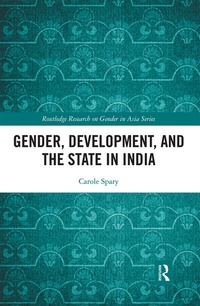
Gender, Development, and the State in India
1st Edition
Published on 30. September 2020
Book
Paperback/Softback
258 pages
978-0-367-66104-5 (ISBN)
Description
This book explores the relationship between the state, development policy, and gender (in)equality in India. It discusses the formation of state policy on gender and development in India in the post-1990 period through three key organising concepts of institutions, discourse, and agency. The book pays particular attention to whether the international policy language of gender mainstreaming has been adopted by the Indian state, and if so, to what extent and with what results. The author examines how these issues play out at multiple levels of governance - at both the national and the subnational (state) level in federal India. This comparative aspect is particularly important in the context of increasing autonomy in development policymaking in India in the 1990s, divergent development policy approaches and outcomes among states, and the emerging importance of subnational state development policies and programmes for women in this period.
The author argues that the state is not a monolith but a heterogeneous, internally differentiated collection of institutions, which offers complex and varying opportunities and consequences for feminists engaging the state. Demonstrating that the Indian empirical case is illuminating for studies of the gendered politics of development, and international debates on gender mainstreaming, the book highlights the politics of negotiating gender equality strategies in the contemporary context of neo-liberal development and brings together complex issues of modernity, postcolonialism, identity politics, federalism, and equality within the broader context of the world's largest democracy.
This book will be of interest to scholars interested in the politics of gender equality, state feminism, and gender mainstreaming; federalism and multi-level governance; and development studies and gender in South Asia.
The author argues that the state is not a monolith but a heterogeneous, internally differentiated collection of institutions, which offers complex and varying opportunities and consequences for feminists engaging the state. Demonstrating that the Indian empirical case is illuminating for studies of the gendered politics of development, and international debates on gender mainstreaming, the book highlights the politics of negotiating gender equality strategies in the contemporary context of neo-liberal development and brings together complex issues of modernity, postcolonialism, identity politics, federalism, and equality within the broader context of the world's largest democracy.
This book will be of interest to scholars interested in the politics of gender equality, state feminism, and gender mainstreaming; federalism and multi-level governance; and development studies and gender in South Asia.
More details
Series
Language
English
Place of publication
London
United Kingdom
Publishing group
Taylor & Francis Ltd
Target group
College/higher education
Postgraduate
Dimensions
Height: 234 mm
Width: 156 mm
Weight
560 gr
ISBN-13
978-0-367-66104-5 (9780367661045)
Copyright in bibliographic data and cover images is held by Nielsen Book Services Limited or by the publishers or by their respective licensors: all rights reserved.
Schweitzer Classification
Other editions
Additional editions
Carole Spary
Gender, Development, and the State in India
Book
02/2019
1st Edition
Routledge
€233.40
Shipment within 15-20 days
Carole Spary
Gender, Development, and the State in India
E-Book
02/2019
1st Edition
Routledge
€67.49
Available for download
Carole Spary
Gender, Development, and the State in India
E-Book
02/2019
1st Edition
Routledge
€67.49
Available for download
Person
Carole Spary is Assistant Professor in the School of Politics and International Relations at the University of Nottingham, UK.
Content
1 Introduction, 2 Gender, Development, and the State in India: Debates and Perspectives, 3 Mapping National Planning Policy Since 1990, 4 Gender Mainstreaming and the State in India: National Initiatives, 5 Subnational Policy in Context: a Profile of Two Indian States, 6 Gendered Institutional Contexts: State-Level Machineries? 7 Gendered Discourses of Development in Two Indian States, 8 Gendered Developmental Subjectivities: Actors, Agency, and Gender Mainstreaming, 9 Conclusion