

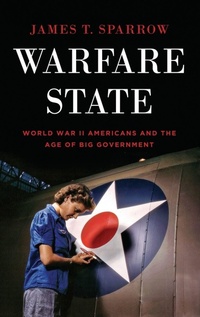
Warfare State
World War II Americans and the Age of Big Government
Published on 8. September 2011
Book
Hardback
344 pages
978-0-19-979101-9 (ISBN)
Description
Although common wisdom and much scholarship assume that "big government" gained its foothold in the United States under the auspices of the New Deal during the Great Depression, in fact it was World War II that accomplished this feat. Indeed, as the federal government mobilized for war it grew tenfold, quickly dwarfing the New Deal's welfare programs.
Warfare State shows how the federal government, in the course of World War II, vastly expanded its influence over American society. Equally important, it looks at how and why Americans adapted to this expansion of authority. Through mass participation in military service, war work, rationing, price control, income taxation and ownership of the national debt in the form of war bonds, ordinary Americans learned to live with the warfare state. They accepted these new obligations because the government encouraged all citizens to think of themselves as personally connected to the battle front, and to imagine the impact of their every action on the combat soldier. By working for the American Soldier, they habituated themselves to the authority of the government. Citizens made their own counter-claims on the state--particularly in the case of industrial workers, women, African Americans, and most of all, the soldiers. Their demands for fuller citizenship offer important insights into the relationship between citizen morale, the uses of patriotism, and the legitimacy of the state in wartime.
World War II forged a new bond between citizens, nation, and government. Warfare State tells the story of this dramatic transformation in American life.
Warfare State shows how the federal government, in the course of World War II, vastly expanded its influence over American society. Equally important, it looks at how and why Americans adapted to this expansion of authority. Through mass participation in military service, war work, rationing, price control, income taxation and ownership of the national debt in the form of war bonds, ordinary Americans learned to live with the warfare state. They accepted these new obligations because the government encouraged all citizens to think of themselves as personally connected to the battle front, and to imagine the impact of their every action on the combat soldier. By working for the American Soldier, they habituated themselves to the authority of the government. Citizens made their own counter-claims on the state--particularly in the case of industrial workers, women, African Americans, and most of all, the soldiers. Their demands for fuller citizenship offer important insights into the relationship between citizen morale, the uses of patriotism, and the legitimacy of the state in wartime.
World War II forged a new bond between citizens, nation, and government. Warfare State tells the story of this dramatic transformation in American life.
Reviews / Votes
But what he [Professor Sparrow] has accomplished, and it is no small thing, is to show how the Roosevelt administration induced people to buy bonds, pay extremely high taxes, and otherwise support the war effort with a minimum of coercion and a maximum of coaxing. This is an interesting and important story and one that he tells well * William I. O'Neill, War in History *More details
Language
English
Place of publication
New York
United States
Illustrations
20 halftones
Dimensions
Height: 240 mm
Width: 161 mm
Thickness: 23 mm
Weight
684 gr
ISBN-13
978-0-19-979101-9 (9780199791019)
Copyright in bibliographic data and cover images is held by Nielsen Book Services Limited or by the publishers or by their respective licensors: all rights reserved.
Schweitzer Classification
Other editions
Additional editions
Book
02/2013
Oxford University Press Inc
€51.20
Shipment within 15-20 days
E-Book
08/2011
1st Edition
OUP eBook
€21.99
Available for download
E-Book
05/2011
1st Edition
OUP eBook
€21.99
Available for download
Person
James T. Sparrow is Assistant Professor of U.S. History at the University of Chicago.
Content
INTRODUCTION: WAR AND THE POPULAR FOUNDATIONS OF THE STATE; PART I. IDEOLOGY, POLITICAL CULTURE, AND STATE FORMATION; PART II. ENCOUNTERING THE STATE IN EVERYDAY LIFE; CONCLUSION: THE PARADOX OF RIGHTS IN THE WARFARE STATE; APPENDIX; NOTES; INDEX