

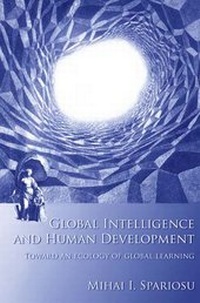
Global Intelligence and Human Development
Toward an Ecology of Global Learning
Published on 28. October 2004
Book
Hardback
296 pages
978-0-262-19511-9 (ISBN)
Description
Increasing concerns about the future of humankind that arise from threats of terrorism, nuclear war, and environmental destruction dramatize the fact that we must begin working collectively to change our ways of interacting with one another and with our habitat. In Global Intelligence and Human Development, Mihai Spariosu argues that the best way to bring about this change is through education. We need, he says, to create learning environments that help us to develop a "global mindset."
Spariosu presents a new conceptual framework for dealing with globalization from an intercultural perspective and outlines an innovative model of learning based on an ethics of global intelligence, which he defines as the ability to understand and work toward what will benefit all life on earth. This kind of understanding, he argues, can emerge only from ongoing intercultural dialogue and cooperation. He identifies the problems that pervade today's education system and then proposes concrete ways to begin moving toward global intelligence.
To overcome the adverse global consequences of prevalent Western scientific practices, Spariosu proposes a nonreductionist ecological model of science that draws on nonlinear concepts from general systems theory. He concludes that there is only one kind of science: human science, which incorporates the physical and the social sciences as well as the humanities and the arts, engaged in continuous dialogue and cooperation. In the final sections of the book he discusses ways in which universities could be reoriented toward promoting the kind of local-global learning environments needed for sustainable human development. He proposes a new field of studies, intercultural knowledge management that would encourage intercultural and transdisciplinary dialogue and teamwork.
Spariosu presents a new conceptual framework for dealing with globalization from an intercultural perspective and outlines an innovative model of learning based on an ethics of global intelligence, which he defines as the ability to understand and work toward what will benefit all life on earth. This kind of understanding, he argues, can emerge only from ongoing intercultural dialogue and cooperation. He identifies the problems that pervade today's education system and then proposes concrete ways to begin moving toward global intelligence.
To overcome the adverse global consequences of prevalent Western scientific practices, Spariosu proposes a nonreductionist ecological model of science that draws on nonlinear concepts from general systems theory. He concludes that there is only one kind of science: human science, which incorporates the physical and the social sciences as well as the humanities and the arts, engaged in continuous dialogue and cooperation. In the final sections of the book he discusses ways in which universities could be reoriented toward promoting the kind of local-global learning environments needed for sustainable human development. He proposes a new field of studies, intercultural knowledge management that would encourage intercultural and transdisciplinary dialogue and teamwork.
More details
Series
Language
English
Place of publication
Cambridge, Mass.
United States
Publishing group
MIT Press Ltd
Target group
Professional and scholarly
Interest Age: From 18 years
Dimensions
Height: 229 mm
Width: 152 mm
Thickness: 17 mm
Weight
544 gr
ISBN-13
978-0-262-19511-9 (9780262195119)
Copyright in bibliographic data and cover images is held by Nielsen Book Services Limited or by the publishers or by their respective licensors: all rights reserved.
Schweitzer Classification
Person
Mihai I. Spariosu is Distinguished Research Professor and Academic Director at the Institute for European Studies at the University of Georgia.