

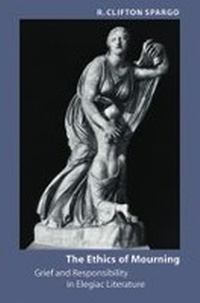
The Ethics of Mourning
Grief and Responsibility in Elegiac Literature
Published on 13. January 2005
Book
Hardback
328 pages
978-0-8018-7977-7 (ISBN)
Description
The Ethics of Mourning dramatically shifts the critical discussion of the lyric elegy from psychological economy to ethical responsibility. Beginning from a reevaluation of famously inconsolable mourners such as Niobe and Hamlet, R. Clifton Spargo discerns the tendency of all grief to depend at least temporarily upon the refusal of consolation. By disrupting the traditional social and psychological functions of grief, resistant mourners transform mourning into a profoundly ethical act. Spargo finds such examples of ethical mourning in opposition to socially acceptable expressions of grief throughout the English and American elegiac tradition. Drawing on the work of Paul Ricoeur, Bernard Williams, and Emmanuel Levinas, his book explores the ethical dimensions of anti-consolatory grief through astute readings of a wide range of texts-including treatments of Hamlet, Milton, and Renaissance elegists, extended readings of Dickinson, Shelley, and Hardy, and final chapters on American Holocaust elegies by Sylvia Plath and Randall Jarrell.
Spargo argues that, to the extent that elegies are melancholic, to the extent that they resist the history of consolation and the strategies of commemoration implicit in elegiac conventions, they make an extraordinary ethical demand on us, asking that we remain in relationship to the other, even past the point of all usefulness. In the wake of the atrocities of the twentieth century, particularly the Holocaust, Spargo finds the crisis in the project of commemoration to be an event already inscribed with ethical meaning. He argues for the particular capacity of literature to undertake an imaginative risk on behalf of another that seems the very ground of ethics itself.
Spargo argues that, to the extent that elegies are melancholic, to the extent that they resist the history of consolation and the strategies of commemoration implicit in elegiac conventions, they make an extraordinary ethical demand on us, asking that we remain in relationship to the other, even past the point of all usefulness. In the wake of the atrocities of the twentieth century, particularly the Holocaust, Spargo finds the crisis in the project of commemoration to be an event already inscribed with ethical meaning. He argues for the particular capacity of literature to undertake an imaginative risk on behalf of another that seems the very ground of ethics itself.
Reviews / Votes
Spargo challenges traditional ideas about mourning. Choice 2005 Engaging and wide-ranging study. -- Patricia Phillippy Shakespeare Yearbook 2007More details
Language
English
Place of publication
Baltimore, MD
United States
Target group
Professional and scholarly
College/higher education
Product notice
sewn/stitched
Cloth over boards
Dimensions
Height: 237 mm
Width: 162 mm
Thickness: 24 mm
Weight
635 gr
ISBN-13
978-0-8018-7977-7 (9780801879777)
DOI
10.56021/9780801879777
Copyright in bibliographic data and cover images is held by Nielsen Book Services Limited or by the publishers or by their respective licensors: all rights reserved.
Schweitzer Classification
Person
R. Clifton Spargo has taught American literature at Marquette University and creative writing at Yale University. In 2000-2001 he was the Pearl Resnick Fellow at the Center for Advanced Holocaust Studies of the U.S. Holocaust Memorial Museum.
Content
Acknowledgements
Introduction
Ethics Versus Morality
From Literature to Ethics, and Back Again
Chapter 1. Toward and Ethics of Mourning
Chapter 2. Mourning and Substitution in Hamlet
Chapter 3. Lyrical Economy and the Question of Alterity
Chapter 4. The Ethical Rhetoric of Anti-Elegy
Chapter 5. Wishful Reciprocity in Thomas Hardy's Poems of 1912-13
Chapter 6. The Bad Conscience of American Holocaust Elegy: The Example of Randall Jarrell
Chapter 7. The Holocaust She Walks In: Sylvia Plath and the Demise of Lyrical Selfhood
Notes
Index
Introduction
Ethics Versus Morality
From Literature to Ethics, and Back Again
Chapter 1. Toward and Ethics of Mourning
Chapter 2. Mourning and Substitution in Hamlet
Chapter 3. Lyrical Economy and the Question of Alterity
Chapter 4. The Ethical Rhetoric of Anti-Elegy
Chapter 5. Wishful Reciprocity in Thomas Hardy's Poems of 1912-13
Chapter 6. The Bad Conscience of American Holocaust Elegy: The Example of Randall Jarrell
Chapter 7. The Holocaust She Walks In: Sylvia Plath and the Demise of Lyrical Selfhood
Notes
Index