

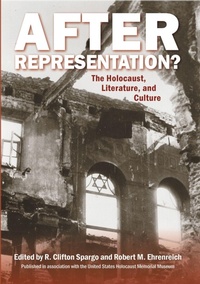
After Representation?
The Holocaust, Literature, and Culture
Published on 11. November 2009
Book
Hardback
256 pages
978-0-8135-4589-9 (ISBN)
Description
After Representation? explores one of the major issues in Holocaust studiesuthe intersection of memory and ethics in artistic expression, particularly within literature.As experts in the study of literature and culture, the scholars in this collection examine the shifting cultural contexts for Holocaust representation and reveal how writersuwhether they write as witnesses to the Holocaust or at an imaginative distance from the Nazi genocideuarticulate the shadowy borderline between fact and fiction, between event and expression, and between the condition of life endured in atrocity and the hope of a meaningful existence. What imaginative literature brings to the study of the Holocaust is an ability to test the limits of language and its conventions. After Representation? moves beyond the suspicion of representation and explores the changing meaning of the Holocaust for different generations, audiences, and contexts.
Reviews / Votes
"A provocative and engaging volume."(Holocaust and Genocide Studies) "Bringing together some of the best known thinkers in the field of Holocaust literary studies, this volume will quickly become required reading for advanced undergraduates, graduate students and scholars of the Shoah." - Irene Kacandes (co-editor of Teaching the Representation of the Holocaust)
More details
Edition
None edition
Language
English
Place of publication
New Brunswick NJ
United States
Target group
College/higher education
Professional and scholarly
Product notice
sewn/stitched
Cloth over boards
With dust jacket
Dimensions
Height: 229 mm
Width: 152 mm
Thickness: 19 mm
Weight
535 gr
ISBN-13
978-0-8135-4589-9 (9780813545899)
Copyright in bibliographic data and cover images is held by Nielsen Book Services Limited or by the publishers or by their respective licensors: all rights reserved.
Schweitzer Classification
Other editions
Additional editions
Unknown | R. Clifton Spargo | Robert Ehrenreich
After Representation?
The Holocaust, Literature, and Culture
E-Book
11/2009
1st Edition
Rutgers University Press
€198.99
Available for download
Persons
R. Clifton Spargo is an associate professor of English at Marquette University. He is the author of Vigilant Memory: Emmanuel Levinas, the Holocaust, and the Unjust Death and The Ethics of Mourning: Grief and Responsibility in Elegiac Literature.
Robert M. Ehrenreich is the director of the university programs division of the Center for Advanced Holocaust Studies at the U.S. Holocaust Memorial Museum.
Robert M. Ehrenreich is the director of the university programs division of the Center for Advanced Holocaust Studies at the U.S. Holocaust Memorial Museum.
Content
Preface
Introduction
Part One. Is the Holocaust Still to Be Written?
The Holocaust, History Writing, and the Role of Fiction
Nostalgia and the Holocaust
Death in Language
Oskar Rosenfeld and Historiographic Realism (including Sex, Shit, and Status)
Part Two. A Question for Aesthetics?
Nazi Aesthetics in Historical Context
Writing Ruins
"If I forget thee, O Jerusalem"
Part Three. Does Culture Influence Memory?
The Holocaust and the Economy of Memory, from Bellow to Morrison (The Technique of Figurative Allegory)
"And in the Distance You Hear Music, a Band Playing"
Reading Heart of Darkness after the Holocaust
Theorizing the Perpetrator in Bernhard Schlink's The Reader and Martin Amis's Time's Arrow
Introduction
Part One. Is the Holocaust Still to Be Written?
The Holocaust, History Writing, and the Role of Fiction
Nostalgia and the Holocaust
Death in Language
Oskar Rosenfeld and Historiographic Realism (including Sex, Shit, and Status)
Part Two. A Question for Aesthetics?
Nazi Aesthetics in Historical Context
Writing Ruins
"If I forget thee, O Jerusalem"
Part Three. Does Culture Influence Memory?
The Holocaust and the Economy of Memory, from Bellow to Morrison (The Technique of Figurative Allegory)
"And in the Distance You Hear Music, a Band Playing"
Reading Heart of Darkness after the Holocaust
Theorizing the Perpetrator in Bernhard Schlink's The Reader and Martin Amis's Time's Arrow