

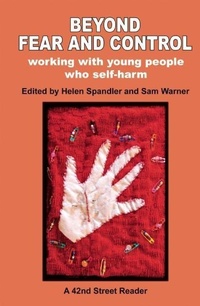
Beyond Fear and Control
Working with Young People Who Self Harm
Published on 30. March 2007
Book
Paperback/Softback
196 pages
978-1-898059-87-5 (ISBN)
Description
"Beyond Fear and Control" discusses ways in which services can change the focus from managing or 'stopping' self harm to working with young people in more permissive, 'young person centred' and empowering ways. Although the need for such a change is increasingly being recognised, the practical implications and ethical dilemmas of this shift have rarely been explored. This book addresses this gap by providing in-depth descriptions of a range of innovative practices which are effective in supporting young people who self harm. People harm themselves in many ways and for many different reasons. Whilst we recognise that there is a complex relationship between self harm and suicide, this book is about supporting young people who use self harm primarily as a way of coping with distress. In this context self harm can be viewed as - the expression of, and temporary relief from overwhelming, unbearable and often conflicting emotions, thoughts or memories, through a self injurious act which they can control and regulate. Undoubtedly young people who self harm arouse strong emotional reactions in most people including fear, helplessness, confusion and anger.Responses are often based on a need to try and protect or rescue young people from danger.
However, our heightened emotional response, coupled with myths and misunderstandings about both young people and self harm, can lead us to respond in ways that, rather than being empowering and helpful, can be felt as controlling and harmful.
However, our heightened emotional response, coupled with myths and misunderstandings about both young people and self harm, can lead us to respond in ways that, rather than being empowering and helpful, can be felt as controlling and harmful.
Reviews / Votes
The contributions in this book recognise that positive strategies are requred in this often distressing and uncomfortable area of work, and offer some thought-provoking recommendations on how to support young people who self-harm. The book should leave readers - people working across children's services and service users alike - with renewed optimism. Jude Sellen, Mental Health Today (UK), November 2007. I found the writing refreshing and easy to negotiate - Several chapters relate theory to practice but this is not clumsy or unnecessary. Rather, the theory adds strength to the discussion which is at all times focussed on the practical application of the work and the narratives of the young people. The narratives both illuminate the work being related an also serve as a constant reminder of the humanity and validity of the narratives of people who self-harm. Kathryn Kinmond, Lecturer in Psychology at Manchester Metropolitan Univerisity, Youth and Policy Journal (UK) Spring 2008More details
Language
English
Place of publication
Manchester
United Kingdom
Target group
Professional and scholarly
College/higher education
Product notice
Paperback (trade)
Unsewn / adhesive bound
Illustrations
illustrations
Dimensions
Height: 231 mm
Width: 152 mm
Thickness: 13 mm
Weight
295 gr
ISBN-13
978-1-898059-87-5 (9781898059875)
Copyright in bibliographic data and cover images is held by Nielsen Book Services Limited or by the publishers or by their respective licensors: all rights reserved.
Schweitzer Classification
Persons
Helen Spandler is a research fellow in the Department of Social Work, University of Central Lancashire (UK). Sam works as a freelance consultant clinical psychologist, trainer, therapist, and expert witness, and was a Research Fellow at Manchester Metropolitan University for over 15 years. She specialises in work around child sexual abuse, within community and secure care services with children, adolescents, (and their parents) and adults. Her books include Understanding Women and Child Sexual Abuse: Feminist revolutions in theory, research and practice (London: Psychology Press). Sam is also designing a training manual and producing a video pack (together with Flexible Films) for working with clients who have experienced child sexual abuse. Sam has also worked for the department of health as a national adviser on sexual violence and mental health.
Content
Part One: Working alongside Young People 1. A Dialogue of Hope and Survival. Clare Shaw and Terri Shaw 2. Edges and Ledges: Reflections on informal support at 42nd Street Eamonn Kirk 3. Finding your own Voice: Social Action group work with young people Keith Green 4.Supportive communities and helpful practices: the challenge for services Ian Murray Part Two: Abuse, Oppression and Self Harm 5. Calming Down: self injury as stress control Rose CameronV 6.Whose Fear Is It Anyway? Working with young people who dissociate Theres Fickl 7. Disordered Boundaries?: A critique of 'Borderline Personality Disorder' Gillian Proctor 8. 'To that piece of each of us that refuses to be silent': Working with self harm and black identity Vera Martins Part Three: Strategies of Survival 9. Self Injury and the Law: What choices do we really have? Sam Warner and Doug Feery 10. Weaving different practices: Working with children and young people who self-harm in prison Carolyn McQueen 11.Harm-Minimisation: limiting the damage of self-injury Louise Roxanne Pembroke 12. Exercising Choice and Control: Independent Living, Direct Payments and Self Harm Helen Spandler and Pauline Heslop