

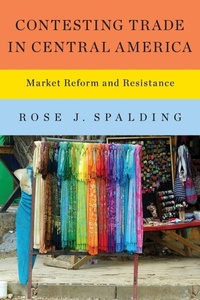
Contesting Trade in Central America
Market Reform and Resistance
Published on 1. April 2014
Book
Paperback/Softback
350 pages
978-1-4773-0764-9 (ISBN)
Description
In 2004, the United States, five Central American countries, and the Dominican Republic signed the Central American Free Trade Agreement (CAFTA), signaling the region's commitment to a neoliberal economic model. For many, however, neoliberalism had lost its luster as the new century dawned, and resistance movements began to gather force. Contesting Trade in Central America is the first book-length study of the debate over CAFTA, tracing the agreement's drafting, its passage, and its aftermath across Central America.
Rose J. Spalding draws on nearly two hundred interviews with representatives from government, business, civil society, and social movements to analyze the relationship between the advance of free market reform in Central America and the parallel rise of resistance movements. She views this dynamic through the lens of Karl Polanyi's "double movement" theory, which posits that significant shifts toward market economics will trigger oppositional, self-protective social countermovements. Examining the negotiations, political dynamics, and agents involved in the passage of CAFTA in Costa Rica, El Salvador, and Nicaragua, Spalding argues that CAFTA served as a high-profile symbol against which Central American oppositions could rally. Ultimately, she writes, post-neoliberal reform "involves not just the design of appropriate policy mixes and sequences, but also the hard work of building sustainable and inclusive political coalitions, ones that prioritize the quality of social bonds over raw economic freedom."
Rose J. Spalding draws on nearly two hundred interviews with representatives from government, business, civil society, and social movements to analyze the relationship between the advance of free market reform in Central America and the parallel rise of resistance movements. She views this dynamic through the lens of Karl Polanyi's "double movement" theory, which posits that significant shifts toward market economics will trigger oppositional, self-protective social countermovements. Examining the negotiations, political dynamics, and agents involved in the passage of CAFTA in Costa Rica, El Salvador, and Nicaragua, Spalding argues that CAFTA served as a high-profile symbol against which Central American oppositions could rally. Ultimately, she writes, post-neoliberal reform "involves not just the design of appropriate policy mixes and sequences, but also the hard work of building sustainable and inclusive political coalitions, ones that prioritize the quality of social bonds over raw economic freedom."
More details
Language
English
Place of publication
Austin, TX
United States
Target group
Professional and scholarly
Dimensions
Height: 229 mm
Width: 152 mm
Thickness: 21 mm
Weight
572 gr
ISBN-13
978-1-4773-0764-9 (9781477307649)
Copyright in bibliographic data and cover images is held by Nielsen Book Services Limited or by the publishers or by their respective licensors: all rights reserved.
Schweitzer Classification
Person
Rose J. Spalding is Professor of Political Science at DePaul University. Her previous books include Capitalists and Revolution in Nicaragua and The Political Economy of Revolutionary Nicaragua.
Content
List of Acronyms and Initialisms
Acknowledgments
Introduction, Overview, and Methods
Chapter 1. The March to Market Reform in Central America
Chapter 2. Rule Makers and Rule Takers: Negotiating CAFTA
Chapter 3. Resistance: Competing Voices
Chapter 4. Ratification Politics: In the Chamber and in the Street
Chapter 5. After CAFTA: Antimining Movements, Investment Disputes, and New Organizational Territory
Chapter 6. Electoral Challenges and Transitions
Chapter 7. Post-Neoliberalism and Alternative Approaches to Change
Appendix A. Note on Interview Methodology
Appendix B. Presidential Election Results, Costa Rica, El Salvador, and Nicaragua, 1978-2011
Notes
Bibliography
Index
Acknowledgments
Introduction, Overview, and Methods
Chapter 1. The March to Market Reform in Central America
Chapter 2. Rule Makers and Rule Takers: Negotiating CAFTA
Chapter 3. Resistance: Competing Voices
Chapter 4. Ratification Politics: In the Chamber and in the Street
Chapter 5. After CAFTA: Antimining Movements, Investment Disputes, and New Organizational Territory
Chapter 6. Electoral Challenges and Transitions
Chapter 7. Post-Neoliberalism and Alternative Approaches to Change
Appendix A. Note on Interview Methodology
Appendix B. Presidential Election Results, Costa Rica, El Salvador, and Nicaragua, 1978-2011
Notes
Bibliography
Index