

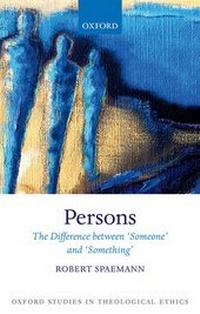
Persons
The Difference between `Someone' and `Something'
Published on 29. June 2017
Book
Paperback/Softback
272 pages
978-0-19-880848-0 (ISBN)
Description
An examination and defence of the concept of personality, long central to Western moral culture but now increasingly under attack, by a leading European philosopher. Persons takes issue with major contemporary philosophers, especially in the English-speaking world (such as Parfit and Singer), who have contributed to the eclipse of the idea, and traces the debate back to the foundations of modern philosophy in Descartes and Locke. Robert Spaemann offers extended discussions of the sources of the idea in Christian theology and its development in Western philosophy. He also provides a number of pointed discussions of pressing practical questions--for example, our treatment of the severely disabled human and the moral status of intelligent non-human animals. The book covers a great deal of ground before coming to a focused conclusion: all human beings are persons.
Reviews / Votes
Spaemann provides substantive analysis about what persons are by distinguishing what persons do from what nonpersons do. But this is no mere case of positing-in good Sartrean fashion-that human existence precedes essence. No, this is a sophisticated investigation into what makes persons unique among all other existing entities through a focus on those activities, primarily of the mind, that enable one to understand human beings as persons. * Chris Emerick, PNEUMA * Persons is a significant contribution to contemporary thinking and, as such, needs to be read. * Sue Patterson, The Journal of Theological Studies * Until recently relatively unknown outside Germany, the work of the Christian moral philosopher Robert Spaemann is now commanding the attention of English readers; this elegant translation of his work on personhood will do much to further his reputation as a thinker of uncommon breadth and penetration . . . It is a work of a remarkably poised and fully realized intelligence, full of passages of breathtaking perception, all the more striking for their calm modest simplicity. * John Webster, The Expository Times * A prolific German Catholic intellectual historian, ethicist, political theorist, and public intellectual. * Arthur Madigan, The Journal of Religious Ethics Vol. 38, No. 2 (June 2010) *More details
Series
Language
English
Place of publication
Oxford
United Kingdom
Target group
College/higher education
Professional and scholarly
Dimensions
Height: 216 mm
Width: 137 mm
Thickness: 15 mm
Weight
334 gr
ISBN-13
978-0-19-880848-0 (9780198808480)
Copyright in bibliographic data and cover images is held by Nielsen Book Services Limited or by the publishers or by their respective licensors: all rights reserved.
Schweitzer Classification
Other editions
Additional editions
Book
12/2006
Oxford University Press
€235.40
Shipment within 15-20 days
Persons
Robert Spaemann is Emeritus Professor at the University of Munich and Honorary Professor of the University of Salzburg. His research focuses on Christian ethics with particular attention to bioethics, ecology, and human rights.
Oliver O'Donovan is Professor Emeritus of Christian Ethics and Practical Theology at the University of Edinburgh. He is the Series Editor of the Oxford Studies in Theological Ethics series and a past President of the Society for the Study of Christian Ethics. His publications include The Desire of the Nations (Cambridge University Press, 1996), Common Objects of Love (Eerdmans, 2002), and The Ways of Judgment (2005).
Oliver O'Donovan is Professor Emeritus of Christian Ethics and Practical Theology at the University of Edinburgh. He is the Series Editor of the Oxford Studies in Theological Ethics series and a past President of the Society for the Study of Christian Ethics. His publications include The Desire of the Nations (Cambridge University Press, 1996), Common Objects of Love (Eerdmans, 2002), and The Ways of Judgment (2005).
Content
Introduction
1: Why we Speak of Persons
2: Why we call Persons `Persons'
3: How we Identify Persons
4: The Negative
5: Intentionality
6: Transcendence
7: Fiction
8: Religion
9: Time
10: Death and the Future Perfect Tense
11: Independence of Context
12: Subjects
13: Souls
14: Conscience
15: Recognition
16: Freedom
17: Promise and Forgiveness
18: Are All Human Beings Persons?
1: Why we Speak of Persons
2: Why we call Persons `Persons'
3: How we Identify Persons
4: The Negative
5: Intentionality
6: Transcendence
7: Fiction
8: Religion
9: Time
10: Death and the Future Perfect Tense
11: Independence of Context
12: Subjects
13: Souls
14: Conscience
15: Recognition
16: Freedom
17: Promise and Forgiveness
18: Are All Human Beings Persons?