

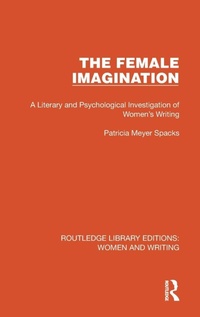
The Female Imagination
A Literary and Psychological Investigation of Women's Writing
1st Edition
Published on 12. September 2022
Book
Hardback
348 pages
978-1-032-26366-3 (ISBN)
Description
Is there such a thing as a female literary imagination - a special brand of insight and intuition that characterises women's writing? Is there something about a novel, whether by Jane Austen, Charlotte Bronte or Doris Lessing, that tells us that it could only have been written by a woman? Do the subject matter, form and style that women choose throw light on the way they think and feel?
In this brilliant and highly readable book, originally published in 1976, Patricia Spacks analyses the female view of the world. Juxtaposing - sometimes in startlingly original combination some eighty books written between the seventeenth century and the present day she uses both literary and psychological analysis to explore patterns that recur again and again in the stories women tell - whether about their own lives or the lives of their fictional characters. She dissects female experience in the twentieth century as viewed by an array of writers ranging from Kate Millet to Virginia Woolf; examines the interplay of social passivity and psychic power that dominates characters such as Maggie Tulliver and Jane Eyre, the altruism that impels Jane Austen's and Mrs Gaskell's heroines, the 'acceptance' of Virginia Woolf's Mrs Ramsey, the personal and social conflicts that beset so many of the adolescent girls that figure in both nineteenth-century and contemporary literature; reveals the complex motives that can be bound up in a women's deliberate choice of the artist's role, as appears in the writings of Isadora Duncan's and Dora Carrington, Marie Bashkirtseff and Mary McCartney - and the surprising forms 'freedom' can take, as for Beatrice Webb in the East End of London or Isak Dinerson in the wilds of Africa...
The voices echo and re-echo across the years in fascinating counter-point. Their range is enormous - rebels and reformers, actresses and painters, Society ladies and unknown girls in small towns, novels, poems, memoirs, diaries and letters, both English and American, and alongside classics such as Wuthering Heights and well-known modern works such as The Bell Jar, Patricia Spacks introduces an intriguing selection of relatively unknown writers, such as Napoleon's psychoanalyst great-niece Marie Bonaparte, the Victorian arch-fantasist Mary MacLane and the autobiography of a seventeenth-century Duchess.
The Female Imagination is much more than a study of women's writing. It is an inquiry into the nature of female thought, self-expression and experience. As such it should appeal to every educated woman - and to many men too.
In this brilliant and highly readable book, originally published in 1976, Patricia Spacks analyses the female view of the world. Juxtaposing - sometimes in startlingly original combination some eighty books written between the seventeenth century and the present day she uses both literary and psychological analysis to explore patterns that recur again and again in the stories women tell - whether about their own lives or the lives of their fictional characters. She dissects female experience in the twentieth century as viewed by an array of writers ranging from Kate Millet to Virginia Woolf; examines the interplay of social passivity and psychic power that dominates characters such as Maggie Tulliver and Jane Eyre, the altruism that impels Jane Austen's and Mrs Gaskell's heroines, the 'acceptance' of Virginia Woolf's Mrs Ramsey, the personal and social conflicts that beset so many of the adolescent girls that figure in both nineteenth-century and contemporary literature; reveals the complex motives that can be bound up in a women's deliberate choice of the artist's role, as appears in the writings of Isadora Duncan's and Dora Carrington, Marie Bashkirtseff and Mary McCartney - and the surprising forms 'freedom' can take, as for Beatrice Webb in the East End of London or Isak Dinerson in the wilds of Africa...
The voices echo and re-echo across the years in fascinating counter-point. Their range is enormous - rebels and reformers, actresses and painters, Society ladies and unknown girls in small towns, novels, poems, memoirs, diaries and letters, both English and American, and alongside classics such as Wuthering Heights and well-known modern works such as The Bell Jar, Patricia Spacks introduces an intriguing selection of relatively unknown writers, such as Napoleon's psychoanalyst great-niece Marie Bonaparte, the Victorian arch-fantasist Mary MacLane and the autobiography of a seventeenth-century Duchess.
The Female Imagination is much more than a study of women's writing. It is an inquiry into the nature of female thought, self-expression and experience. As such it should appeal to every educated woman - and to many men too.
More details
Series
Language
English
Place of publication
London
United Kingdom
Publishing group
Taylor & Francis Ltd
Target group
College/higher education
Professional and scholarly
Postgraduate, Professional, and Undergraduate
Dimensions
Height: 240 mm
Width: 161 mm
Thickness: 24 mm
Weight
696 gr
ISBN-13
978-1-032-26366-3 (9781032263663)
Copyright in bibliographic data and cover images is held by Nielsen Book Services Limited or by the publishers or by their respective licensors: all rights reserved.
Schweitzer Classification
Other editions
Additional editions
Patricia Meyer Spacks
The Female Imagination
A Literary and Psychological Investigation of Women's Writing
Book
09/2024
1st Edition
Routledge
€53.90
Shipment within 10-20 days
Patricia Meyer Spacks
The Female Imagination
A Literary and Psychological Investigation of Women's Writing
E-Book
09/2022
1st Edition
Routledge
€40.99
Available for download
Patricia Meyer Spacks
The Female Imagination
A Literary and Psychological Investigation of Women's Writing
E-Book
09/2022
1st Edition
Routledge
€40.99
Available for download
Content
Acknowledgements, Prologue, 1. Theorists, 2. Power and Passivity, 3. Taking Care, 4. The Adolescent as Heroine, 5. The Artist as Woman, 6. Finger Posts, 7. The World Outside, 8. Free Women, Afterword, Work Cited, Index