

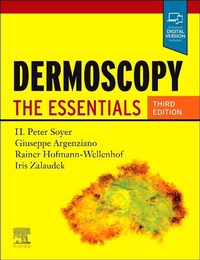
Dermoscopy
The Essentials
3rd Edition
Published on 13. March 2020
Book
Paperback/Softback
240 pages
978-0-7020-6882-9 (ISBN)
Description
Dermoscopy: The Essentials presents the practical guidance you need to master this highly effective, more economical, and less invasive alternative to biopsy. Drs. Peter Soyer, Giuseppe Argenziano, Rainer Hofmann-Wellenhof, and Iris Zalaudek explain all aspects of performing dermoscopy and interpreting results. With approximately 30% new clinical and dermoscopic images, valuable pearls and checklists, and online access to the fully searchable and downloadable text, you'll have everything you need to diagnose earlier and more accurately.
Avoid diagnostic pitfalls through pearls that explain how to accurately use dermoscopy and highlight common mistakes
Master all aspects of performing dermoscopy and interpreting the results with easy-to-use "traffic light" systems and checklists for quick and effective learning
Gain a better visual understanding with approximately 30% new clinical and dermoscopic images that depict the appearance of benign and malignant lesions and feature arrows and labels to highlight important manifestations
Get better diagnostic results for less by learning how to successfully perform dermoscopy with this portable, to-the-point resource
Enhanced eBook version included with purchase. Your enhanced eBook allows you to access all of the text, figures, and references from the book on a variety of devices
Avoid diagnostic pitfalls through pearls that explain how to accurately use dermoscopy and highlight common mistakes
Master all aspects of performing dermoscopy and interpreting the results with easy-to-use "traffic light" systems and checklists for quick and effective learning
Gain a better visual understanding with approximately 30% new clinical and dermoscopic images that depict the appearance of benign and malignant lesions and feature arrows and labels to highlight important manifestations
Get better diagnostic results for less by learning how to successfully perform dermoscopy with this portable, to-the-point resource
Enhanced eBook version included with purchase. Your enhanced eBook allows you to access all of the text, figures, and references from the book on a variety of devices
Reviews / Votes
"This book presents hundreds of dermatoscopic color images of melanoma, nevi, and non-melanoma skin cancers. The objective is to teach readers how to recognize a skin malignancy by training the eye to scan for the major pertinent criteria. This is an essential skill for all dermatologists to master." --Patricia Wong, MD (Private Practice) Doody's Review ServiceMore details
Edition
3rd edition
Language
English
Place of publication
London
United Kingdom
Target group
Professional and scholarly
Product notice
Paperback (trade)
Unsewn / adhesive bound
Illustrations
Approx. 700 illustrations (700 in full color); Illustrations
Dimensions
Height: 251 mm
Width: 192 mm
Thickness: 15 mm
Weight
529 gr
ISBN-13
978-0-7020-6882-9 (9780702068829)
Copyright in bibliographic data and cover images is held by Nielsen Book Services Limited or by the publishers or by their respective licensors: all rights reserved.
Schweitzer Classification
Other editions
New editions
Giuseppe Argenziano | Gabriella Brancaccio | Rainer Hofmann-Wellenhof
Dermoscopy: The Essentials
The Essentials
Book
approx. 12/2026
4th Edition
Churchill Livingstone
€80.00
Not yet published
Additional editions
H. Peter Soyer MD | Giuseppe Argenziano MD | Rainer Hofmann-Wellenhof MD
Dermoscopy E-Book
The Essentials
E-Book
11/2019
3rd Edition
Elsevier
€51.99
Available for download
Previous edition
H. Peter Soyer | Giuseppe Argenziano | Rainer Hofmann-Wellenhof
Dermoscopy
The Essentials: Expert Consult - Online and Print
Book
08/2011
2nd Edition
Saunders
€94.39
Article exhausted; check for reprint
Persons
Professor Soyer is an academic dermatologist with over 30 years' experience in the field. He was appointed Chair in Dermatology by The University of Queensland in 2007 and as Director of the Princess Alexandra Hospital Dermatology Department in 2008.
Professor Soyer is internationally recognised for his expertise in the areas of clinical dermatology, dermatooncology, dermatopathology and dermatologic imaging. He is a pioneer and world leader in the field of dermoscopy of pigmented skin lesions, a non-invasive diagnostic method. He has lead the development of the morphologic classification system currently used worldwide.
Professor Soyer has an extensive publication record with over 600 publications to date, with more than 650 citations per year (in the last 5 years) and an h-index of 70 (Google Scholar).
Professor Soyer has received numerous awards and in total, through his involvement as an investigator, he has achieved over $24M in research funding for UQ. Giuseppe Argenziano is the Head of the Dermatology Unit at the University of Campania, Naples, Italy; Co-founder and past president of the International Dermoscopy Society; President of the Italian Society of Dermatology; and Editor-in-Chief of Dermatology Practical and Conceptual Journal.
Dr Argenziano's main research area is dermato-oncology - having authored over 800 scientific articles and landmark primary publications and books concerning dermoscopy, melanoma and non-melanoma skin cancer - with an h-index of 76 (Scopus, 2024).
Over the past 25 years he has supervised over 500 foreign and Italian residents in Dermatology, established scientific collaborations with 1500+ colleagues from more than 50 Nations, and organized more than 500 national and international didactic meetings, courses and conferences. Dr Argenziano is a frequently invited speaker and/or has been elected chairman in more than 500 national and international conferences in the field of dermatology. Iris Zalaudek is Chair of the Department of Dermatology and Venereology of the University of Trieste (Italy) and the Hospitals of the Azienda Sanitaria Universitaria Giuliano Isontina (Trieste, Italy).
She is an expert in Dermatologic Oncology with a worldwide network of collaborations and teaching activities, with a profound knowledge in conducting clinical trials and fundraising. Her research comprises 580+ publications with an h-index of 72 (Scopus, 2023) and over 600 participations as speaker at congresses and workshops. Her research on melanocytic tumors led to a new classification of nevi and her working group was the first to describe the dermoscopic patterns of different forms of epithelial skin cancers.
Dr Zalaudek has received awards for TOP Researcher at the University of Graz, Austria and the University of Trieste, Italy. She was the First Female President of the International Dermoscopy Society and was nominated among the TOP 50 Women in Dermatology (2020).
Professor Soyer is internationally recognised for his expertise in the areas of clinical dermatology, dermatooncology, dermatopathology and dermatologic imaging. He is a pioneer and world leader in the field of dermoscopy of pigmented skin lesions, a non-invasive diagnostic method. He has lead the development of the morphologic classification system currently used worldwide.
Professor Soyer has an extensive publication record with over 600 publications to date, with more than 650 citations per year (in the last 5 years) and an h-index of 70 (Google Scholar).
Professor Soyer has received numerous awards and in total, through his involvement as an investigator, he has achieved over $24M in research funding for UQ. Giuseppe Argenziano is the Head of the Dermatology Unit at the University of Campania, Naples, Italy; Co-founder and past president of the International Dermoscopy Society; President of the Italian Society of Dermatology; and Editor-in-Chief of Dermatology Practical and Conceptual Journal.
Dr Argenziano's main research area is dermato-oncology - having authored over 800 scientific articles and landmark primary publications and books concerning dermoscopy, melanoma and non-melanoma skin cancer - with an h-index of 76 (Scopus, 2024).
Over the past 25 years he has supervised over 500 foreign and Italian residents in Dermatology, established scientific collaborations with 1500+ colleagues from more than 50 Nations, and organized more than 500 national and international didactic meetings, courses and conferences. Dr Argenziano is a frequently invited speaker and/or has been elected chairman in more than 500 national and international conferences in the field of dermatology. Iris Zalaudek is Chair of the Department of Dermatology and Venereology of the University of Trieste (Italy) and the Hospitals of the Azienda Sanitaria Universitaria Giuliano Isontina (Trieste, Italy).
She is an expert in Dermatologic Oncology with a worldwide network of collaborations and teaching activities, with a profound knowledge in conducting clinical trials and fundraising. Her research comprises 580+ publications with an h-index of 72 (Scopus, 2023) and over 600 participations as speaker at congresses and workshops. Her research on melanocytic tumors led to a new classification of nevi and her working group was the first to describe the dermoscopic patterns of different forms of epithelial skin cancers.
Dr Zalaudek has received awards for TOP Researcher at the University of Graz, Austria and the University of Trieste, Italy. She was the First Female President of the International Dermoscopy Society and was nominated among the TOP 50 Women in Dermatology (2020).
Author
Professor and Chair, Dermatology Research Centre, The University of Queensland, School of Medicine, Princess Alexandra Hospital, Brisbane, Australia
Professor and Head, Dermatology Unit, University of Campania, Naples, Italy
Professor of Dermatology, Department of Dermatology, Medical University of Graz, Graz, Austria
Chair/Director, Department of Dermatology and Venereology, University of Trieste and Public Hospital Giuliano Isontino, Italy
Content
Chapter 1 - Introduction: The 3-point checklist: The short, easy way to avoid missing a melanoma using dermoscopy
Technique
The 3-point checklist
Triage of suspicious pigmented skin lesions
Chapter 2 - Pattern analysis: Dermoscopic criteria for specific diagnoses
Four global dermoscopic patterns for melanocytic nevi
Diagnosis of melanoma using five melanoma-specific criteria
Diagnosis of facial melanoma using four site-specific melanoma-specific criteria
Four patterns for acral melanocytic lesions
Six criteria for diagnosing non-melanocytic lesions
Chapter 3 - Common clinical scenarios: Side-by-side comparisons of similar-appearing lesions that are benign or malignant
Introduction
Pediatric scenario
Black lesions
Inkspot lentigo
Blue lesions
Reticular lesions
Spitzoid lesions
Special nevi
Multiple Clark (dysplastic) nevi
Follow-up of melanocytic lesions
Lesions with regression
Flat lesions on the face
Nodular lesions on the face
Acral lesions
Pigmented lesions of the nails
Mucosal lesions
Differential diagnostic value of blood vessels
Amelanotic and partially pigmented melanoma
Dermoscopy tests
Further reading
Technique
The 3-point checklist
Triage of suspicious pigmented skin lesions
Chapter 2 - Pattern analysis: Dermoscopic criteria for specific diagnoses
Four global dermoscopic patterns for melanocytic nevi
Diagnosis of melanoma using five melanoma-specific criteria
Diagnosis of facial melanoma using four site-specific melanoma-specific criteria
Four patterns for acral melanocytic lesions
Six criteria for diagnosing non-melanocytic lesions
Chapter 3 - Common clinical scenarios: Side-by-side comparisons of similar-appearing lesions that are benign or malignant
Introduction
Pediatric scenario
Black lesions
Inkspot lentigo
Blue lesions
Reticular lesions
Spitzoid lesions
Special nevi
Multiple Clark (dysplastic) nevi
Follow-up of melanocytic lesions
Lesions with regression
Flat lesions on the face
Nodular lesions on the face
Acral lesions
Pigmented lesions of the nails
Mucosal lesions
Differential diagnostic value of blood vessels
Amelanotic and partially pigmented melanoma
Dermoscopy tests
Further reading