

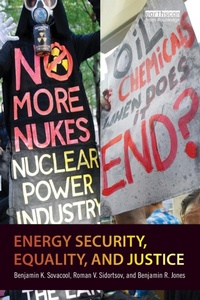
Energy Security, Equality and Justice
1st Edition
Published on 13. December 2013
Book
Paperback/Softback
222 pages
978-0-415-81520-8 (ISBN)
Description
This book applies concepts from ethics, justice, and political philosophy to five sets of contemporary energy problems cutting across time, economics, politics, geography, and technology.
In doing so, the authors derive two key energy justice principles from modern theories of distributive justice, procedural justice, and cosmopolitan justice. The prohibitive principle states that "energy systems must be designed and constructed in such a way that they do not unduly interfere with the ability of people to acquire those basic goods to which they are justly entitled." The affirmative principle states that "if any of the basic goods to which people are justly entitled can only be secured by means of energy services, then in that case there is also a derivative entitlement to the energy services." In laying out and employing these principles, the book details a long list of current energy injustices ranging from human rights abuses and energy-related civil conflict to energy poverty and pervasive and growing negative externalities.
The book illustrates the significance of energy justice by combining the most up-to-date data on global energy security and climate change, including case studies and examples from the electricity supply, transport, and heating and cooking sectors, with appraisals based on centuries of thought about the meaning of justice in social decisions.
In doing so, the authors derive two key energy justice principles from modern theories of distributive justice, procedural justice, and cosmopolitan justice. The prohibitive principle states that "energy systems must be designed and constructed in such a way that they do not unduly interfere with the ability of people to acquire those basic goods to which they are justly entitled." The affirmative principle states that "if any of the basic goods to which people are justly entitled can only be secured by means of energy services, then in that case there is also a derivative entitlement to the energy services." In laying out and employing these principles, the book details a long list of current energy injustices ranging from human rights abuses and energy-related civil conflict to energy poverty and pervasive and growing negative externalities.
The book illustrates the significance of energy justice by combining the most up-to-date data on global energy security and climate change, including case studies and examples from the electricity supply, transport, and heating and cooking sectors, with appraisals based on centuries of thought about the meaning of justice in social decisions.
Reviews / Votes
"Many aspects of growing worldwide energy consumption have sparked debate and discussion, but very little attention has been paid to the social and ethical dimensions of this issue - despite the fact that these aspects are certain to a play an increasingly critical role as doubts arise over the adequacy and desirability of existing supplies. Now, thanks to Messrs. Sovacool, Sidortsov, and Jones, we have a thoughtful, comprehensive assessment of this important topic." - Michael Klare, Five College Professor of Peace & World Security Studies, Hampshire College, USA"A brilliant and much-needed contribution to one of the most pressing issues of our time: meeting global energy needs in ethically defensible ways. Sovacool and his co-authors have distinguished themselves yet again. A must-read for anyone interested in energy." - Kristin Shrader-Frechette, O'Neill Family Endowed Professor, University of Notre Dame, USA
"This book's perspective is a vital one in the age of climate change; it will become more vital as the impacts of our energy choices harm more people in the future, especially the world's poor. It will be essential reading for anyone interested in the role of energy in the modern world, especially those concerned about the resulting injustices and how to reduce them." - Paul G. Harris, Chair Professor of Global and Environmental Studies, Hong Kong Institute of Education
"Energy Security, Equality and Justice proposes the novel and important idea that energy security should be construed widely to encompass principles derived from modern theories of distributive justice, procedural justice, and cosmopolitan justice. This is a provocative and pathbreaking book that permits us to think about the debate over the transition to a low-carbon energy system in terms of current energy injustices whether human rights abuses and energy-related civil conflicts or the social and class character of energy poverty. A timely and important book." - Michael Watts, Class of 63 Professor at the University of California, Berkeley, USA
"Sovacool, Sidortsov and Jones' contribution is both timely and essential ... Alongside such a crucial and timely focus, the main strength of this book is its well-chosen and well developed case study approach ... we owe Benjamin Sovacool, Roman Sidortsov and Benjamin Jones a great deal of gratitude. This book contributes to a debate that it would be remiss to ignore." - Darren McCauley, Energy, University of St Andrews, UK
"In tackling one of the most complex societal problems of all - the human use of energy - Benjamin Sovacool, Roman Sidortsov and Benjamin Jones have written an excellent expose of the global energy system from an injustice perspective. Their book provides clear evidence and a strong rationale as to why justice principles should be incorporated into energy decision-making." - Energy Research & Social Justice, Catherine Gross, The Australian National University
More details
Language
English
Place of publication
London
United Kingdom
Publishing group
Taylor & Francis Ltd
Target group
College/higher education
Illustrations
30 s/w Abbildungen, 9 s/w Tabellen
9 Tables, black and white; 30 Illustrations, black and white
Dimensions
Height: 234 mm
Width: 156 mm
Thickness: 13 mm
Weight
371 gr
ISBN-13
978-0-415-81520-8 (9780415815208)
Copyright in bibliographic data and cover images is held by Nielsen Book Services Limited or by the publishers or by their respective licensors: all rights reserved.
Schweitzer Classification
Other editions
Additional editions
Benjamin K. Sovacool | Roman V. Sidortsov | Benjamin R. Jones
Energy Security, Equality and Justice
Book
12/2013
1st Edition
Routledge
€230.80
Shipment within 15-20 days
Benjamin K. Sovacool | Roman V. Sidortsov | Benjamin R. Jones
Energy Security, Equality and Justice
E-Book
12/2013
1st Edition
Routledge
€72.49
Available for download
Benjamin K. Sovacool | Roman V. Sidortsov | Benjamin R. Jones
Energy Security, Equality and Justice
E-Book
12/2013
1st Edition
Routledge
€72.49
Available for download
Persons
Benjamin K. Sovacool is Director of the Danish Center for Energy Technology at AU-Herning and a Professor of Social Sciences at the School of Business and Social Sciences at Aarhus University in Denmark. He is also Associate Professor of Law at Vermont Law School and Director of the Energy Security and Justice Program at their Institute for Energy and the Environment.
Roman V. Sidortsov is currently a Senior Global Energy Fellow at the Institute for Energy and the Environment of Vermont Law School, as well as a Doctoral Researcher at the Scott Polar Research Institute, Cambridge University, United Kingdom.
Benjamin R. Jones is currently a Senior Global Energy Fellow at the Institute for Energy and the Environment of Vermont Law School, as well as a Doctoral Candidate in the Faculty of Law at the University of Victoria, Canada.
Roman V. Sidortsov is currently a Senior Global Energy Fellow at the Institute for Energy and the Environment of Vermont Law School, as well as a Doctoral Researcher at the Scott Polar Research Institute, Cambridge University, United Kingdom.
Benjamin R. Jones is currently a Senior Global Energy Fellow at the Institute for Energy and the Environment of Vermont Law School, as well as a Doctoral Candidate in the Faculty of Law at the University of Victoria, Canada.
Content
1. The Global Energy System beyond Technology and Economics 2. Deciphering Energy Justice and Injustice 3. The Temporal Dimension: Externalities and Climate Change 4. The Economic Dimension: Inequality, Poverty and Rising Prices 5. The Socio-Political Dimension: Corruption, Authoritarianism, and Energy Conflict 6. The Geographic Dimension: Uneven Development and Environmental Risks 7. The Technological Dimension: Efficiency, Reliability, Safety, and Vulnerability 8. Towards a More Just and Secure Energy Future