

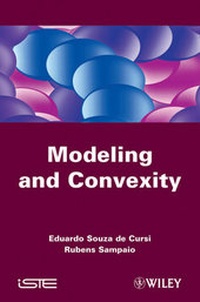
Modeling and Convexity
1st Edition
Will be published approx. on 11. May 2010
Book
Hardback
516 pages
978-1-84821-177-3 (ISBN)
Description
This reference book gives the reader a complete but comprehensive presentation of the foundations of convex analysis and presents applications to significant situations in engineering. The presentation of the theory is self-contained and the proof of all the essential results is given. The examples consider meaningful situations such as the modeling of curvilinear structures, the motion of a mass of people or the solidification of a material. Non convex situations are considered by means of relaxation methods and the connections between probability and convexity are explored and exploited in order to generate numerical algorithms.
Reviews / Votes
"The book is addressed mainly to mechanical engineers, but it can also be useful to mathematicians who are interested in applications." (Mathematical Reviews, 2012)More details
Product info
GB
Edition
1., Auflage
Language
English
Place of publication
London
United Kingdom
Target group
Professional and scholarly
Product notice
sewn/stitched
Cloth over boards
Dimensions
Height: 241 mm
Width: 164 mm
Thickness: 35 mm
Weight
901 gr
ISBN-13
978-1-84821-177-3 (9781848211773)
Schweitzer Classification
Other editions
Additional editions
Eduardo Souza de Cursi | Rubens Sampaio
Modeling and Convexity
E-Book
03/2013
Wiley-ISTE
€207.99
Available for download
Eduardo Souza de Cursi | Rubens Sampaio
Modeling and Convexity
E-Book
03/2013
Wiley-ISTE
€207.99
Available for download
Persons
Eduardo Souza De Cursi is Professor at the National Institute for Applied Sciences in Rouen, France, where he is also Dean of International Affairs and Director of the Laboratory for the Optimization and Reliability in Structural Mechanics.
Rubens Sampaio is Professor at PUC-Rio, Rio de Janeiro, Brazil. His fields of interest are Applied Mathematics and Mechanics.
Rubens Sampaio is Professor at PUC-Rio, Rio de Janeiro, Brazil. His fields of interest are Applied Mathematics and Mechanics.
Content
Introduction ix
PART 1 MOTIVATION: EXAMPLES AND APPLICATIONS 1
Chapter 1 Curvilinear Continuous Media 3
1.1 One-dimensional curvilinear media 4
1.2 Supple membranes 22
Chapter 2 Unilateral System Dynamics 33
2.1 Dynamics of ideally flexible strings 34
2.2 Contact dynamics 40
Chapter 3 A Simplified Model of Fusion/Solidification 53
3.1 A simplified model of phase transition 53
Chapter 4 Minimization of a Non-Convex Function 61
4.1 Probabilities, convexity and global optimization 61
Chapter 5 Simple Models of Plasticity 69
5.1 Ideal elastoplasticity 72
PART 2 THEORETICAL ELEMENTS 77
Chapter 6 Elements of Set Theory 79
6.1 Elementary notions and operations on sets 80
6.2 The axiomof choice 83
6.3 Zorn's lemma 89
Chapter 7 Real Hilbert Spaces 97
7.1 Scalar product and norm 99
7.2 Bases anddimensions 107
7.3 Open sets and closed sets 114
7.4 Sequences 123
7.5 Linear functionals 137
7.6 Complete space 146
7.7 Orthogonal projection onto a vector subspace 160
7.8 Riesz's representationtheory 167
7.9 Weak topology 173
7.10 Separable spaces: Hilbert bases and series 184
Chapter 8 Convex Sets 201
8.1 Hyperplanes 201
8.2 Convexsets 208
8.3 Convexhulls 212
8.4 Orthogonal projection on a convex set 217
8.5 Separationtheorems 228
8.6 Convexcone 241
Chapter 9 Functionals on a Hilbert Space 253
9.1 Basic notions 254
9.2 Convexfunctionals 261
9.3 Semi-continuous functionals 271
9.4 Affine functionals 298
9.5 Convexification and LSC regularization 303
9.6 Conjugate functionals 320
9.7 Subdifferentiability 331
Chapter 10 Optimization 361
10.1 The optimization problem 361
10.2 Basic notions 362
10.3 Fundamental results 374
Chapter 11 Variational Problems 421
11.1 Fundamental notions 421
11.2 Zeros of operators 455
11.3 Variational inequations 463
11.4 Evolutionequations 469
Bibliography 487
Index 495
PART 1 MOTIVATION: EXAMPLES AND APPLICATIONS 1
Chapter 1 Curvilinear Continuous Media 3
1.1 One-dimensional curvilinear media 4
1.2 Supple membranes 22
Chapter 2 Unilateral System Dynamics 33
2.1 Dynamics of ideally flexible strings 34
2.2 Contact dynamics 40
Chapter 3 A Simplified Model of Fusion/Solidification 53
3.1 A simplified model of phase transition 53
Chapter 4 Minimization of a Non-Convex Function 61
4.1 Probabilities, convexity and global optimization 61
Chapter 5 Simple Models of Plasticity 69
5.1 Ideal elastoplasticity 72
PART 2 THEORETICAL ELEMENTS 77
Chapter 6 Elements of Set Theory 79
6.1 Elementary notions and operations on sets 80
6.2 The axiomof choice 83
6.3 Zorn's lemma 89
Chapter 7 Real Hilbert Spaces 97
7.1 Scalar product and norm 99
7.2 Bases anddimensions 107
7.3 Open sets and closed sets 114
7.4 Sequences 123
7.5 Linear functionals 137
7.6 Complete space 146
7.7 Orthogonal projection onto a vector subspace 160
7.8 Riesz's representationtheory 167
7.9 Weak topology 173
7.10 Separable spaces: Hilbert bases and series 184
Chapter 8 Convex Sets 201
8.1 Hyperplanes 201
8.2 Convexsets 208
8.3 Convexhulls 212
8.4 Orthogonal projection on a convex set 217
8.5 Separationtheorems 228
8.6 Convexcone 241
Chapter 9 Functionals on a Hilbert Space 253
9.1 Basic notions 254
9.2 Convexfunctionals 261
9.3 Semi-continuous functionals 271
9.4 Affine functionals 298
9.5 Convexification and LSC regularization 303
9.6 Conjugate functionals 320
9.7 Subdifferentiability 331
Chapter 10 Optimization 361
10.1 The optimization problem 361
10.2 Basic notions 362
10.3 Fundamental results 374
Chapter 11 Variational Problems 421
11.1 Fundamental notions 421
11.2 Zeros of operators 455
11.3 Variational inequations 463
11.4 Evolutionequations 469
Bibliography 487
Index 495