

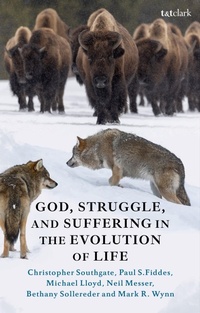
God, Struggle, and Suffering in the Evolution of Life
Published on 16. October 2025
Book
Hardback
208 pages
978-0-567-71649-1 (ISBN)
Description
This open access book stems from a unique set of conversations between six scholars concerned with the theological problem of suffering in the non-human world over millions of years.
How is the confession of the Christian God compatible with all the struggle, violence and suffering to which the Darwinian world testifies? This work identifies key fault lines in this rapidly growing debate - over the questions of resistance to the divine will in the non-human creation in particular. Is the picture of the biological world we derive from the sciences indicative of a profound resistance, distorting the character of creation? If so, what is the origin and character of this resistance? Or is it unnecessary to postulate such resistance before the evolution of human beings and their sin? Or is an intermediate position, in which some specific characteristics hint at resistance, the most coherent approach?
Six leading academic press on this question in a way that illustrates the quality of the conversation we have been able to achieve in our colloquia. As such it also provides a model for how theology can be done collaboratively, respecting diversity of positions and using that diversity to advance the frontiers of debate.
The eBook editions of this book are available open access under a CC BY-NC-ND 4.0 license on bloomsburycollections.com. Open Access was funded by the University of Exeter, Baylor University, and Wycliffe Hall, Oxford.
How is the confession of the Christian God compatible with all the struggle, violence and suffering to which the Darwinian world testifies? This work identifies key fault lines in this rapidly growing debate - over the questions of resistance to the divine will in the non-human creation in particular. Is the picture of the biological world we derive from the sciences indicative of a profound resistance, distorting the character of creation? If so, what is the origin and character of this resistance? Or is it unnecessary to postulate such resistance before the evolution of human beings and their sin? Or is an intermediate position, in which some specific characteristics hint at resistance, the most coherent approach?
Six leading academic press on this question in a way that illustrates the quality of the conversation we have been able to achieve in our colloquia. As such it also provides a model for how theology can be done collaboratively, respecting diversity of positions and using that diversity to advance the frontiers of debate.
The eBook editions of this book are available open access under a CC BY-NC-ND 4.0 license on bloomsburycollections.com. Open Access was funded by the University of Exeter, Baylor University, and Wycliffe Hall, Oxford.
Reviews / Votes
Whether you are new the debates surrounding theodicy and the suffering of animals or looking for the next chapter in the conversation, Southgate and crew offer robust and engaging dialogue that remembers-as so few do-that animals an integral part of creation and its redemption. * D. T. Everhart, London School of Theology, UK * Though we often read the polished reflections of theologians on the problem of evil, rarely can we watch them as they struggle with suffering in the world. This short book gives you front-row seats as six Christian scholars meet and discuss how best to understand nature 'red in tooth and claw'. The richness of the debate on animal suffering offers readers a wealth of options to choose from ? but also an inspiring model of positive Christian dialogue across differences that (one hopes) will be widely emulated. * Philip Clayton, Claremont School of Theology, USA * These leading scholars address a fundamental problem in the interaction between Christian theology and the natural sciences: the problem of theodicy as it arises in the evolution of life. Their method is highly creative, engaging, and unique: After defining the problem, the authors develop provocative and constructive responses through intensive interactions with each other. The book concludes with an analysis of common positions, remaining problems, and suggestions for future work. I most highly recommend this book to all those who have struggled with the challenge to faith posed by suffering in nature. * Robert Russell, Graduate Theological Union, USA *More details
Language
English
Place of publication
Edinburgh
United Kingdom
Publishing group
Bloomsbury Publishing PLC
Target group
College/higher education
Dimensions
Height: 222 mm
Width: 145 mm
Thickness: 15 mm
Weight
399 gr
ISBN-13
978-0-567-71649-1 (9780567716491)
Copyright in bibliographic data and cover images is held by Nielsen Book Services Limited or by the publishers or by their respective licensors: all rights reserved.
Schweitzer Classification
Persons
Christopher Southgate is Professor of Christian Theodicy at the University of Exeter, UK.
Paul S. Fiddes is Professor of Systematic Theology in the University of Oxford, and is Director of Research at Regent's Park College, Oxford, UK.
Michael Lloyd is the Principle of Wycliffe Hall, University of Oxford, UK.
Neil Messer is Professor of Theological Bioethics at the University of Baylor, USA.
Bethany Sollereder is Lecturer in Science & Religion at the University of Edinburgh, UK.
Mark R. Wynn is Nolloth Professor of the Philosophy of the Christian Religion at the University of Oxford, UK.
Paul S. Fiddes is Professor of Systematic Theology in the University of Oxford, and is Director of Research at Regent's Park College, Oxford, UK.
Michael Lloyd is the Principle of Wycliffe Hall, University of Oxford, UK.
Neil Messer is Professor of Theological Bioethics at the University of Baylor, USA.
Bethany Sollereder is Lecturer in Science & Religion at the University of Edinburgh, UK.
Mark R. Wynn is Nolloth Professor of the Philosophy of the Christian Religion at the University of Oxford, UK.
Content
Chapter 1: Introduction by Christopher Southgate
Chapter 2:
2.1 Michael Lloyd (Wycliffe Hall, Oxford, UK)
2.1.1 On an originating cause of disvalues in the natural world
2.1.2 On God's relation to the suffering of non-human creatures
2.1.3 On the role of atonement
2.1.4 On the eschatological life of creatures
2.1.5 Lloyd on the strengths and weakness of his scheme
2.2 Neil Messer (Baylor University, USA)
2.2.1 On an originating cause of disvalues in the natural world
2.2.2 On God's relation to the suffering of non-human creatures
2.2.3 On the role of atonement
2.2.4 On the eschatological life of creatures
2.2.5 Messer on the strengths and weaknesses of his scheme
2.3 Christopher Southgate (University of Exeter, UK)
2.3.1 On an originating cause of disvalues in the natural world
2.3.2 On God's relation to the suffering of non-human creatures
2.3.3 On the role of atonement
2.3.4 On the eschatological life of creatures
2.3.5 Southgate on the strengths and weaknesses of his scheme
2.4 Bethany Sollereder (University of Edinburgh, UK)
2.4.1 On an originating cause of disvalues in the natural world
2.4.2 On God's relation to the suffering of non-human creatures
2.4.3 On the role of atonement
2.4.4 On the eschatological life of creatures
2.4.5 Sollereder on the strengths and weakness of her scheme
2.5 Response by Paul Fiddes (University of Oxford, UK) to the initial position papers, and outlining of his own position
2.5.1 Four position papers, two groups
2.5.2 An originating cause and an ongoing relation
2.5.3 The resistance to God in all creation
2.5.4 Atonement and eschatology
Chapter 3
3.1 Michael Lloyd
3.1.1 Is my three-fold taxonomy too rigid?
3.1.2 Is God the ultimate 'cause' of the disvalues of creation?
3.1.3 How far does the Fall of the Angels hypothesis get us?
3.1.4 Why does God not use divine power to prevent or ameliorate suffering?
3.1.5 If God's action in the world is non-coercive, how can we sustain eschatological hope?
3.1.6 Could the process of evolution have happened otherwise?
3.1.7 Three questions for the Resistance Theodicy
3.2 Neil Messer
3.2.1 Das Nichtige, resistance, and originating causes
3.2.2 Death, pain, and suffering
3.2.3 Divine co-suffering, atonement, and eschatology
3.2.4 Conclusion
3.3. Christopher Southgate
3.3.1 Two emerging emphases
3.3.2 God's onging providential engagement
3.3.3 Atonement and eschatology
3.4 Bethany Sollereder
3.4.1 The necessity of suffering
3.4.2 The Cooperation of God with the world
3.4.3 Eschatological Hope
3.4.4 Resistance and Reconciliation in Humans
3.5 Paul Fiddes
3.5.1 The nature of theodicy
3.5.2 Proportionate and disproportionate suffering
3.5.3 The state of a fallen universe
3.5.4 The 'only way' and the argument from non-being
3.5.5 The nature of freedom
3.5.6 The response of creatures to an open-ended purpose
3.5.7 Suffering as something strange to God
3.5.8 Divine cooperation and the new creation
Chapter 4 Mark Wynn (University of Oxford, UK): reflection on the conversation
Chapter 5 Christopher Southgate: conclusion
Bibliography
Index
Chapter 2:
2.1 Michael Lloyd (Wycliffe Hall, Oxford, UK)
2.1.1 On an originating cause of disvalues in the natural world
2.1.2 On God's relation to the suffering of non-human creatures
2.1.3 On the role of atonement
2.1.4 On the eschatological life of creatures
2.1.5 Lloyd on the strengths and weakness of his scheme
2.2 Neil Messer (Baylor University, USA)
2.2.1 On an originating cause of disvalues in the natural world
2.2.2 On God's relation to the suffering of non-human creatures
2.2.3 On the role of atonement
2.2.4 On the eschatological life of creatures
2.2.5 Messer on the strengths and weaknesses of his scheme
2.3 Christopher Southgate (University of Exeter, UK)
2.3.1 On an originating cause of disvalues in the natural world
2.3.2 On God's relation to the suffering of non-human creatures
2.3.3 On the role of atonement
2.3.4 On the eschatological life of creatures
2.3.5 Southgate on the strengths and weaknesses of his scheme
2.4 Bethany Sollereder (University of Edinburgh, UK)
2.4.1 On an originating cause of disvalues in the natural world
2.4.2 On God's relation to the suffering of non-human creatures
2.4.3 On the role of atonement
2.4.4 On the eschatological life of creatures
2.4.5 Sollereder on the strengths and weakness of her scheme
2.5 Response by Paul Fiddes (University of Oxford, UK) to the initial position papers, and outlining of his own position
2.5.1 Four position papers, two groups
2.5.2 An originating cause and an ongoing relation
2.5.3 The resistance to God in all creation
2.5.4 Atonement and eschatology
Chapter 3
3.1 Michael Lloyd
3.1.1 Is my three-fold taxonomy too rigid?
3.1.2 Is God the ultimate 'cause' of the disvalues of creation?
3.1.3 How far does the Fall of the Angels hypothesis get us?
3.1.4 Why does God not use divine power to prevent or ameliorate suffering?
3.1.5 If God's action in the world is non-coercive, how can we sustain eschatological hope?
3.1.6 Could the process of evolution have happened otherwise?
3.1.7 Three questions for the Resistance Theodicy
3.2 Neil Messer
3.2.1 Das Nichtige, resistance, and originating causes
3.2.2 Death, pain, and suffering
3.2.3 Divine co-suffering, atonement, and eschatology
3.2.4 Conclusion
3.3. Christopher Southgate
3.3.1 Two emerging emphases
3.3.2 God's onging providential engagement
3.3.3 Atonement and eschatology
3.4 Bethany Sollereder
3.4.1 The necessity of suffering
3.4.2 The Cooperation of God with the world
3.4.3 Eschatological Hope
3.4.4 Resistance and Reconciliation in Humans
3.5 Paul Fiddes
3.5.1 The nature of theodicy
3.5.2 Proportionate and disproportionate suffering
3.5.3 The state of a fallen universe
3.5.4 The 'only way' and the argument from non-being
3.5.5 The nature of freedom
3.5.6 The response of creatures to an open-ended purpose
3.5.7 Suffering as something strange to God
3.5.8 Divine cooperation and the new creation
Chapter 4 Mark Wynn (University of Oxford, UK): reflection on the conversation
Chapter 5 Christopher Southgate: conclusion
Bibliography
Index