

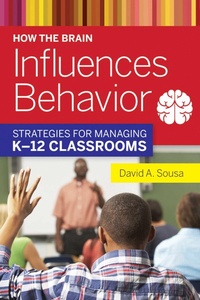
How the Brain Influences Behavior
Strategies for Managing K?12 Classrooms
Published on 26. March 2015
Book
Paperback/Softback
264 pages
978-1-63220-684-8 (ISBN)
Description
Combining theory and practice, David A. Sousa helps educators understand what is happening in the brains of students with behavior problems and offers practical, effective intervention strategies compatible with current findings in neuroscience.
In easy-to-understand language, the author presents current information on brain development and function and highlights factors that affect social and emotional decision-making and negative behaviors like impulsivity, defiance, and violence. Comprehensive yet concise, this guide for K?12 teachers and counselors provides methods for teaching self-control and fostering positive relationships with troubled students and provides case studies that match effective strategies with specific behaviors.
Educators will find answers to critical questions such as:
How does the rate of brain development explain erratic behavior of adolescents?
What type of data collection can help teachers manage misbehavior?
Can peer influence help curb misbehavior rather than encourage it?
Why are boys more likely to misbehave than girls and what can teachers do about it?
How do school and classroom climates affect student behavior?
This invaluable handbook also features reproducible forms, worksheets, checklists, additional references, and an expanded list of primary research sources to help teachers understand and apply research-based principles for classroom and behavior management.
In easy-to-understand language, the author presents current information on brain development and function and highlights factors that affect social and emotional decision-making and negative behaviors like impulsivity, defiance, and violence. Comprehensive yet concise, this guide for K?12 teachers and counselors provides methods for teaching self-control and fostering positive relationships with troubled students and provides case studies that match effective strategies with specific behaviors.
Educators will find answers to critical questions such as:
How does the rate of brain development explain erratic behavior of adolescents?
What type of data collection can help teachers manage misbehavior?
Can peer influence help curb misbehavior rather than encourage it?
Why are boys more likely to misbehave than girls and what can teachers do about it?
How do school and classroom climates affect student behavior?
This invaluable handbook also features reproducible forms, worksheets, checklists, additional references, and an expanded list of primary research sources to help teachers understand and apply research-based principles for classroom and behavior management.
More details
Language
English
Place of publication
New York, NY
United States
Product notice
Paperback (trade)
Illustrations
56 B&W illustrations
Dimensions
Height: 230 mm
Width: 152 mm
Thickness: 19 mm
Weight
404 gr
ISBN-13
978-1-63220-684-8 (9781632206848)
Copyright in bibliographic data and cover images is held by Nielsen Book Services Limited or by the publishers or by their respective licensors: all rights reserved.
Schweitzer Classification
Other editions
Additional editions
E-Book
03/2015
Skyhorse Publishing
€12.85
Available for download
Person
David A. Sousa is an international consultant in educational neuroscience and author and is a member of the Cognitive Neuroscience Society. Dr. Sousa has a bachelor's degree in chemistry from Bridgewater State University, a Master of Arts in Teaching degree in science from Harvard University, and a doctorate from Rutgers University. He has been an adjunct professor of education at Seton Hall University and a visiting lecturer at Rutgers University. Dr. Sousa has been interviewed by Matt Lauer on NBC's Today Show and by National Public Radio about his work with schools using brain research. He makes his home in Palm Beach, Florida.