

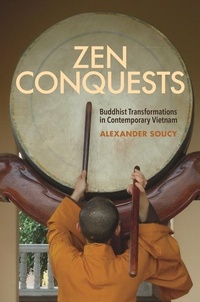
Zen Conquests
Buddhist Transformations in Contemporary Vietnam
Published on 31. July 2022
Book
Hardback
277 pages
978-0-8248-8998-2 (ISBN)
Description
At the tail end of the twentieth century, a monk transformed a small village temple on the outskirts of Hanoi into a monastery and meditation center called Thi?n Vi?n Sung Phuc-a place where monastics and lay Buddhists could learn and practice Zen meditation. In time the original temple was replaced by numerous large buildings to accommodate meditation sessions, youth events, weddings, classes, and a variety of other activities designed to keep practitioners engaged. Thi?n Vi?n Sung Phuc's approach to Buddhism as a life commitment for all ages and genders has been very successful, attracting more than a thousand Buddhists to its weekly services. It joined Thi?n phai Truc Lam, a much larger organization started by Thich Thanh T? in southern Vietnam that has expanded to northern Vietnam and internationally. In Zen Conquests, Alexander Soucy presents not only the first ethnography of Thi?n Vi?n Sung Phuc and its followers, but also a compelling look at how the discourses of Buddhist Modernism were incorporated at a local level into this new space on the outskirts of Hanoi and how and why new constituencies of followers are drawn to Zen Buddhism in contemporary Vietnam.
Thi?n Vi?n Sung Phuc's Zen tradition purports to be a continuation of the only Zen Buddhist sect founded in Vietnam: the fourteenth-century Truc Lam Zen School. However, the movement can also be seen as the product of Buddhism's globalization, born from the D. T. Suzuki-inspired interest in Zen in South Vietnam during the American War. Despite its claims to be authentically Vietnamese Zen, it more closely resembles Modernist versions of Buddhism practiced by Western converts in North America than anything Vietnamese. Soucy maintains that it is only by looking at the processes of globalization that Vietnamese Buddhism (both in the context of Vietnam but also in the Vietnamese diaspora) can be properly understood. He argues convincingly for acknowledging the continued influence of transnational, pan-Asian, and global flows of migration and communication on the development of multiple forms of Buddhism worldwide.
Thi?n Vi?n Sung Phuc's Zen tradition purports to be a continuation of the only Zen Buddhist sect founded in Vietnam: the fourteenth-century Truc Lam Zen School. However, the movement can also be seen as the product of Buddhism's globalization, born from the D. T. Suzuki-inspired interest in Zen in South Vietnam during the American War. Despite its claims to be authentically Vietnamese Zen, it more closely resembles Modernist versions of Buddhism practiced by Western converts in North America than anything Vietnamese. Soucy maintains that it is only by looking at the processes of globalization that Vietnamese Buddhism (both in the context of Vietnam but also in the Vietnamese diaspora) can be properly understood. He argues convincingly for acknowledging the continued influence of transnational, pan-Asian, and global flows of migration and communication on the development of multiple forms of Buddhism worldwide.
More details
Language
English
Place of publication
Honolulu, HI
United States
Target group
Professional and scholarly
Product notice
sewn/stitched
Cloth over boards
Dimensions
Height: 234 mm
Width: 155 mm
Thickness: 25 mm
Weight
540 gr
ISBN-13
978-0-8248-8998-2 (9780824889982)
Copyright in bibliographic data and cover images is held by Nielsen Book Services Limited or by the publishers or by their respective licensors: all rights reserved.
Schweitzer Classification
Person
Alexander Soucy is professor and chair of the Religious Studies Department at Saint Mary's University (Halifax).