

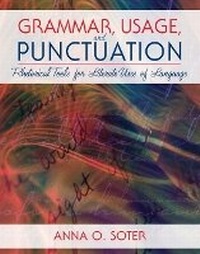
Grammar, Usage, and Punctuation
Rhetorical Tools for Literate Uses of Language
Published on 13. August 2012
Book
Paperback/Softback
288 pages
978-0-13-294657-5 (ISBN)
Description
Grammar, Usage, and Punctuation: Rhetorical Tools for Literate Uses of Language gives pre- and in-service teachers of English and English as a Foreign Language a concise look at language as a rhetorical tool, while focusing on teaching and learning about grammar, usage, and punctuation through play and experimentation. The book focuses on having readers work with language in ways that develop their meta-linguistic awareness-showing how we work language and how we make it work for us. Easy to understand and navigate, the book presents the ideas of each chapter with objectives, a discussion of the main concept(s), key assumptions and detailed applications with variations.
More details
Person
Anna Soter is Professor in English Education at The Ohio State University. She earned her B.A. in English and History at the University of Western Australia, Perth, and her M.A. in English Language and Literature at the University of Sydney, Australia. She taught English (Grades 7-12) for 15 years in Australia and prior to earning her Ph.D. specializing in cross-cultural written language analysis at the University of Illinois, Urbana-Champaign. Anna is also a poet and writer of creative nonfiction and short fiction. She teaches language learning, and language methods, poetry, literary theory and young adult literature courses for prospective English Language teachers, and professional development and graduate programs. Professor Soter has also developed a seminar that examines the role of language in the lives we live. She can be contacted by email at soter.1@osu.edu or annasoter@aol.com.
Content
Dedication
Foreword by Robin Troth
Acknowledgements
Figures and Cartoons in Order of Appearance
Introduction
Chapter One
Language as a Function of Purpose: The Conceptual Frame
Cartoon Illustration by David Rickert
Chapter Two
Discourse Communities and Kinds of Language Use
Cartoon Illustration by David Rickert
Chapter Three
Sentence Play (1) Expanding, Combining, Chunking, and Unscrambling
Cartoon Illustration by David Rickert
Chapter Four
Sentence Play (2): Portability, Variability, and Punctuation as Rhetorical Choices
Chapter Five
Style and Language Play
Cartoon Illustration by David Rickert
Chapter Six
Incorporating Diverse Learners' Knowledge About Language for Language Play
Cartoon Illustration by David Rickert
Chapter Seven
Personalizing The Power of Language
Chapter Eight
The Big Picture: Implementing A Language-Infused English
Language Arts Curriculum
Part II: Back to Basics: Elements of the English Language that Matter in Written
and Formal Spoken Contexts
Cartoon Illustration by David Rickert
Glossary
Annotated Resources
References 394
Foreword by Robin Troth
Acknowledgements
Figures and Cartoons in Order of Appearance
Introduction
Chapter One
Language as a Function of Purpose: The Conceptual Frame
Cartoon Illustration by David Rickert
Chapter Two
Discourse Communities and Kinds of Language Use
Cartoon Illustration by David Rickert
Chapter Three
Sentence Play (1) Expanding, Combining, Chunking, and Unscrambling
Cartoon Illustration by David Rickert
Chapter Four
Sentence Play (2): Portability, Variability, and Punctuation as Rhetorical Choices
Chapter Five
Style and Language Play
Cartoon Illustration by David Rickert
Chapter Six
Incorporating Diverse Learners' Knowledge About Language for Language Play
Cartoon Illustration by David Rickert
Chapter Seven
Personalizing The Power of Language
Chapter Eight
The Big Picture: Implementing A Language-Infused English
Language Arts Curriculum
Part II: Back to Basics: Elements of the English Language that Matter in Written
and Formal Spoken Contexts
Cartoon Illustration by David Rickert
Glossary
Annotated Resources
References 394