

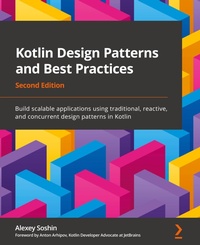
Kotlin Design Patterns and Best Practices
Build scalable applications using traditional, reactive, and concurrent design patterns in Kotlin
2nd Edition
Published on 21. January 2022
Book
Paperback/Softback
356 pages
978-1-80181-572-7 (ISBN)
Description
Future-proof your applications with best practices and design patterns in Kotlin
Key Features
Understand traditional and modern design patterns to improve the design of your application
Combine the benefits of object-oriented, functional, reactive, and concurrent programming
Choose the best microservices architecture and frameworks for your web application
Book DescriptionThis book shows you how easy it can be to implement traditional design patterns in the modern multi-paradigm Kotlin programming language, and takes you through the new patterns and paradigms that have emerged.
This second edition is updated to cover the changes introduced from Kotlin 1.2 up to 1.5 and focuses more on the idiomatic usage of coroutines, which have become a stable language feature. You'll begin by learning about the practical aspects of smarter coding in Kotlin, as well as understanding basic Kotlin syntax and the impact of design patterns on your code.
The book also provides an in-depth explanation of the classical design patterns, such as Creational, Structural, and Behavioral families, before moving on to functional programming. You'll go through reactive and concurrent patterns, and finally, get to grips with coroutines and structured concurrency to write performant, extensible, and maintainable code.
By the end of this Kotlin book, you'll have explored the latest trends in architecture and design patterns for microservices. You'll also understand the tradeoffs when choosing between different architectures and make informed decisions.
What you will learn
Implement all the classical design patterns using the Kotlin programming language
Apply reactive and concurrent design patterns to make your application more scalable
Discover best practices in Kotlin and explore its new features
Understand the key principles of functional programming and learn how they apply to Kotlin
Find out how to write idiomatic Kotlin code and learn which patterns to avoid
Harness the power of Kotlin to design concurrent and reliable systems with ease
Create an effective microservice with Kotlin and the Ktor framework
Who this book is forThis book is for developers who want to apply design patterns they've learned from other languages in Kotlin and build reliable, scalable, and maintainable applications. You'll need a good grasp on at least one programming language before you get started with this book. Java or design patterns will be particularly useful, but you'll still be able to follow along if you code in other languages.
Key Features
Understand traditional and modern design patterns to improve the design of your application
Combine the benefits of object-oriented, functional, reactive, and concurrent programming
Choose the best microservices architecture and frameworks for your web application
Book DescriptionThis book shows you how easy it can be to implement traditional design patterns in the modern multi-paradigm Kotlin programming language, and takes you through the new patterns and paradigms that have emerged.
This second edition is updated to cover the changes introduced from Kotlin 1.2 up to 1.5 and focuses more on the idiomatic usage of coroutines, which have become a stable language feature. You'll begin by learning about the practical aspects of smarter coding in Kotlin, as well as understanding basic Kotlin syntax and the impact of design patterns on your code.
The book also provides an in-depth explanation of the classical design patterns, such as Creational, Structural, and Behavioral families, before moving on to functional programming. You'll go through reactive and concurrent patterns, and finally, get to grips with coroutines and structured concurrency to write performant, extensible, and maintainable code.
By the end of this Kotlin book, you'll have explored the latest trends in architecture and design patterns for microservices. You'll also understand the tradeoffs when choosing between different architectures and make informed decisions.
What you will learn
Implement all the classical design patterns using the Kotlin programming language
Apply reactive and concurrent design patterns to make your application more scalable
Discover best practices in Kotlin and explore its new features
Understand the key principles of functional programming and learn how they apply to Kotlin
Find out how to write idiomatic Kotlin code and learn which patterns to avoid
Harness the power of Kotlin to design concurrent and reliable systems with ease
Create an effective microservice with Kotlin and the Ktor framework
Who this book is forThis book is for developers who want to apply design patterns they've learned from other languages in Kotlin and build reliable, scalable, and maintainable applications. You'll need a good grasp on at least one programming language before you get started with this book. Java or design patterns will be particularly useful, but you'll still be able to follow along if you code in other languages.
More details
Edition
2nd Revised edition
Language
English
Place of publication
Birmingham
United Kingdom
Target group
Professional and scholarly
Edition type
Revised edition
Dimensions
Height: 235 mm
Width: 191 mm
Thickness: 20 mm
Weight
665 gr
ISBN-13
978-1-80181-572-7 (9781801815727)
Copyright in bibliographic data and cover images is held by Nielsen Book Services Limited or by the publishers or by their respective licensors: all rights reserved.
Schweitzer Classification
Persons
Alexey Soshin is a software architect with 15 years of experience in the industry. He started exploring Kotlin when Kotlin was still in beta, and since then has been a big enthusiast of the language. He's a conference speaker, published writer, and the author of a video course titled Pragmatic System Design.
Content
Table of Contents
Getting Started with Kotlin
Working with Creational Patterns
Understanding Structural Patterns
Getting Familiar with Behavioral Patterns
Introducing Functional Programming
Threads and Coroutines
Controlling the Data Flow
Designing for Concurrency
Idioms and Anti-Patterns
Concurrent Microservices with Ktor
Reactive Microservices with Vert.x
Getting Started with Kotlin
Working with Creational Patterns
Understanding Structural Patterns
Getting Familiar with Behavioral Patterns
Introducing Functional Programming
Threads and Coroutines
Controlling the Data Flow
Designing for Concurrency
Idioms and Anti-Patterns
Concurrent Microservices with Ktor
Reactive Microservices with Vert.x