

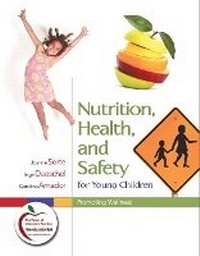
Nutrition, Health, and Safety for Young Children
Promoting Wellness
Published on 21. May 2010
Book
Paperback/Softback
696 pages
978-0-13-234941-3 (ISBN)
Description
This book provides students with a comprehensive understanding of the nutrition, health, and safety needs of young children from birth through 8 years of age. The book is designed to give future teachers practical, applied, easy-to-understand information that will prepare them to serve young children in the family child care, childcare center, preschool and early primary school setting. Students will find the case scenarios woven throughout the chapters engaging and an effective means to transfer the learning of concepts to real life settings. This transfer of learning is reinforced by web video clips available at the MyEducationlab website that bring what students read and learn to life. The text demonstrates how a strong curriculum at any age or stage of early childhood, birth through age 8, allows teachers to teach and model healthy practices with regard to nutrition, health, and safety. The authors' accessible and engaging writing style bring the reader into the classroom by weaving in classroom scenarios. In addition, chapter features entitled "Nutrition Notes," "Safety Segments," "Policy Points," and "Health Hints" provide students with information on current topics of interest and controversy while "What ifs.. " feature boxes promote critical thinking skills to make decisions about topics they might encounter in the early childhood setting.
Presents integrated curriculum for teaching nutrition, health and wellness; promotescurrent evidence-based practices; aligns with National Health Education standards; accessible writing style brings readers into the classroom; promotes culturally responsive teaching.
KEY TOPICS: Addresses the obesity epidemic, promoting sustainability, health curriculum, accommodating the nutrition, health and safety needs of all children; building relationships with families
MARKET: Two-year health, safety, and nutrition courses.
Presents integrated curriculum for teaching nutrition, health and wellness; promotescurrent evidence-based practices; aligns with National Health Education standards; accessible writing style brings readers into the classroom; promotes culturally responsive teaching.
KEY TOPICS: Addresses the obesity epidemic, promoting sustainability, health curriculum, accommodating the nutrition, health and safety needs of all children; building relationships with families
MARKET: Two-year health, safety, and nutrition courses.
More details
Language
English
Place of publication
United States
Publishing group
Pearson Education (US)
Target group
College/higher education
Dimensions
Height: 276 mm
Width: 216 mm
Weight
1247 gr
ISBN-13
978-0-13-234941-3 (9780132349413)
Copyright in bibliographic data is held by Nielsen Book Services Limited or its licensors: all rights reserved.
Schweitzer Classification
Other editions
New editions
Joanne Sorte | Inge Daeschel | Carolina Amador
Nutrition, Health and Safety for Young Children
Promoting Wellness with Video-Enhanced Pearson eText -- Access Card Package
Book
04/2015
2nd Edition
Pearson
€118.21
Article exhausted; check for reprint
Joanne Sorte | Inge Daeschel | Carolina Amador
Nutrition, Health and Safety for Young Children
Promoting Wellness
Book
03/2013
2nd Edition
Pearson
€110.35
Article exhausted; check for reprint
Persons
Joanne Sorte has been an early childhood professional for over 30 years. She earned her Bachelor of Arts in Child Development & Family Life, and her Master of Science in Human Development & Family Sciences at Oregon State University. She and began her early childhood professional experiences as a home visitor for the Home Base program in Yakima, Washington. She then directed the Afternoon Preschool Program for Lower Columbia College in Longview, Washington and worked as the Family Services Coordinator for Head Start. These experiences inspired her commitment to serving families from diverse backgrounds, while raising three children with her husband, provided her many opportunities to experience the joys of child development and parenting. She taught in preschool settings for several years, until accepting a position on the faculty of Human Development & Family Sciences at OSU as Director of the Hallie Ford Child Development Laboratory. She is also director of the OSU Oregon Head Start Prekindergarten Program and an active member of the Oregon Head Start Association. Recognizing the value of the laboratory preschool as a formative experience for children, families and students, she guided the evolution of a blended early education program model where children from low income families, children with special needs, and children from the general community attend preschool together in the early education laboratory. She directs the practicum experience for students in Early Childhood Development & Education, supervises graduate students and facilitates research on child development and wellness. She has coauthored an intervention program with Inge Daeschel, called Health in Action: 5 Steps to Good Health. She enjoys advocating for education and being active with her family.
Inge Daeschel is licensed and registered dietitian who is Board Certified as a specialist in pediatric nutrition. She received her Bachelor of Science degree in Foods and Nutrition Science at Plattsburgh State University in New York. She completed her dietetic internship at Massachusetts General Hospital in Boston and received her Masters of Science in Nutrition Science from the University of Tennessee at Knoxville. She worked at Duke University Medical Center, first as Pediatric Dietitian Clinician and later as Assistant Chief Clinical Dietitian. This position was instrumental in her interest in helping families understand the nutritional needs of their children.
She and her family relocated to Oregon where she worked at the Corvallis Clinic and later accepted a faculty position as instructor in the department of Human Development & Family Sciences at OSU where she is Health and Nutrition Services Coordinator of the Hallie Ford Child Development Laboratory and OSU Oregon Head Start Prekindergarten Program. She is also is a nutrition consultant providing services to an area hospital, two WIC programs, a Head Start and Migrant Head Start program. Her expertise in feeding children is based on personal as well as professional experience, gained raising 4 children, including one with multiple food allergies. She has coauthored with Joanne Sorte an intervention program called Health in Action: 5 Steps to Good Health which promotes wellness by providing focused messages that address nutrition and physical activity in early childhood programs.
Carolina Amador, M.D., is a Board Certified Pediatrician. She received a Bachelor's of Education in Speech Pathology at University of Georgia in Athens, Georgia. She earned her Medical Degree from the Medical College of Georgia in Augusta, Georgia and completed her residency in Pediatrics at West Virginia University in Morgantown, West Virginia. She worked as Chief Resident in Pediatrics at West Virginia University where she developed a lactation clinic as well as a focus on advocacy for breastfeeding mothers. She is in the process of obtaining a Master's in Public Health from University of Washington with a focus on Maternal and Child Health. She moved with her husband to Corvallis, Oregon and has worked as a general Pediatrician for 7 years and is currently employed by a Community Health Center which serves a large percentage of Hispanics and migrant workers. During these years as a General Pediatrician, she has developed professional interests in childhood obesity prevention, health disparities, and latino health. She has been involved in community events and organizations advocating for children's health including the Oregon State University Head Start Health Advisory Committe, the Benton County Healthy Weight and Lifestyle Coalition, Benton County Oral Health Coalition, and the Breastfeeding Coalition of Benton County. Throughout her years of education and medical practice, she has participating in several international health experiences in Ecuador, Honduras, Uganda, and Malawi.
Inge Daeschel is licensed and registered dietitian who is Board Certified as a specialist in pediatric nutrition. She received her Bachelor of Science degree in Foods and Nutrition Science at Plattsburgh State University in New York. She completed her dietetic internship at Massachusetts General Hospital in Boston and received her Masters of Science in Nutrition Science from the University of Tennessee at Knoxville. She worked at Duke University Medical Center, first as Pediatric Dietitian Clinician and later as Assistant Chief Clinical Dietitian. This position was instrumental in her interest in helping families understand the nutritional needs of their children.
She and her family relocated to Oregon where she worked at the Corvallis Clinic and later accepted a faculty position as instructor in the department of Human Development & Family Sciences at OSU where she is Health and Nutrition Services Coordinator of the Hallie Ford Child Development Laboratory and OSU Oregon Head Start Prekindergarten Program. She is also is a nutrition consultant providing services to an area hospital, two WIC programs, a Head Start and Migrant Head Start program. Her expertise in feeding children is based on personal as well as professional experience, gained raising 4 children, including one with multiple food allergies. She has coauthored with Joanne Sorte an intervention program called Health in Action: 5 Steps to Good Health which promotes wellness by providing focused messages that address nutrition and physical activity in early childhood programs.
Carolina Amador, M.D., is a Board Certified Pediatrician. She received a Bachelor's of Education in Speech Pathology at University of Georgia in Athens, Georgia. She earned her Medical Degree from the Medical College of Georgia in Augusta, Georgia and completed her residency in Pediatrics at West Virginia University in Morgantown, West Virginia. She worked as Chief Resident in Pediatrics at West Virginia University where she developed a lactation clinic as well as a focus on advocacy for breastfeeding mothers. She is in the process of obtaining a Master's in Public Health from University of Washington with a focus on Maternal and Child Health. She moved with her husband to Corvallis, Oregon and has worked as a general Pediatrician for 7 years and is currently employed by a Community Health Center which serves a large percentage of Hispanics and migrant workers. During these years as a General Pediatrician, she has developed professional interests in childhood obesity prevention, health disparities, and latino health. She has been involved in community events and organizations advocating for children's health including the Oregon State University Head Start Health Advisory Committe, the Benton County Healthy Weight and Lifestyle Coalition, Benton County Oral Health Coalition, and the Breastfeeding Coalition of Benton County. Throughout her years of education and medical practice, she has participating in several international health experiences in Ecuador, Honduras, Uganda, and Malawi.
Content
Part 1: Promoting Wellness
Chapter 1: The Interconnection of Nutrition, Health, and Safety
Chapter 2: Teaching Wellness Concepts to Young Children
Part 2: Promoting Good Nutrition
Chapter 3: Foundations of Optimal Nutrition
Chapter 4: Understanding the Science of Nutrition
Chapter 5: Feeding Infants and Toddlers
Chapter 6: Feeding Preschoolers and School-Age Children
Chapter 7: Menu Planning
Chapter 8: Food Safety
Part 3: Promoting Healthful Practices
Chapter 9: Creating a Climate of Heath and Wellness
Chapter 10: Health Screening and Assessment
Chapter 11: Managing Infectious Disease
Chapter 12: Teaching Children with Special Health Needs
Chapter 13: Children's Mental Health
Part 4: Promoting Safety
Chapter 14: Ensuring Physical and Emotional Safety
Chapter 15: Creating Safe Environments
Chapter 16: Promoting Safe Practices through Effective Classroom Management
Chapter 17: Responding to Emergencies and Illness
Chapter 18: Child Abuse and Neglect
Chapter 1: The Interconnection of Nutrition, Health, and Safety
Chapter 2: Teaching Wellness Concepts to Young Children
Part 2: Promoting Good Nutrition
Chapter 3: Foundations of Optimal Nutrition
Chapter 4: Understanding the Science of Nutrition
Chapter 5: Feeding Infants and Toddlers
Chapter 6: Feeding Preschoolers and School-Age Children
Chapter 7: Menu Planning
Chapter 8: Food Safety
Part 3: Promoting Healthful Practices
Chapter 9: Creating a Climate of Heath and Wellness
Chapter 10: Health Screening and Assessment
Chapter 11: Managing Infectious Disease
Chapter 12: Teaching Children with Special Health Needs
Chapter 13: Children's Mental Health
Part 4: Promoting Safety
Chapter 14: Ensuring Physical and Emotional Safety
Chapter 15: Creating Safe Environments
Chapter 16: Promoting Safe Practices through Effective Classroom Management
Chapter 17: Responding to Emergencies and Illness
Chapter 18: Child Abuse and Neglect