

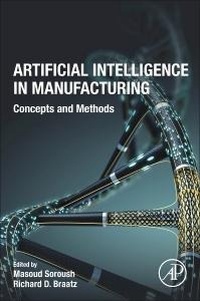
Artificial Intelligence in Manufacturing
Concepts and Methods
Published on 25. January 2024
Book
Paperback/Softback
372 pages
978-0-323-99134-6 (ISBN)
Description
Artificial Intelligence in Manufacturing: Concepts and Methods explains the most successful emerging techniques for applying AI to engineering problems. Artificial intelligence is increasingly being applied to all engineering disciplines, producing more insights into how we understand the world and allowing us to create products in new ways. This book unlocks the advantages of this technology for manufacturing by drawing on work by leading researchers who have successfully developed methods that can apply to a range of engineering applications.
The book addresses educational challenges needed for widespread implementation of AI and also provides detailed technical instructions for the implementation of AI methods. Drawing on research in computer science, physics and a range of engineering disciplines, this book tackles the interdisciplinary challenges of the subject to introduce new thinking to important manufacturing problems.
The book addresses educational challenges needed for widespread implementation of AI and also provides detailed technical instructions for the implementation of AI methods. Drawing on research in computer science, physics and a range of engineering disciplines, this book tackles the interdisciplinary challenges of the subject to introduce new thinking to important manufacturing problems.
More details
Language
English
Place of publication
Oxford
United Kingdom
Publishing group
Elsevier Science & Technology
Target group
Professional and scholarly
Product notice
Paperback (trade)
Unsewn / adhesive bound
Dimensions
Height: 228 mm
Width: 152 mm
Thickness: 19 mm
Weight
582 gr
ISBN-13
978-0-323-99134-6 (9780323991346)
Copyright in bibliographic data and cover images is held by Nielsen Book Services Limited or by the publishers or by their respective licensors: all rights reserved.
Schweitzer Classification
Other editions
Additional editions
E-Book
01/2024
Academic Press
€175.00
Available for download
Persons
Masoud Soroush is the George B. Francis Chair Professor of Engineering at Drexel University and directs the Future Layered nAnomaterials Knowledge and Engineering (FLAKE) Consortium, collaborating with over 30 researchers from Drexel, the University of Pennsylvania, and Purdue. He has held positions as a Visiting Scientist at DuPont and a Visiting Professor at Princeton. An Elected Fellow of AIChE and Senior Member of IEEE, Soroush has received numerous awards, including the AIChE 2023 Excellence in Process Development Research Award. He holds a BS from Abadan Institute of Technology and MS/PhD degrees from the University of Michigan, with research focusing on advanced manufacturing and nanomaterials. Dr. Richard D. Braatz is the Edwin R. Gilliland Professor of Chemical Engineering at MIT, specializing in advanced manufacturing systems. His research focuses on process data analytics, mechanistic modeling, and robust control systems, particularly in monoclonal antibody, vaccine, and gene therapy production. He holds an M.S. and Ph.D. from Caltech and previously served as a professor at the University of Illinois and a visiting scholar at Harvard. Dr. Braatz has received several prestigious awards, including the Donald P. Eckman Award and the Curtis W. McGraw Research Award, and is a Fellow of multiple professional organizations and a member of the U.S. National Academy of Engineering.
Content
1. Data-driven Physics-based Digital Twins
2. Hybrid Modeling Approach Integrating PLS Models with First-principles Knowledge
3. Dynamical Systems-Guided Learning of PDEs from Data
4. Learning First-principles Knowledge from Data
5. Actual Learning through Machine Learning
6. Iterative Cross Learning
7. Learning an Algebraic Model from Data
8. Data-driven Optimization Algorithms
9. Interpretable Machine Learning
10. Learning Science and Algorithms
11. Reinforcement Learning
12. Machine Learning: Trends, Perspectives, and Prospects
13. Artificial Intelligence: Trends, Perspectives, and Prospects
14. Artificial Intelligence Education for Chemical Engineers
2. Hybrid Modeling Approach Integrating PLS Models with First-principles Knowledge
3. Dynamical Systems-Guided Learning of PDEs from Data
4. Learning First-principles Knowledge from Data
5. Actual Learning through Machine Learning
6. Iterative Cross Learning
7. Learning an Algebraic Model from Data
8. Data-driven Optimization Algorithms
9. Interpretable Machine Learning
10. Learning Science and Algorithms
11. Reinforcement Learning
12. Machine Learning: Trends, Perspectives, and Prospects
13. Artificial Intelligence: Trends, Perspectives, and Prospects
14. Artificial Intelligence Education for Chemical Engineers