

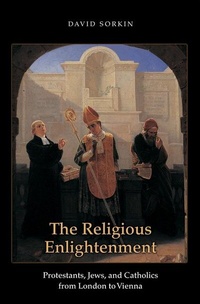
The Religious Enlightenment
Protestants, Jews, and Catholics from London to Vienna
Published on 21. July 2008
Book
Hardback
360 pages
978-0-691-13502-1 (ISBN)
Description
In intellectual and political culture today, the Enlightenment is routinely celebrated as the starting point of modernity and secular rationalism, or demonized as the source of a godless liberalism in conflict with religious faith. In The Religious Enlightenment, David Sorkin alters our understanding by showing that the Enlightenment, at its heart, was religious in nature. Sorkin examines the lives and ideas of influential Protestant, Jewish, and Catholic theologians of the Enlightenment, such as William Warburton in England, Moses Mendelssohn in Prussia, and Adrien Lamourette in France, among others. He demonstrates that, in the century before the French Revolution, the major religions of Europe gave rise to movements of renewal and reform that championed such hallmark Enlightenment ideas as reasonableness and natural religion, toleration and natural law. Calvinist enlightened orthodoxy, Jewish Haskalah, and reform Catholicism, to name but three such movements, were influential participants in the eighteenth century's burgeoning public sphere and promoted a new ideal of church-state relations.
Sorkin shows how they pioneered a religious Enlightenment that embraced the new science of Copernicus and Newton and the philosophy of Descartes, Locke, and Christian Wolff, uniting reason and revelation to renew faith and piety. This book reveals how Enlightenment theologians refashioned belief as a solution to the dogmatism and intolerance of previous centuries. Read it and you will never view the Enlightenment the same way.
Sorkin shows how they pioneered a religious Enlightenment that embraced the new science of Copernicus and Newton and the philosophy of Descartes, Locke, and Christian Wolff, uniting reason and revelation to renew faith and piety. This book reveals how Enlightenment theologians refashioned belief as a solution to the dogmatism and intolerance of previous centuries. Read it and you will never view the Enlightenment the same way.
Reviews / Votes
"Why can't religion and the Enlightenment be friends? What's that, you say? They were friends? Why didn't anyone tell us? Well, David Sorkin has. A professor of history and Jewish studies at the University of Wisconsin, he argues in a new study that religion and the Enlightenment were even more than friends... The French Revolution and its Napoleonic aftermath not only destroyed the religious Enlightenment in practice; it also created, as Dr. Sorkin notes, a 'religious-secular dichotomy' that condemned this side of the Enlightenment to historical obscurity. Rescuing it from that obscurity, he insists, is of much more than academic interest."--Peter Steinfels, New York Times "This is a book about religious ideas of the 18th century. Although scholars tend to see the Enlightenment as antireligious and secular, Sorkin persuasively argues that this was not the whole story. Instead, all of Europe's major religions produced movements of religious reform compatible with the Enlightenment... [S]orkin makes his case that there were individuals and groups within organized religion who welcomed the Enlightenment and tried to accommodate religion within it."--P. Grendler, Choice "Sorkin makes very interesting discoveries about the parallel developments within different religions in the eighteenth century."--Larry Wolff, American Historical Review "Sorkin has written a powerful, imaginative, and path-breaking study that fundamentally challenges reigning academic conceptions of the Enlightenment, the birth of modern Europe, and the path of modern European history... The author's argument for a more moderate view of the birth and path of modernity across the European continent--one that grew out of dialogue and toleration and not out of religious or ethnic conflict--is compelling and persuasive."--Scott Ury, Religious Studies Review "This dense, erudite and necessary book certainly establishes that religious reform was a central--and precarious--feature of the Enlightenment. It ... should effect a decisive shift in our understanding of that period."--Ritchie Robertson, German History "Sorkin's study presents a valuable contribution to the ongoing reassessment of the Enlightenment... The beautifully written essays display an uncommon fairness to each faith and are supported by an admirable historical erudition."--Louis Dupre, Catholic Historical Review "Theologians and historians will both find this book useful."--Erna Oliver, Studia Historiae Ecclesisticae "[O]ne hopes that this concise, erudite, and unprepossessing book succeeds in putting its moderate subjects where they should be: in the middle of our eighteenth-century map."--Suzanne Marchand, Cambridge Journals "[N]ot the least among this book's achievements is the revival of discussion on the religious Enlightenment in the multiconfessional and multinational Austrian monarchy."--Grete Klingenstein, Austrian History Yearbook "In brief, this is a deeply researched, well-written, and compelling account of the importance of religion in shaping European enlightenments."--James E. Bradley, Church HistoryMore details
Series
Language
English
Place of publication
New Jersey
United States
Target group
College/higher education
Professional and scholarly
Product notice
Trade binding
Illustrations
12 line illus.
Dimensions
Height: 229 mm
Width: 152 mm
Weight
652 gr
ISBN-13
978-0-691-13502-1 (9780691135021)
Copyright in bibliographic data and cover images is held by Nielsen Book Services Limited or by the publishers or by their respective licensors: all rights reserved.
Schweitzer Classification
Other editions
Additional editions
E-Book
11/2018
1st Edition
Princeton University Press
€46.49
Available for download
Book
05/2011
Princeton University Press
€36.10
Shipment within 10-20 days
Person
David Sorkin is the Frances and Laurence Weinstein Professor of Jewish Studies and professor of history at the University of Wisconsin-Madison. His books include "The Berlin Haskalah and German Religious Thought" and "Moses Mendelssohn and the Religious Enlightenment".
Content
List of Illustrations xi List of Maps xii Preface xiii Introduction 1 Enlightenment or Enlightenments? 3 The Religious Enlightenment 5 Reasonableness 11 Toleration 14 The Public Sphere 16 State Nexus 18 The Enlightenment Spectrum 19 Chapter One: BRANT BROUGHTON, LONDON, GLOUCESTER William Warburton's "Heroic Moderation" 23 Natural Right and Toleration 31 History 39 Established Religion 53 Justifi cation, Philosophy, and Science 54 Secular Culture 61 Moderation in Decline 64 Conclusion 65 Chapter Two: GENEVA Jacob Vernet's "Middle Way" 67 Theology 76 Politics 85 The Enlightenment and the Philosophes 97 Geneva Transformed 109 Chapter Three: HALLE Siegmund Jacob Baumgarten's "Vital Knowledge" 113 "The Union with God" 128 Exegesis 136 History, Sacred and Secular 142 Natural Right and Toleration 152 Neology and the State 158 Chapter Four: BERLIN Moses Mendelssohn's "Vital Script" 165 Intellectual Renewal: Philosophy 176 Intellectual Renewal: Exegesis 180 "Civic Ac cep tance" and "Divine Legislation" 193 "The Socrates of Berlin" 206 Haskalah and Beyond 208 Conclusion 212 Chapter Five: VIENNA- LINZ Joseph Valentin Eybel's "Reasonable Doctrine" 215 Church Law 228 Linz and Joseph II 237 "True Devotion" 249 Revolution 254 Conclusion 258 Chapter Six: TOUL- PARIS- LYON Adrien Lamourette's "Luminous Side of Faith" 261 Where France Differed 263 Catholicism 266 The 1780s 269 Theology 274 Revolution, 1789-91 282 Revolution, 1791-94 296 Conclusion 307 Epilogue 311 Glossary 315 Index 319