

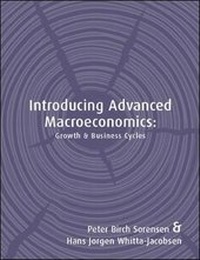
Introducing Advanced Macroeconomics
Published on 16. December 2004
Book
Paperback/Softback
750 pages
978-0-07-710425-2 (ISBN)
Description
Aimed at the advanced undergraduate student, Introducing Advanced Macroeconomics: Growth and Business Cycles bridges the gap between intermediate macroeconomics texts and more advanced macroeconomics texts, something not currently available in the market. The text seeks to give students a thorough understanding of some fundamental workhorse models in macroeconomics and to introduce them to methods of formal macroeconomics analysis, without requiring too many technical skills. The first half of the book focuses on macroeconomics for the long run, introducing and developing the basic Solow model. While the second half of the book deals with the economy in the short run, focussing on the explanation of business fluctuations.
Reviews / Votes
This is an excellent addition to the macro text market. The treatment of the topics is clear and always involves engagement with the emperical evidence. The latter is drawn from Europe and the US and the rest of the world. The coverage of topics is good. Review by Shaun P. Hargreaves Heap, University of East Anglica, Textbook Guide May 2005 The Times Ed Supp 20050527More details
Language
English
Place of publication
London
United States
Publishing group
McGraw-Hill Education - Europe
Target group
College/higher education
Dimensions
Height: 246 mm
Width: 191 mm
Thickness: 37 mm
Weight
1590 gr
ISBN-13
978-0-07-710425-2 (9780077104252)
Copyright in bibliographic data and cover images is held by Nielsen Book Services Limited or by the publishers or by their respective licensors: all rights reserved.
Schweitzer Classification
Other editions
New editions
Hans Jorgen Whitta-Jacobsen | Peter Birch Sorensen
Introducing Advanced Macroeconomics
Growth and Business Cycles
Book
07/2022
3rd Edition
Oxford University Press
€87.00
Available immediately
Persons
Peter Birch Si?rensen is Professor of Economics at the University of Copenhagen and Chairman of the Danish Productivity Committee. He is a former Director of the university's Economic Policy Research Unit. He is a former Chairman of the Danish Economic Council, and he has served as a consultant on tax policy for the OECD, the European Commission, the International Monetary Fund and several national governments.
Hans Ji?rgen Whitta-Jacobsen is Professor of Economics at the University of Copenhagen and Chairman of the Danish Economic Council. He has served as a consultant for the Danish government on tax reform and as a reporter on economic issues for the main Danish public service TV channel.
Hans Ji?rgen Whitta-Jacobsen is Professor of Economics at the University of Copenhagen and Chairman of the Danish Economic Council. He has served as a consultant for the Danish government on tax reform and as a reporter on economic issues for the main Danish public service TV channel.
Content
Chapter 1Macroeconomics for the Long Run and for the Short Run Book One:The Long Run: Economic Growth, Long Run Unemployment, and Structural Economic Policy
Part IBasic Theory and Empirics about Prosperity and Growth
Chapter 2Some Facts about Prosperity and Growth
Chapter 3Capital Accumulation and Growth: The Basic Solow Model
Chapter 4Wealth Accumulation and Capital Mobility: The Solow Model for a Small Open Economy
Part IIExogenous Growth
Chapter 5Technological Progress and Growth: The General Solow Model
Chapter 6Education and Growth: The Solow Model with Human Capital
Chapter 7Limits to Growth? The Solow Model with Scarce Natural Resources
Part IIIEndogenous Growth
Chapter 8Productive Externalities and Endogenous Growth
Chapter 9R&D-Based Models of Endogenous Growth: Macroeconomic Modelling
Chapter 10R&D-Based Models of Endogenous Growth: Micro Foundations
Part IVStructural Unemployment
Chapter 11Some Facts and Introductory Theory about Unemployment
Chapter 12Efficiency Wages and Unemployment
Chapter 12Trade Unions and Unemployment
Book TwoThe Short Run: Economic Fluctuations, Short Run Unemployment, and Stabilisation Policy
Chapter 14The Economy in the Short Run: Some Facts about Business Cycles
Part VThe Building Blocks for the Short Run Model
Chapter 15Investment and Asset Prices
Chapter 16Consumption, Income and Wealth
Chapter 17Monetary Policy and Aggregate Demand
Chapter 18Inflation, Unemployment and Aggregate Supply
Part VIThe Short Run Model for the Closed Economy
Chapter 19Explaining Business Cycles: Aggregate Supply and Aggregate Demand in Action
Chapter 20Stabilization Policy: Why and How?
Chapter 21Stabilization Policy with Rational Expectations
Chapter 22The Limits to Stabilization Policy: Credibility, Uncertainty and Time Lags
Part VIIThe Short Run Model for the Open Economy
Chapter 23Aggregate Demand and Aggregate Supply in the Open Economy
Chapter 24The Open Economy with Fixed Exchange Rates
Chapter 25The Open Economy with Flexible Exchange Rates
Chapter 26The Choice of Exchange Rate Regime and the Theory of Optimum Currency Areas
Part IBasic Theory and Empirics about Prosperity and Growth
Chapter 2Some Facts about Prosperity and Growth
Chapter 3Capital Accumulation and Growth: The Basic Solow Model
Chapter 4Wealth Accumulation and Capital Mobility: The Solow Model for a Small Open Economy
Part IIExogenous Growth
Chapter 5Technological Progress and Growth: The General Solow Model
Chapter 6Education and Growth: The Solow Model with Human Capital
Chapter 7Limits to Growth? The Solow Model with Scarce Natural Resources
Part IIIEndogenous Growth
Chapter 8Productive Externalities and Endogenous Growth
Chapter 9R&D-Based Models of Endogenous Growth: Macroeconomic Modelling
Chapter 10R&D-Based Models of Endogenous Growth: Micro Foundations
Part IVStructural Unemployment
Chapter 11Some Facts and Introductory Theory about Unemployment
Chapter 12Efficiency Wages and Unemployment
Chapter 12Trade Unions and Unemployment
Book TwoThe Short Run: Economic Fluctuations, Short Run Unemployment, and Stabilisation Policy
Chapter 14The Economy in the Short Run: Some Facts about Business Cycles
Part VThe Building Blocks for the Short Run Model
Chapter 15Investment and Asset Prices
Chapter 16Consumption, Income and Wealth
Chapter 17Monetary Policy and Aggregate Demand
Chapter 18Inflation, Unemployment and Aggregate Supply
Part VIThe Short Run Model for the Closed Economy
Chapter 19Explaining Business Cycles: Aggregate Supply and Aggregate Demand in Action
Chapter 20Stabilization Policy: Why and How?
Chapter 21Stabilization Policy with Rational Expectations
Chapter 22The Limits to Stabilization Policy: Credibility, Uncertainty and Time Lags
Part VIIThe Short Run Model for the Open Economy
Chapter 23Aggregate Demand and Aggregate Supply in the Open Economy
Chapter 24The Open Economy with Fixed Exchange Rates
Chapter 25The Open Economy with Flexible Exchange Rates
Chapter 26The Choice of Exchange Rate Regime and the Theory of Optimum Currency Areas