

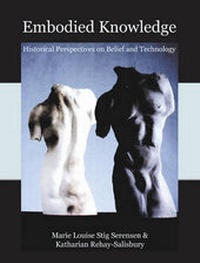
Embodied Knowledge
Historical Perspectives on Belief and Technology
Published on 30. November 2012
Book
Hardback
176 pages
978-1-84217-490-6 (ISBN)
Description
The body is the main forum for learning about how to do, think and believe and it is a starting point for the granting and forming of many forms of meaning. Fourteen papers explore the relationship between knowledge and the body through a series of historical and archaeological case studies. More specifically, it considers the concept of embodied knowledge by exploring some of the apparent diverse and yet shared forms of what may be called embodied knowledge. The papers share a focus on knowledge as it is implicit and expressed through the human body and bodily action, and as it formed through intentional practices. But what is this kind of knowledge? Using specific case studies of knowledgeable actions, the book explores embodied knowledge through a focus on practice. It does so through two different, yet interconnected aspects of how such knowledge expresses itself: belief and technology.
More details
Language
English
Place of publication
Oxford
United Kingdom
Target group
College/higher education
Professional and scholarly
Illustrations
42 b/w illus
ISBN-13
978-1-84217-490-6 (9781842174906)
Copyright in bibliographic data and cover images is held by Nielsen Book Services Limited or by the publishers or by their respective licensors: all rights reserved.
Schweitzer Classification
Other editions
Additional editions
Stig Sorensen Marie Louise Stig Sorensen | Rebay-Salisbury Katharina Rebay-Salisbury
Embodied Knowledge
Historical Perspectives on Belief and Technology
E-Book
11/2012
Oxbow Books
€25.49
Available for download
Stig Sorensen Marie Louise Stig Sorensen | Rebay-Salisbury Katharina Rebay-Salisbury
Embodied Knowledge
Historical Perspectives on Belief and Technology
E-Book
11/2012
OXBOW BOOKS
€25.49
Available for download
Content
1. Embodied knowledge. Reflections on belief and technology: Introduction (Marie Louise Stig Sorensen and Katharina Rebay-Salisbury)
Part I
2. Introduction to Part I: belief as practice. (Marie Louise Stig Sorensen)
3. Inhumation and cremation: how burial practices are linked to beliefs (Katharina Rebay-Salisbury)
4. Delusion and disclosure: human disposal and the aesthetics of vagueness (Tim Flohr Sorensen)
5. Material culture, embodiment and the construction of religious knowledge (Mads Dengso Jessen)
6. Sealed by the cross: protecting the body in Anglo-Saxon England (Helen Foxhall Forbes)
7. The role of healing in the Jesuit mission to China, 1582-1610 (Mary Laven)
8. Protest re-embodied: shifting technologies of moral suasion in India (Jacob Copeman)
Part II
9. Introduction to Part II: technology as practice. (Lise Bender Jorgensen)
10. The language of craftsmanship (Harald Bentz Hogseth)
11. Conceptual knowledge as technologically materialised: a case study of pottery production, consumption and community practice (Sheila Kohring)
12. Many hands make light work: potting and embodied knowledge at the Bronze Age tell at Szazhalombatta, Hungary (Sofaer and Sandy Budden)
13. Spinning faith (Lise Bender Jorgensen)
14. The sound of fire, taste of copper, feel of bronze, and colours of the cast: sensory aspects of metalworking technology (Maikel Henricus Gerardus Kuijpers)
Part I
2. Introduction to Part I: belief as practice. (Marie Louise Stig Sorensen)
3. Inhumation and cremation: how burial practices are linked to beliefs (Katharina Rebay-Salisbury)
4. Delusion and disclosure: human disposal and the aesthetics of vagueness (Tim Flohr Sorensen)
5. Material culture, embodiment and the construction of religious knowledge (Mads Dengso Jessen)
6. Sealed by the cross: protecting the body in Anglo-Saxon England (Helen Foxhall Forbes)
7. The role of healing in the Jesuit mission to China, 1582-1610 (Mary Laven)
8. Protest re-embodied: shifting technologies of moral suasion in India (Jacob Copeman)
Part II
9. Introduction to Part II: technology as practice. (Lise Bender Jorgensen)
10. The language of craftsmanship (Harald Bentz Hogseth)
11. Conceptual knowledge as technologically materialised: a case study of pottery production, consumption and community practice (Sheila Kohring)
12. Many hands make light work: potting and embodied knowledge at the Bronze Age tell at Szazhalombatta, Hungary (Sofaer and Sandy Budden)
13. Spinning faith (Lise Bender Jorgensen)
14. The sound of fire, taste of copper, feel of bronze, and colours of the cast: sensory aspects of metalworking technology (Maikel Henricus Gerardus Kuijpers)