

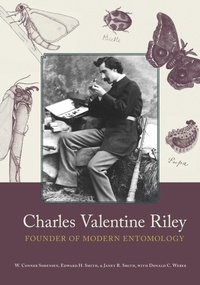
Charles Valentine Riley
Founder of Modern Entomology
Will be published approx. on 30. July 2019
Book
Hardback
554 pages
978-0-8173-2009-6 (ISBN)
Description
Riley propelled entomology from a collector's parlor hobby of the nineteenth century to the serious study of insects in the Modern Age.
This definitive biography is the first full account of a fascinating American scientist whose leadership created the modern science of entomology that recognizes both the essential role of insects in natural systems and their challenge to the agricultural food supply that sustains humankind. Charles Valentine Riley: Founder of Modern Entomology tells the story of how Riley (1843-1895), a young British immigrant to America-with classical schooling, only a smattering of natural history knowledge, and with talent in art and writing but no formal training in science-came to play a key role in the reorientation of entomology from the collection and arrangement of specimens to a scientific approach to insect evolution, diversity, ecology, and applied management of insect pests.
Drawing on Riley's personal diaries, family records, correspondence, and publications, the authors trace Riley's career as farm laborer, Chicago journalist, Missouri State Entomologist, chief federal entomologist, founder of the National Insect Collection, and initiator of the professional organization that became the Entomological Society of America. Also examined in detail are his spectacular campaigns against the Rocky Mountain Locust that stalled western migration in the 1870s, the Grape Phylloxera that threatened French vineyards in the 1870s and 80s, the Cotton Worm that devastated southern cotton fields after the Civil War, and the Cottony Cushion Scale that threatened the California citrus industry in the 1880s. The latter was defeated through importation of the Vedalia Beetle from Australia, the spectacular first example of biological control of an invasive insect pest by its introduced natural enemy.
A striking figure in appearance and deed, Riley combined scientific, literary, artistic, and managerial skills that enabled him to influence every aspect of entomology. A correspondent of Darwin and one of his most vocal American advocates, he discovered the famous example of mimicry of the Monarch butterfly by the Viceroy, and described the intricate coevolution of yucca moths and yuccas, a complex system that fascinates evolutionary scientists to this day. Whether applying evolutionary theory to pest control, promoting an American silk industry, developing improved spray technologies, or promoting applied entomology in state and federal government and to the public, Riley was the central figure in the formative years of the entomology profession. In addition to showcasing his own renderings of the insects he investigated, this comprehensive account provides fresh insight into the personal and public life of an ingenious, colorful, and controversial scientist, who aimed to discover, understand, and outsmart the insects.
This definitive biography is the first full account of a fascinating American scientist whose leadership created the modern science of entomology that recognizes both the essential role of insects in natural systems and their challenge to the agricultural food supply that sustains humankind. Charles Valentine Riley: Founder of Modern Entomology tells the story of how Riley (1843-1895), a young British immigrant to America-with classical schooling, only a smattering of natural history knowledge, and with talent in art and writing but no formal training in science-came to play a key role in the reorientation of entomology from the collection and arrangement of specimens to a scientific approach to insect evolution, diversity, ecology, and applied management of insect pests.
Drawing on Riley's personal diaries, family records, correspondence, and publications, the authors trace Riley's career as farm laborer, Chicago journalist, Missouri State Entomologist, chief federal entomologist, founder of the National Insect Collection, and initiator of the professional organization that became the Entomological Society of America. Also examined in detail are his spectacular campaigns against the Rocky Mountain Locust that stalled western migration in the 1870s, the Grape Phylloxera that threatened French vineyards in the 1870s and 80s, the Cotton Worm that devastated southern cotton fields after the Civil War, and the Cottony Cushion Scale that threatened the California citrus industry in the 1880s. The latter was defeated through importation of the Vedalia Beetle from Australia, the spectacular first example of biological control of an invasive insect pest by its introduced natural enemy.
A striking figure in appearance and deed, Riley combined scientific, literary, artistic, and managerial skills that enabled him to influence every aspect of entomology. A correspondent of Darwin and one of his most vocal American advocates, he discovered the famous example of mimicry of the Monarch butterfly by the Viceroy, and described the intricate coevolution of yucca moths and yuccas, a complex system that fascinates evolutionary scientists to this day. Whether applying evolutionary theory to pest control, promoting an American silk industry, developing improved spray technologies, or promoting applied entomology in state and federal government and to the public, Riley was the central figure in the formative years of the entomology profession. In addition to showcasing his own renderings of the insects he investigated, this comprehensive account provides fresh insight into the personal and public life of an ingenious, colorful, and controversial scientist, who aimed to discover, understand, and outsmart the insects.
More details
Language
English
Place of publication
Alabama
United States
Product notice
sewn/stitched
Cloth over boards
Illustrations
17 colour figures, 27 black & white figures, 4 maps, 1 table
Dimensions
Height: 257 mm
Width: 178 mm
Thickness: 43 mm
Weight
1792 gr
ISBN-13
978-0-8173-2009-6 (9780817320096)
Copyright in bibliographic data and cover images is held by Nielsen Book Services Limited or by the publishers or by their respective licensors: all rights reserved.
Schweitzer Classification
Other editions
Additional editions

W. Conner Sorensen | Edward H. Smith | Janet R. Smith
Charles Valentine Riley
Founder of Modern Entomology
E-Book
07/2019
1st Edition
University of Alabama Press
€140.99
Available for download
Persons
W. Conner Sorensen is the author of Brethren of the Net: American Entomology, 1840-1880 and many articles in scientific journals.
Edward H. Smith (1915 - 2012) was professor emeritus and head of entomology at Cornell University where he chaired the Department of Entomology and authored numerous Riley-related articles in scientific journals and publications.
Janet R. Smith (1922 - 2018) was Edward H. Smith's research partner and spouse.
Donald C. Weber occupies Riley's former position as research entomologist for the USDA Agricultural Research Service.
Edward H. Smith (1915 - 2012) was professor emeritus and head of entomology at Cornell University where he chaired the Department of Entomology and authored numerous Riley-related articles in scientific journals and publications.
Janet R. Smith (1922 - 2018) was Edward H. Smith's research partner and spouse.
Donald C. Weber occupies Riley's former position as research entomologist for the USDA Agricultural Research Service.
Content
List of Illustrations
Preface
Acknowledgments
Abbreviations
1. The Thames, the Channel, the Rhine, 1843-1859
2. Along the Kankakee River, 1860-1863
3. Chicago and the Prairie Farmer, 1863-1868
4. Missouri State Entomologist, 1868-1877
5. The ""Book of Nature"" According to Darwin
6. Subterranean Killers
7. Devouring Locusts
8. Washington Gadfly, 1879-1881
9. Assisting Nature's Balance
10. Years of Fulfillment
11. ""A Great Big Silk Farm""
12. Vedalia the ""Wonder Beetle"" and Biological Control
13. Creating a National Insect Collection
14. Unfinished Business
15. A Valuable Career Cut Short
Appendix: List of Insects and Other Arthropods
Notes
Bibliography
Index
Preface
Acknowledgments
Abbreviations
1. The Thames, the Channel, the Rhine, 1843-1859
2. Along the Kankakee River, 1860-1863
3. Chicago and the Prairie Farmer, 1863-1868
4. Missouri State Entomologist, 1868-1877
5. The ""Book of Nature"" According to Darwin
6. Subterranean Killers
7. Devouring Locusts
8. Washington Gadfly, 1879-1881
9. Assisting Nature's Balance
10. Years of Fulfillment
11. ""A Great Big Silk Farm""
12. Vedalia the ""Wonder Beetle"" and Biological Control
13. Creating a National Insect Collection
14. Unfinished Business
15. A Valuable Career Cut Short
Appendix: List of Insects and Other Arthropods
Notes
Bibliography
Index