

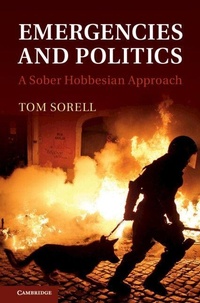
Emergencies and Politics
A Sober Hobbesian Approach
Published on 12. September 2013
Book
Hardback
234 pages
978-1-107-04431-9 (ISBN)
Description
In this book Tom Sorell argues that emergencies can justify types of action that would normally be regarded as wrong. Beginning with the ethics of emergencies facing individuals, he explores the range of effective and legitimate private emergency response and its relation to public institutions, such as national governments. He develops a theory of the response of governments to public emergencies which indicates the possibility of a democratic politics that is liberal but that takes seriously threats to life and limb from public disorder, crime or terrorism. Informed by Hobbes, Schmitt and Walzer, but substantially different from them, the book widens the justification for recourse to normally forbidden measures, without resorting to illiberal politics. This book will interest students of politics, philosophy, international relations and law.
Reviews / Votes
'This is an outstanding book on an under-treated and important topic. With careful and engaging arguments, Sorell develops a 'sober' Hobbesianism that supports a liberal Leviathan and a 'thin' conception of security for international politics, enabling it to speak to some of the most pressing real-world emergencies we presently face. This is Hobbesian political thinking at its best.' Catriona McKinnon, University of Reading 'Although emergency situations are prevalent in public life, surprisingly little attention has been paid to them in contemporary political philosophy. Emergencies and Politics is a timely and praiseworthy attempt to fill this gap, and is sure to become the standard reference in the field. Sorell convincingly shows that the violation of moral precepts in times of emergency does not create a 'black hole' in which everything is permitted, but is anchored in conventional morality.' Daniel Statman, University of Haifa 'Tom Sorell's Emergencies and Politics is 'not a book about Hobbes,' as the author points out. However, it is an outstanding example of how Hobbes's thought could be engaged in view of important present-day concerns, and therefore should be recommended to a Hobbesian audience. There is a particularly strong case for the relevance of Hobbes's ideas with regard to ethical and political questions raised by emergencies.' Maximilian Jaede, Hobbes StudiesMore details
Language
English
Place of publication
Cambridge
United Kingdom
Target group
Professional and scholarly
Dimensions
Height: 235 mm
Width: 157 mm
Thickness: 17 mm
Weight
498 gr
ISBN-13
978-1-107-04431-9 (9781107044319)
Copyright in bibliographic data and cover images is held by Nielsen Book Services Limited or by the publishers or by their respective licensors: all rights reserved.
Schweitzer Classification
Other editions
Additional editions
E-Book
09/2013
1st Edition
Cambridge University Press
€90.49
Available for download
E-Book
09/2013
Cambridge University Press
€73.99
Available for download
Person
Tom Sorell is Professor of Politics and Philosophy at Warwick University. From 2008 to 2012, he led the European Union FP7 Security project DETECTER (on the ethics and human rights issues surrounding the use of detection technologies in counter-terrorism) and is now leader of several Work Packages in the current SURVEILLE project (2012-15). He is Principal Investigator of the major AHRC project, 'Responsibilities, Ethics and the Financial Crisis' (FinCris), running from 2012 to 2015, and also contributes to the FP7 IT project ACCOMPANY, on robotics and care companions. He has published monographs in history of philosophy, especially on Hobbes and Descartes; moral and political philosophy; epistemology and philosophy of science; as well as several distinct areas of applied ethics.
Content
1. Private emergencies and institutions; 2. Public emergencies, black holes and sober Hobbesianism; 3. Liberalism with Hobbesian sobriety; 4. Can liberal emergency-response address threats to peoples and civilizations?; 5. Liberalism and emergency-response: national community; 6. Legislating for emergencies and legislating in emergencies; 7. International security, human security and emergency; Conclusion.