

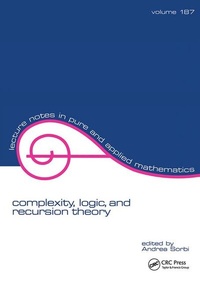
Complexity, Logic, and Recursion Theory
1st Edition
Will be published approx. on 4. February 1997
Book
Paperback/Softback
384 pages
978-0-8247-0026-3 (ISBN)
Description
"Integrates two classical approaches to computability. Offers detailed coverage of recent research at the interface of logic, computability theory, nd theoretical computer science. Presents new, never-before-published results and provides informtion not easily accessible in the literature."
More details
Series
Language
English
Place of publication
Bosa Roca
United States
Publishing group
Taylor & Francis Inc
Target group
College/higher education
Professional and scholarly
Professional
Dimensions
Height: 280 mm
Width: 210 mm
Weight
635 gr
ISBN-13
978-0-8247-0026-3 (9780824700263)
Copyright in bibliographic data and cover images is held by Nielsen Book Services Limited or by the publishers or by their respective licensors: all rights reserved.
Schweitzer Classification
Other editions
Additional editions
Andrea Sorbi
Complexity, Logic, and Recursion Theory
Book
06/2019
1st Edition
CRC Press
€259.90
Shipment within 10-20 days
Andrea Sorbi
Complexity, Logic, and Recursion Theory
E-Book
05/2019
CRC Press
€350.99
Available for download
Andrea Sorbi
Complexity, Logic, and Recursion Theory
E-Book
05/2019
1st Edition
CRC Press
€350.99
Available for download
Person
Andrea Sorbi is Associate Professor in the Department of Mathematics at the University of Siena, Italy. The author or coauthor of several key professional papers and book chapters on computability theory and mathematical logic, he is a member of the American Mathematical Society and the Association for Symbolic Logic, among other organizations. Dr. Sorbi received the Ph.D. degree (1987) in mathematics from the City University of New York, New York.
Content
Resource-bounded measure and randomness; degree structures in local degree theory; compressibility of infinite binary sequences; beyond Godel's theorem - the failure to capture information content; progressions of theories of bounded arithmetic; on presentations of algebraic structures; witness-isomorphic reductions and local search; a survey of inductive inference with an emphasis on queries; a uniformity of degree structures; short course on logic, algebra, and topology; the convenience of Tiling. (Part contents).