

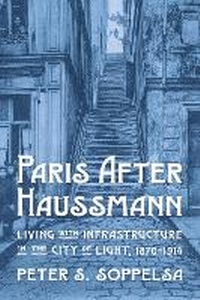
Inverting Haussmannization
Living with Infrastructure in Paris, 1870-1914
Will be published approx. on 17. March 2026
Book
Hardback
300 pages
978-0-8229-4882-7 (ISBN)
Description
Modern Paris is often hailed as a capital of urban infrastructure. Baron Georges-Eugene Haussmann's rebuilding of Paris in 1853-1870, branded "Haussmannization," helped define urban modernity for cities worldwide.
Reviews / Votes
This marvelous book provides critical insight into the relationships between technology, society, and the urban environment in a modernizing Paris. Peter S. Soppelsa lays bare the visible and invisible aspects of the infrastructure that shaped both the form and the human experience of the city's vertical, spatial, and subterranean geographies. The result is an essential portrait of the uneven reach of Paris's infrastructures of transportation, sanitation, and organization, which both reflected and reinforced novel inequalities. -- Richard C. Keller, University of Wisconsin-Madison Well-written and conceived, Paris After Haussmann presents an original perspective on the making of an iconic modern city, and will make an important contribution to historical studies of nineteenth-century Paris specifically, as well as the fields of French history, science and technology studies, and modern urban history more generally. -- Min Kyung Lee, Bryn Mawr College Paris after Haussmann offers key insight into the ideal and reality of living with urban modernity in the City of Light. Peter Soppelsa lays bare the entanglement of infrastructure, environment, health, and society. A groundbreaking analysis and a great read. -- Rosemary Wakeman, Fordham UniversityMore details
Language
English
Place of publication
Pittsburgh PA
United States
Target group
Professional and scholarly
Dimensions
Height: 229 mm
Width: 152 mm
ISBN-13
978-0-8229-4882-7 (9780822948827)
Copyright in bibliographic data and cover images is held by Nielsen Book Services Limited or by the publishers or by their respective licensors: all rights reserved.
Schweitzer Classification
Person
Peter S. Soppelsa is an assistant professor in the University of Oklahoma Department of History of Science, Technology, and Medicine. His research combines environmental and urban history with the history of technology to explore the past of infrastructures, public works, public health, and the everyday experience of urban environments and technologies.