

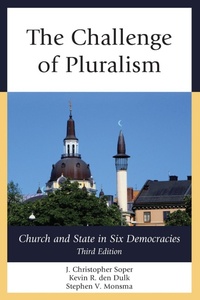
The Challenge of Pluralism
Church and State in Six Democracies
3rd Edition
Published on 31. January 2017
Book
Paperback/Softback
284 pages
978-1-4422-5043-7 (ISBN)
Description
In a thoroughly revised and expanded edition that now includes France, this essential text offers a rigorous, systematic comparison of church-state relations in six Western nations: the United States, France, England, Germany, the Netherlands, and Australia. As successful and stable political democracies, these countries share a commitment to protecting the religious rights of their citizens. The book demonstrates, however, that each has taken substantially different approaches to resolving basic church-state questions. The authors examine both the historical roots of those differences and more recent conflicts over Islam and other religious minorities, explain how contemporary church-state issues are addressed, and provide a framework for assessing the success of each of the six states in protecting the religious rights of its citizens using a framework based on the ideal of governmental neutrality and evenhandedness toward people of all faiths and of none.
Responding to the general confusion about the relationship between church and state in the West, this book offers a much-needed comparative analysis of a topic that is increasingly a source of political conflict. The authors argue that the US conception of church-state separation, with its emphasis on avoiding government establishment of religion, is unique among political democracies and discriminates against religious groups by denying religious organizations access to government services provided to other organizations. The authors persuasively conclude that the United States can learn a great deal from other Western nations in promoting religious neutrality and the free exercise of religion.
Responding to the general confusion about the relationship between church and state in the West, this book offers a much-needed comparative analysis of a topic that is increasingly a source of political conflict. The authors argue that the US conception of church-state separation, with its emphasis on avoiding government establishment of religion, is unique among political democracies and discriminates against religious groups by denying religious organizations access to government services provided to other organizations. The authors persuasively conclude that the United States can learn a great deal from other Western nations in promoting religious neutrality and the free exercise of religion.
Reviews / Votes
One of my favorite books on religion in public life. On a subject especially in need of light, insight, and balance, its very readable historical, legal, and comparative analyses are most enlightening and fair. I recommend it for college classes and as good reading for ordinary citizens. -- Christian Smith, University of Notre Dame Marvelous. The authors perform the rare and difficult feat of generating a genuinely cross-national analysis, while paying strict, detailed attention to the nuances of each country. This book will change the manner in which church-state relations are contested in the United States and is required reading for anyone, at any level. -- Ted G. Jelen, University of Nevada, Las Vegas An exceptionally illuminating book . . . this volume is, in short, an excellent piece of scholarship and deserves a wide readership. -- George Moyser, University of Vermont * Journal of Church and State * A useful comparative study. . . . This survey can help Americans appreciate the peculiarities, both good and bad, of our church-state arrangements. * First Things * The argument of the book is not why America is right, but on the contrary, why the other democracies do it better. The methodology is comparative only after the historical evolution of church-state relationships in each society has been examined with some subtlety. It is a model of a worthwhile comparative study. * Australian Journal of Political Science * A genuine comparative study undertaken by two political scientists surveying church-state relations and it brings together a great deal of valuable historical, legal, and other information . . . relevant to its subject. -- John T. S. Madeley, London School of Economics * West European Politics * When it was first published, The Challenge of Pluralism was one of the earliest and most detailed explorations of how Europe is dealing with its changing religious landscape amidst a history of state churches and secularization. With the increasing cultural presence of Islam being felt across the continent, this updated study of Europe's regulation of religion remains all the more relevant and important. -- Anthony Gill, University of Washington and author of The Political Origins of Religious Liberty The addition of a chapter on France is a wonderful feature of this new edition, showing students the full range of regimes of religion and state in established democracies. When I began lecturing on religion and politics in the 1970s, French audiences would smile indulgently at the crazy behavior of Americans in mixing religion and politics. On recent visits, they ask me anxiously for advice on how the United States has so successfully integrated its religious newcomers. This volume traces the changes in the legal position of religion over the decades and remains the gold standard of books on religion and state from a comparative perspective. -- Kenneth Wald, University of Florida The new edition of this important volume comes at a crucial time in discussions about managing the relationship between state and religion and protecting the rights of citizens, regardless of their religious, philosophical, or political allegiances. The book contains useful, practical, and easy-to-follow advice and recommendations on how to balance rights and interests of all groups fairly that is relevant for a variety of contexts. Most important, the book reminds us that these crucial questions of how to live well in pluralist societies are never fully answered or settled, that we should never become complacent and assume that our societies are as democratic and inclusive as they possibly can be, and that we should continually seek to improve the conditions for liberty of conscience for all and learn from the experiences of one another. -- Erin Wilson, University of GroningenMore details
Edition
3rd edition
Language
English
Place of publication
United States
Publishing group
Bloomsbury Publishing Plc
Target group
Professional and scholarly
US School Grade: From College Freshman to College Graduate Student
Dimensions
Height: 229 mm
Width: 152 mm
Thickness: 17 mm
Weight
468 gr
ISBN-13
978-1-4422-5043-7 (9781442250437)
Copyright in bibliographic data and cover images is held by Nielsen Book Services Limited or by the publishers or by their respective licensors: all rights reserved.
Schweitzer Classification
Other editions
Additional editions
J. Christopher Soper | Kevin R. den Dulk | Stephen V. Monsma
The Challenge of Pluralism
Church and State in Six Democracies
E-Book
01/2017
3rd Edition
Rowman & Littlefield Publishers
€40.49
Available for download
J. Christopher Soper | Kevin R. den Dulk | Stephen V. Monsma
The Challenge of Pluralism
Church and State in Six Democracies
E-Book
01/2017
3rd Edition
Rowman & Littlefield Publishers
€40.49
Available for download
Persons
J. Christopher Soper is Distinguished Professor of Political Science at Pepperdine University.
Kevin R. den Dulk is Paul B. Henry Chair of Political Science and director of the Henry Institute for the Study of Christianity and Politics at Calvin College. Stephen V. Monsma (1936-2017) was senior fellow at the Henry Institute at Calvin College.
Kevin R. den Dulk is Paul B. Henry Chair of Political Science and director of the Henry Institute for the Study of Christianity and Politics at Calvin College. Stephen V. Monsma (1936-2017) was senior fellow at the Henry Institute at Calvin College.
Content
Preface to the Third Edition
Preface to the Second Edition
Preface to the First Edition
Chapter One: Introduction
Part I: Models of Separation
Chapter Two: The United States: Strict Separation under Fire
Chapter Three: France: Separation from the Public Square
Part II: Models of Pluralism
Chapter Four: The Netherlands: Principled Pluralism
Chapter Five: Australia: Pragmatic Pluralism
Part II: Models of Establishment
Chapter Six: England: Restrained Establishment
Chapter Seven: Germany: Church-State Partnership
Chapter Eight: Conclusion: Church and State in Pluralistic Democracies
Selected Bibliography
Preface to the Second Edition
Preface to the First Edition
Chapter One: Introduction
Part I: Models of Separation
Chapter Two: The United States: Strict Separation under Fire
Chapter Three: France: Separation from the Public Square
Part II: Models of Pluralism
Chapter Four: The Netherlands: Principled Pluralism
Chapter Five: Australia: Pragmatic Pluralism
Part II: Models of Establishment
Chapter Six: England: Restrained Establishment
Chapter Seven: Germany: Church-State Partnership
Chapter Eight: Conclusion: Church and State in Pluralistic Democracies
Selected Bibliography