

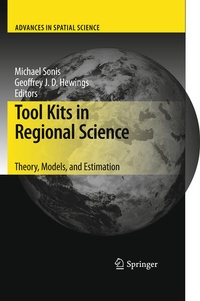
Tool Kits in Regional Science
Theory, Models, and Estimation
Published on 16. July 2009
Book
Hardback
VIII, 305 pages
978-3-642-00626-5 (ISBN)
Description
Regional Science is now more than 50 years old; in the last two decades, significant advances in methodology have occurred, spurred in large part by access to computers. The range of analytical techniques now available is enormous; this books provides a sampling of the toolkit that is now at the disposal of analysts interested in understanding and interpreting the complexity of the spatial structure of sub- national economies. The set of tools ranges from the more traditional (input-output) to new developments in computable general equilibrium models, nonlinear dynamics, neural modelling and innovation.
Reviews / Votes
From the reviews:
"'Tool Kits' is an intriguing phrase. Many readers will pick up this book for a quick look. . describes tools at many levels of abstraction. . The long list of references is also valuable. I learned something here. . useful for some students. . It is an erudite, and interesting, essay, and I recommend it. . The book may well have something for you, and you should look it over at least briefly. . Certainly I found various parts of the book useful." (Roger Bolton, Journal of Regional Science, Vol. 51 (5), 2011)More details
Series
Edition
2009 ed.
Language
English
Place of publication
Berlin
Germany
Publishing group
Springer Berlin
Target group
Professional and scholarly
Research
Illustrations
38 s/w Abbildungen
VIII, 305 p. 38 illus.
Dimensions
Height: 23.5 cm
Width: 15.5 cm
Weight
1380 gr
ISBN-13
978-3-642-00626-5 (9783642006265)
DOI
10.1007/978-3-642-00627-2
Schweitzer Classification
Other editions
Additional editions
Book
11/2011
Springer
€106.99
Shipment within 7-9 days
E-Book
06/2009
1st Edition
Springer
€96.29
Available for download
Content
Complex Socio-Economic Systems in Regional Science.- New Developments in Input-Output Analysis.- Interregional Computable General Equilibrium Models.- Optimality Versus Stability: Pattern Formation in Spatial Economics.- Urban and Hinterland Evolution Under Growing Population Pressure.- Socio-Spatial Dynamics and Discrete Non-Linear Probabilistic Chains.- Principles of Neural Spatial Interaction Modeling.- Quick but not so Dirty ML Estimation of Spatial Autoregressive Models.- Innovation Diffusion Theory: 100 Years of Development.- Urban Economics at a Cross-Road.- Conclusion.