

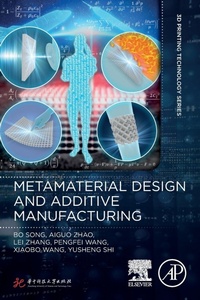
Metamaterial Design and Additive Manufacturing
Published on 25. April 2023
Book
Paperback/Softback
342 pages
978-0-443-18900-5 (ISBN)
Description
Metamaterial Design and Additive Manufacturing covers optimization design, manufacturing, microstructure, mechanical properties, acoustic properties, mass-transport properties and application examples of PMs fabricated by selective laser melting additive manufacturing technology. The book introduces the definition and concept of pentamode metamaterials and then describes their characterization, including manufacturing fidelity, mechanical response, acoustic properties and so on. Final sections analyze research situations, problems and applications of additive manufacturing pentamode metamaterials.
More details
Series
Language
English
Place of publication
San Diego
United States
Publishing group
Elsevier Science Publishing Co Inc
Target group
Professional and scholarly
Dimensions
Height: 152 mm
Width: 229 mm
Thickness: 20 mm
Weight
562 gr
ISBN-13
978-0-443-18900-5 (9780443189005)
Copyright in bibliographic data and cover images is held by Nielsen Book Services Limited or by the publishers or by their respective licensors: all rights reserved.
Schweitzer Classification
Other editions
Additional editions
Bo Song | Aiguo Zhao | Lei Zhang
Metamaterial Design and Additive Manufacturing
E-Book
04/2023
Academic Press
€155.00
Available for download
Persons
Professor Bo is based at the School of Materials Science and Engineering, Huazhong University of Science and Technology, Wuhan, Hubei, China. Specialties and research interests: Additive manufacturing, Powder metallurgy, Design of materials and structure, Advanced functional parts and coatings Zhao Aiguo is based at the College of Civil Engineering, Nanjing Tech University, Nanjing, Jiangsu, China. Specialties and research interests: Acoustic metamaterials, Fatigue and fracture of materials, Additive manufacturing Dr Lei is based at the School of Materials Science and Engineering, Huazhong University of Science and Technology, Wuhan, Hubei, China. Specialties and research interests: Topological structure design, Metamaterials optimization, Selective laser melting, 3D Printing Technology, application Technology of 3D Printing in Aerospace, Mould and Biomedicine Specialties and research interests: Topological optimization, 3D Printing Technology, Application technology of 3D Printing in Aerospace. Specialties and research interests: Structure design, Metamaterials optimization, Selective laser melting, 3D Printing Technology, application Technology of 3D Printing in Aerospace, and Biomedicine. School of Materials Science and Engineering, Huazhong University of Science and Technology, Wuhan, Hubei, China. Specialties and research interests: Additive manufacturing, Near-net forming manufacturing, Water-saving product development, Optical, mechanical and electronic integration
Author
Professor, School of Materials Science and Engineering of Huazhong University of Science and Technology, Hubei, China
Professor, College of Civil Engineering, Nanjing Tech University, Nanjing, Jiangsu, China
Assistant research fellow, School of Materials Science and Engineering, Huazhong University of Science and Technology, Wuhan, China
Research fellow, China Aerospace Science and Technology Innovation Research Institute, Beijing, China
Assistant research fellow School of Materials Science and Engineering, Huazhong University of Science and Technology, Wuhan, Hubei, China
Professor, School of Materials Science and Engineering, Huazhong University of Science and Technology, China
Content
1. Introduction
2. Mechanical metamaterials
3. Acoustic metamaterials
4. Thermal metamaterials
5. Metamaterial-based porous metallic biomaterials
6. Microlattice metamaterials
7. Plate-lattice Metamaterials
8. Business opportunities and future research directions
2. Mechanical metamaterials
3. Acoustic metamaterials
4. Thermal metamaterials
5. Metamaterial-based porous metallic biomaterials
6. Microlattice metamaterials
7. Plate-lattice Metamaterials
8. Business opportunities and future research directions