

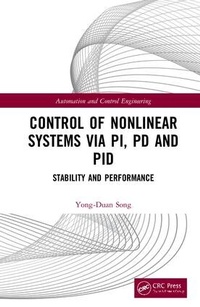
Control of Nonlinear Systems via PI, PD and PID
Stability and Performance
1st Edition
Published on 15. October 2018
Book
Hardback
136 pages
978-1-138-31764-2 (ISBN)
Description
The purpose of this book is to give an exposition of recently adaptive PI/PD/PID control design for nonlinear systems. Since PI/PD/PID control is simple in structure and inexpensive in implementation, it has been undoubtedly the most widely employed controller in industry. In fact, PI/PD/PID controllers are sufficient for many control problems, particularly when process dynamics are benign and the performance requirements are modest. The book focuses on how to design general PI/PD/PID controller with self-tuning gains for different systems, which includes SISO nonlinear system, SISO nonaffine system and MIMO nonlinear system.
More details
Series
Language
English
Place of publication
London
United Kingdom
Publishing group
Taylor & Francis Ltd
Target group
College/higher education
Illustrations
3 s/w Tabellen, 36 s/w Abbildungen
3 Tables, black and white; 36 Illustrations, black and white
Dimensions
Height: 234 mm
Width: 156 mm
Weight
362 gr
ISBN-13
978-1-138-31764-2 (9781138317642)
Copyright in bibliographic data and cover images is held by Nielsen Book Services Limited or by the publishers or by their respective licensors: all rights reserved.
Schweitzer Classification
Other editions
Additional editions
E-Book
10/2018
1st Edition
CRC Press
€231.99
Available for download
E-Book
10/2018
1st Edition
CRC Press
€231.99
Available for download
Person
Yong-Duan Song received his Ph.D. degree in electrical and computer engineering from Tennessee Technological University, Cookeville, USA, in 1992. He held a tenured Full Professor position with North Carolina A&T State University, Greensboro, from 1993 to 2008 and a Langley Distinguished Professor position with the National Institute of Aerospace, Hampton, VA, from 2005 to 2008.
He is now the Dean of School of Automation, Chongqing University, and the Founding Director of the Institute of Smart Systems and Renewable Energy, Chongqing University. He was one of the six Langley Distinguished Professors with the National Institute of Aerospace (NIA), Founding Director of Cooperative Systems at NIA. He has served as an Associate Editor/Guest Editor for several prestigious scientific journals. Prof. Song has received several competitive research awards from the National Science Foundation, the National Aeronautics and Space Administration, the U.S. Air Force Office, the U.S. Army Research Office, and the U.S. Naval Research Office. His research interests include intelligent systems, guidance navigation and control, bio-inspired adaptive and cooperative systems, rail traffic control and safety, and smart grid.
He is now the Dean of School of Automation, Chongqing University, and the Founding Director of the Institute of Smart Systems and Renewable Energy, Chongqing University. He was one of the six Langley Distinguished Professors with the National Institute of Aerospace (NIA), Founding Director of Cooperative Systems at NIA. He has served as an Associate Editor/Guest Editor for several prestigious scientific journals. Prof. Song has received several competitive research awards from the National Science Foundation, the National Aeronautics and Space Administration, the U.S. Air Force Office, the U.S. Army Research Office, and the U.S. Naval Research Office. His research interests include intelligent systems, guidance navigation and control, bio-inspired adaptive and cooperative systems, rail traffic control and safety, and smart grid.
Content
Introduction. Classical PID Control. Adaptive PI Control for SISO Affine Systems. Generalized PI Control for SISO Nonaffine Systems. Adaptive PI Control for MIMO Nonlinear Systems. Adaptive PI Control for Strict Feedback Systems. Adaptive PID Control for MIMO Nonlinear Systems. PD Control Application to High Speed Trains. PID Control Application to Robotic Systems.