

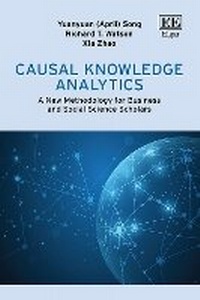
Causal Knowledge Analytics
A New Methodology for Business and Social Science Scholars
Published on 25. March 2025
Book
Hardback
158 pages
978-1-0353-5314-9 (ISBN)
Description
This timely book introduces causal knowledge analytics as a pioneering methodology to enhance scholarly productivity through the systematic digitization and analysis of causal knowledge. It presents a five-level framework for organizing and analysing codified causal knowledge, offering a structured approach for scholars to navigate growing literature landscapes.
By converting knowledge into computable formats, Causal Knowledge Analytics enables scholars to harness digital capabilities for literature processing. The authors apply this new methodology to a set of publications in the information systems field, integrating advanced techniques such as graph theory, network analysis, natural language processing and machine learning methods. They also explore machine learning and computational techniques which help automate and expedite literature processing, enabling scholars to reach the knowledge frontier more efficiently.
Causal Knowledge Analytics is a fundamental resource for business and social science scholars. Students in business and management will also benefit from the book's theoretical and practical insights.
By converting knowledge into computable formats, Causal Knowledge Analytics enables scholars to harness digital capabilities for literature processing. The authors apply this new methodology to a set of publications in the information systems field, integrating advanced techniques such as graph theory, network analysis, natural language processing and machine learning methods. They also explore machine learning and computational techniques which help automate and expedite literature processing, enabling scholars to reach the knowledge frontier more efficiently.
Causal Knowledge Analytics is a fundamental resource for business and social science scholars. Students in business and management will also benefit from the book's theoretical and practical insights.
Reviews / Votes
'In today's fast-paced world of knowledge production, an innovative approach to systematically coding, analyzing, and representing causal knowledge is essential. This book provides clear explanations, methods, and tools to support knowledge accumulation in any discipline, with practical examples from Information Systems research.' -- Leona Chandra Kruse, University of Agder, NorwayMore details
Language
English
Place of publication
Cheltenham
United Kingdom
Target group
Professional and scholarly
Dimensions
Height: 216 mm
Width: 138 mm
ISBN-13
978-1-0353-5314-9 (9781035353149)
Copyright in bibliographic data and cover images is held by Nielsen Book Services Limited or by the publishers or by their respective licensors: all rights reserved.
Schweitzer Classification
Persons
Yuanyuan (April) Song, Assistant Professor of Management Information Systems, Management Department, Marquette University, Richard T. Watson, formerly Research Director, Digital Frontier Partners, Regents Professor and J. Rex Fuqua Distinguished Chair for Internet Strategy Emeritus, University of Georgia and Xia Zhao, Associate Professor of Management Information Systems, Department of Management Information Systems, University of Georgia, USA
Content
Contents
1 The problem of knowledge accumulation
2 Comparing CKA with AI
3 Knowledge digitization
4 Methodology foundations
5 Analysis framework for causal knowledge analytics
6 Illustration of causal knowledge analytics
7 The future of causal knowledge analytics
Appendix 1
Appendix 2
Appendix 3
Appendix 4
Appendix 5
References
1 The problem of knowledge accumulation
2 Comparing CKA with AI
3 Knowledge digitization
4 Methodology foundations
5 Analysis framework for causal knowledge analytics
6 Illustration of causal knowledge analytics
7 The future of causal knowledge analytics
Appendix 1
Appendix 2
Appendix 3
Appendix 4
Appendix 5
References