

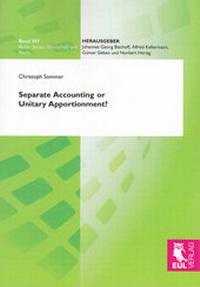
Separate Accounting or Unitary Apportionment?
The Fairy Tale of Arm's Length Pricing and General Equilibrium Analysis of Multinational Enterprise Behavior under the Formulary Taxation Alternative
1st Edition
Published on 26. January 2011
Book
Paperback/Softback
XXIV, 264 pages
978-3-8441-0014-3 (ISBN)
Description
One field where the implications of the omnipresent globalization and hereby initiated new forms of cross-border business activity are exceptionally profound is the income taxation of multinational enterprises. The contemporary worldwide norm, which was adopted in the 1930s, is the separate accounting method. Despite its longevity as the preferred means for the taxation of multinational enterprises, the erosion of tax revenues from alleged transfer price manipulations by firms has goaded public discussion on whether or not the separate accounting method is still a satisfactory solution to the problem of international income taxation. Particularly the European Commission's study "Company Taxation in the Internal Market" and its suggestion to replace separate accounting with unitary apportionment in the European Union has strongly accelerated the debate about the future of group taxation.
In the present treatise, both abovementioned taxation concepts are elucidated as well as qualitatively and quantitatively reviewed against the background of the economic rationale for the multinational enterprise, the way it generates income and the management of its internal affairs. The highlight of this treatise is the general equilibrium model of firm behavior under unitary apportionment, which is, as will be seen, in several important respects more powerful than the usual partial equilibrium treatment of the formulary approach. The presented model, therefore, provides considerable insights regarding the tax incidence and induced real-economic distortions under unitary apportionment. Above all, this model will allow policy-makers and tax authorities to make reasonable estimates concerning potential alterations in tax revenues collected if separate accounting was replaced by unitary apportionment in the future.
More details
Series
Thesis
Doctoral thesis
2010
Freie Universität Berlin
Language
English
Target group
Professional and scholarly
Product notice
Paperback (trade)
Unsewn / adhesive bound
Illustrations
8 Schaubilder
Dimensions
Height: 210 mm
Width: 148 mm
Thickness: 18 mm
Weight
421 gr
ISBN-13
978-3-8441-0014-3 (9783844100143)
Schweitzer Classification
Person
Christoph Sommer studied business administration with a focus on taxation, controlling and audit at the University of Duisburg-Essen from 2001 to 2005. He spent part of his studies at James Cook University, Townsville, Australia. After receiving his degree, he accepted a position as a research assistant at the University of Hamburg before working as a research assistant for a representative at the German parliament (Deutscher Bundestag) from 2006 to 2009. During his time at the Deutscher Bundestag, he pursued his doctoral thesis under the supervision of Prof. Dr. Jochen Hundsdoerfer at Freie Universität Berlin. He is currently with an international consulting firm and practices in the transfer pricing area.
Content
1. Introduction
2. Setting the Stage for Analyzing Separate Accounting and Unitary Apportionment
2.1 Introduction to the Fundamentals of the Analysis
2.2 Theory of the Multinational Enterprise
2.3 The Corporate Income Tax as Withholding Device
2.4 Decision Criteria of the Analysis
3. Separate Accounting: What It Is About and Why It Fails as a Taxation Method for Multi-national Enterprises
3.1 Introduction to Separate Accounting and its Foundation Stones
3.2 The Specifics of Separate Accounting
3.3 Critique of Separate Accounting
3.4 Summary Appraisal of Separate Accounting
4. Unitary Apportionment: Designing a Global Formulary Taxation System and Analyzing Potential Firm Behavior within a General Equilibrium Framework
4.1 Introduction to Unitary Apportionment and its Foundation Stones
4.2 Issues in Implementing a Global Unitary Apportionment System
4.3 General Equilibrium Investigation of Firm Behavior under the Proposed Unitary Apportionment System
4.4 Political Feasibility of Worldwide Adoption of the Proposed System
4.5 Summary Appraisal of Unitary Apportionment
5. Conclusion
2. Setting the Stage for Analyzing Separate Accounting and Unitary Apportionment
2.1 Introduction to the Fundamentals of the Analysis
2.2 Theory of the Multinational Enterprise
2.3 The Corporate Income Tax as Withholding Device
2.4 Decision Criteria of the Analysis
3. Separate Accounting: What It Is About and Why It Fails as a Taxation Method for Multi-national Enterprises
3.1 Introduction to Separate Accounting and its Foundation Stones
3.2 The Specifics of Separate Accounting
3.3 Critique of Separate Accounting
3.4 Summary Appraisal of Separate Accounting
4. Unitary Apportionment: Designing a Global Formulary Taxation System and Analyzing Potential Firm Behavior within a General Equilibrium Framework
4.1 Introduction to Unitary Apportionment and its Foundation Stones
4.2 Issues in Implementing a Global Unitary Apportionment System
4.3 General Equilibrium Investigation of Firm Behavior under the Proposed Unitary Apportionment System
4.4 Political Feasibility of Worldwide Adoption of the Proposed System
4.5 Summary Appraisal of Unitary Apportionment
5. Conclusion