

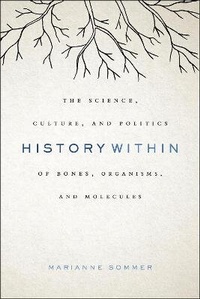
History Within
The Science, Culture, and Politics of Bones, Organisms, and Molecules
Published on 27. May 2016
Book
Hardback
496 pages
978-0-226-34732-5 (ISBN)
Description
Personal genomics services such as 23andMe and Ancestry.com now offer what once was science fiction: the ability to sequence and analyze an individual's entire genetic code-promising, in some cases, facts about that individual's ancestry that may have remained otherwise lost. Such services draw on and contribute to the science of human population genetics that attempts to reconstruct the history of humankind, including the origin and movement of specific populations. Is it true, though, that who we are and where we come from is written into the sequence of our genomes? Are genes better documents for determining our histories and identities than fossils or other historical sources?
Our interpretation of gene sequences, like our interpretation of other historical evidence, inevitably tells a story laden with political and moral values. Focusing on the work of Henry Fairfield Osborn, Julian Sorell Huxley, and Luigi Luca Cavalli-Sforza in paleoanthropology, evolutionary biology, and human population genetics, History Within asks how the sciences of human origins, whether through the museum, the zoo, or the genetics lab, have shaped our idea of what it means to be human. How have these biologically based histories influenced our ideas about nature, society, and culture? As Marianne Sommer shows, the stories we tell about bones, organisms, and molecules often change the world.
Our interpretation of gene sequences, like our interpretation of other historical evidence, inevitably tells a story laden with political and moral values. Focusing on the work of Henry Fairfield Osborn, Julian Sorell Huxley, and Luigi Luca Cavalli-Sforza in paleoanthropology, evolutionary biology, and human population genetics, History Within asks how the sciences of human origins, whether through the museum, the zoo, or the genetics lab, have shaped our idea of what it means to be human. How have these biologically based histories influenced our ideas about nature, society, and culture? As Marianne Sommer shows, the stories we tell about bones, organisms, and molecules often change the world.
More details
Language
English
Place of publication
Chicago
United States
Publishing group
The University of Chicago Press
Target group
College/higher education
Dimensions
Height: 23 mm
Width: 16 mm
Thickness: 4 mm
Weight
879 gr
ISBN-13
978-0-226-34732-5 (9780226347325)
Copyright in bibliographic data and cover images is held by Nielsen Book Services Limited or by the publishers or by their respective licensors: all rights reserved.
Schweitzer Classification
Other editions
Additional editions
E-Book
05/2016
1st Edition
University of Chicago Press
€50.40
Available for download