

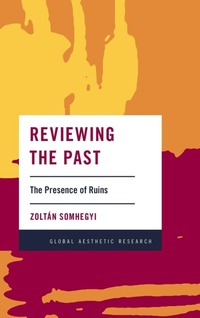
Reviewing the Past
The Presence of Ruins
Published on 10. March 2020
Book
Hardback
274 pages
978-1-78660-760-7 (ISBN)
Description
Though constantly in decay, ruins continue to fascinate the observer. Their still-standing survival is a loud affirmation of their presence, in which we can admire the struggle against the power of Nature aesthetically manifested during the decay.
This volume takes a thematic approach to examining the aesthetics of ruins. It looks at the general aspects of architectural decay and its classical forms of admiration and then turns towards ruins from both classical and contemporary periods, from both Western and non-Western areas, and with examples from "high art" as well as popular culture. Combining the methodologies of art history, aesthetics and cultural history, this book opens up new ways of looking at the phenomenon of ruins.
This volume takes a thematic approach to examining the aesthetics of ruins. It looks at the general aspects of architectural decay and its classical forms of admiration and then turns towards ruins from both classical and contemporary periods, from both Western and non-Western areas, and with examples from "high art" as well as popular culture. Combining the methodologies of art history, aesthetics and cultural history, this book opens up new ways of looking at the phenomenon of ruins.
Reviews / Votes
Zoltan Somhegyi's Reviewing the Past: The Presence of Ruins (Rowman & Littlefield, 2020) takes the reader on a captivating journey through the phenomenon of ruins. It is a remarkable achievement that, I believe, only someone like Somhegyi--a philosophical aesthetician as well as an art historian, and one who has studied ruins on a global scale--could pull off so brilliantly. * Philosophia * Zoltan Somhegyi surveys ruins from across the globe, covering remnants of antiquity, contemporary urban decay, ruins pictured in artworks, and artificial ruins from eighteenth-century gardens to present-day shopping malls. His sophisticated reflections draw upon extensive research from several disciplines, providing a wonderfully readable introduction to ruin appreciation as well as an indispensable resource for scholars. -- Carolyn Korsmeyer, research professor of philosophy, University at Buffalo The book Reviewing the Past: The Presence of Ruins by Zoltan Somhegyi is a must-read book about a very topical subject. We live in an age of ruins. On the one hand we save, document and reconstruct with great technical and financial effort all the fragments that have been historically preserved, and on the other hand new ruins are created all around, through war and iconoclastic terror and furor. Numerous aspects of the cultural and art historical, aesthetic, political and ideological ambivalences that determine the theme of ruins are dealt with in this legible and knowledgeable work. -- Michael Diers, Professor of Art and Visual History at the University of Fine Arts Hamburg and Associate Professor of Art History at the Institute for Art and Visual History of the Humboldt University Berlin Zoltan Somhegyi's new book [provides] readers with a sophisticated, knowledgeable and at the same time absolutely readable perspective on the controversial topic of our relationship with the past and how we should deal with the past's physical remnants, namely, ruins.Somhegyi goes beyond traditional representations of the subject in Romantic aesthetics to embrace the visual implications of ruination in a wide-range of non-conventional contexts. The author's sensitivity, based on many years of travelling throughout Europe and a long stay in the Middle East, brings immediacy and richness of perception to his discussions of the various types of ruins. His survey covers examples ranging from the Greek-Roman world and Byzantium to present-day decaying buildings like abandoned shopping malls and industrial sites, including instances of ruin depiction in seventeenth- and eighteenth-century Flemish and Italian painting, as well as in contemporary media such as conceptual art and photography. -- Lisa Giombini, Studi di Estetica. Italian Journal of Aesthetics The ruin is an enigma that may also provide aesthetic experience, and when wandering among ruins everyone has the right and the opportunity to find their own, subjective reconstruction: how could it have been originally, how to imagine what is now lost. This game of logic based on the strength of imagination will, however, become impossible if the destruction was caused by a terrorist attack or if there is a reconstruction that suggests that "only this form of completion" is correct. Zoltan Somhegyi's book shows that the childhood passion of its author has fortunately remained, the optimistic joy, however, is a thing of the past. Undoubtedly, it is an experience shared by many of us, by the present reviewer for sure.
(This review was originally published in Hungarian.) -- Pal Lovei, President of the Scientific Committee on Art History of the Hungarian Academy of Sciences * BUKSZ (Budapest Review of Books) * Overall, Somhegyi displays commanding knowledge of his subject matter, approaching the monumental topic from interesting and sometimes surprising angles. One could perhaps hope for even more direct engagement with the ruined edifices themselves in addition to their artistic representations, but what Somhegyi does present is impressive and generally convincing. The title of the final chapter, 'Time Transformed into Space', is borrowed from a 2008 novel by Orhan Pamuk referring to museums as places of remembrance (219). And although the chapter centres on museums, one could imagine applying the phrase to many of the edifices discussed in this well-written and fascinating book. * Architectural Histories *
More details
Series
Language
English
Place of publication
United Kingdom
Publishing group
Bloomsbury Publishing PLC
Target group
Professional and scholarly
Illustrations
20 b/w photos;
Dimensions
Height: 235 mm
Width: 157 mm
Thickness: 21 mm
Weight
600 gr
ISBN-13
978-1-78660-760-7 (9781786607607)
Copyright in bibliographic data and cover images is held by Nielsen Book Services Limited or by the publishers or by their respective licensors: all rights reserved.
Schweitzer Classification
Other editions
Additional editions
E-Book
03/2020
1st Edition
Rowman & Littlefield Publishers
€35.49
Available for download
E-Book
03/2020
1st Edition
Rowman & Littlefield Publishers
€35.49
Available for download
Person
Zoltan Somhegyi (b. 1981) is a Hungarian art historian with a PhD in aesthetics, currently based in Sharjah, United Arab Emirates and working as Chair of the Department of Fine Arts of the College of Fine Arts and Design of the University of Sharjah, and from September 2020 he will continue as Associate Professor of Art History at the Karoli Gaspar University of the Reformed Church in Hungary.
Content
Introduction / Part I Classical Tendancies / 1. The fragile presence of ruins. General aspects of the aesthetics of architectural decay / 2. The golden age and fall of ruins / 3. In front of ruins / Part II Modern Appearances / 4. Ruins in East-West perspective / 5. Contemporary ruins. Investigations into a contradiction in terms / 6. "Learning from Detroit?" - From materialised dreams to bitter awakening. Aesthetics around decayed shopping malls / Part III When in Works / 7. Cracks in the walls / 8. Eulogy to the fragment. Artworks and ruination / 9. Ruins as context and scenery. Temporal interference as source of aesthetic experience / Part IV Afterlife 10. Mall with lamassu. Imitated decay and aesthetic education in thematic commercial centres / 11. What remains of that which has remained? Against the eradication of ruins / 12. "Time transformed into Space". Orhan Pamuk and the museums of remembrance