

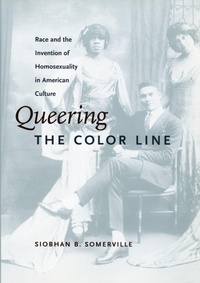
Queering the Color Line
Race and the Invention of Homosexuality in American Culture
Published on 13. January 2000
Book
Paperback/Softback
272 pages
978-0-8223-2443-0 (ISBN)
Description
Queering the Color Line transforms previous understandings of how homosexuality was "invented" as a category of identity in the United States beginning in the late nineteenth century. Analyzing a range of sources, including sexology texts, early cinema, and African American literature, Siobhan B. Somerville argues that the emerging understanding of homosexuality depended on the context of the black/white "color line," the dominant system of racial distinction during this period. This book thus critiques and revises tendencies to treat race and sexuality as unrelated categories of analysis, showing instead that race has historically been central to the cultural production of homosexuality.
At about the same time that the 1896 Supreme Court Plessy v. Ferguson decision hardened the racialized boundary between black and white, prominent trials were drawing the public's attention to emerging categories of sexual identity. Somerville argues that these concurrent developments were not merely parallel but in fact inextricably interrelated and that the discourses of racial and sexual "deviance" were used to reinforce each other's terms. She provides original readings of such texts as Havelock Ellis's late nineteenth-century work on "sexual inversion," the 1914 film A Florida Enchantment, the novels of Pauline E. Hopkins, James Weldon Johnson's Autobiography of an Ex-Coloured Man, and Jean Toomer's fiction and autobiographical writings, including Cane. Through her analyses of these texts and her archival research, Somerville contributes to the growing body of scholarship that focuses on discovering the intersections of gender, race, and sexuality.
Queering the Color Line will have broad appeal across disciplines including African American studies, gay and lesbian studies, literary criticism, cultural studies, cinema studies, and gender studies.
At about the same time that the 1896 Supreme Court Plessy v. Ferguson decision hardened the racialized boundary between black and white, prominent trials were drawing the public's attention to emerging categories of sexual identity. Somerville argues that these concurrent developments were not merely parallel but in fact inextricably interrelated and that the discourses of racial and sexual "deviance" were used to reinforce each other's terms. She provides original readings of such texts as Havelock Ellis's late nineteenth-century work on "sexual inversion," the 1914 film A Florida Enchantment, the novels of Pauline E. Hopkins, James Weldon Johnson's Autobiography of an Ex-Coloured Man, and Jean Toomer's fiction and autobiographical writings, including Cane. Through her analyses of these texts and her archival research, Somerville contributes to the growing body of scholarship that focuses on discovering the intersections of gender, race, and sexuality.
Queering the Color Line will have broad appeal across disciplines including African American studies, gay and lesbian studies, literary criticism, cultural studies, cinema studies, and gender studies.
Reviews / Votes
"Queering the Color Line is a groundbreaking study that sets a new agenda for critical investigations of the intersecting histories of race and sexuality in the United States. Siobhan Somerville provides a model of interdisciplinary, politically engaged scholarship that is certain to become required reading in queer studies, race theory, and U.S. history as well as American literature."-Lisa Duggan, New York University "By offering a new understanding of the emergence of race and sexuality as collaborative entities, Somerville has made an important contribution to the expanding scholarship in African American studies, American studies, queer theory, and cultural studies."-Robyn Wiegman, author of American Anatomies: Theorizing Race and Gender "This book pioneers new strategies for understanding the intersectionality of sexuality and race formation. Equally adept at textual analysis and historical contextualization, Somerville demonstrates how the early sexological division of people into homosexuals and heterosexuals was profoundly shaped by the discourse of scientific racism, and she elaborates her argument through a series of subtle reinterpretations of cinematic and literary texts that illuminate the profound-usually inexplicit-interdependence of racial and sexual discourse. A pathbreaking study."-George Chauncey, University of ChicagoMore details
Series
Language
English
Place of publication
North Carolina
United States
Target group
Professional and scholarly
Product notice
Paperback (trade)
Illustrations
6 illustrations
Dimensions
Height: 228 mm
Width: 156 mm
Thickness: 21 mm
Weight
401 gr
ISBN-13
978-0-8223-2443-0 (9780822324430)
Copyright in bibliographic data and cover images is held by Nielsen Book Services Limited or by the publishers or by their respective licensors: all rights reserved.
Schweitzer Classification
Other editions
Additional editions
Somerville Siobhan B. Somerville
Queering the Color Line
Race and the Invention of Homosexuality in American Culture
E-Book
01/2000
1st Edition
Duke University Press Books
€198.99
Available for download
Person
Siobhan B. Somerville is Assistant Professor of English and Women's Studies at Purdue University.
Content
Acknowledgments ix
Introduction 1
1. Scientific Racism and the Invention of the Homosexual Body 15
2. The Queer Career of Jim Crow: Racial and Sexual Transformation in Early Cinema 39
3. Inverting the Tragic Mulatta Tradition: Race and Homosexuality in Pauline E. Hopkins's Fiction 77
4. Double Lives on the Color Line: "Perverse" Desire in The Autobiography of an Ex-Coloured Man 111
5. "Queer to Myself As I Am to You": Jean Toomer, Racial Disidentification, and Queer Reading 131
Conclusion 166
Appendix 177
Notes 181
Bibliography 221
Index 249
Introduction 1
1. Scientific Racism and the Invention of the Homosexual Body 15
2. The Queer Career of Jim Crow: Racial and Sexual Transformation in Early Cinema 39
3. Inverting the Tragic Mulatta Tradition: Race and Homosexuality in Pauline E. Hopkins's Fiction 77
4. Double Lives on the Color Line: "Perverse" Desire in The Autobiography of an Ex-Coloured Man 111
5. "Queer to Myself As I Am to You": Jean Toomer, Racial Disidentification, and Queer Reading 131
Conclusion 166
Appendix 177
Notes 181
Bibliography 221
Index 249