

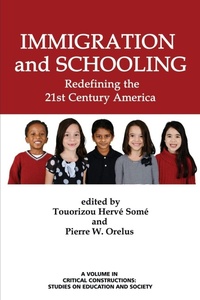
Immigration and Schooling
Redefining the 21st Century America
Published on 23. March 2015
Book
Paperback/Softback
182 pages
978-1-62396-892-2 (ISBN)
Description
At the time of Obama's draconian anti-immigrant policies leading to massive deportation of undocumented, poor immigrants of color, there could not be a more timely and important book than this edited volume, which critically examines ways in which immigration, race, class, language, and gender issues intersect and impact the life of many immigrants, including immigrant students.
This book documents the journey, many success-stories, as well as stories that expose social inequity in schools and U.S. society. Further, this book examines issues of social inequity and resource gaps shaping the relations between affluent and poor-working class students, including students of color.
Authors in this volume also critically unpack anti-immigrant policies leading to the separation of families and children. Equally important, contributors to this book unveil ways and degree to which xenophobia and linguicism have affected immigrants, including immigrant students and faculty of color, in both subtle and overt ways, and the manner in which many have resisted these forms of oppression and affirmed their humanity.
Lastly, chapters in this much-needed and well-timed volume have pointed out the way racism has limited life chances of people of color, including students of color, preventing many of them from fulfilling their potential succeeding in schools and society at large.
This book documents the journey, many success-stories, as well as stories that expose social inequity in schools and U.S. society. Further, this book examines issues of social inequity and resource gaps shaping the relations between affluent and poor-working class students, including students of color.
Authors in this volume also critically unpack anti-immigrant policies leading to the separation of families and children. Equally important, contributors to this book unveil ways and degree to which xenophobia and linguicism have affected immigrants, including immigrant students and faculty of color, in both subtle and overt ways, and the manner in which many have resisted these forms of oppression and affirmed their humanity.
Lastly, chapters in this much-needed and well-timed volume have pointed out the way racism has limited life chances of people of color, including students of color, preventing many of them from fulfilling their potential succeeding in schools and society at large.
More details
Series
Language
English
Place of publication
Charlotte
United States
Publishing group
Emerald Publishing Inc
Target group
College/higher education
Professional and scholarly
Dimensions
Height: 234 mm
Width: 156 mm
Thickness: 10 mm
Weight
286 gr
ISBN-13
978-1-62396-892-2 (9781623968922)
Copyright in bibliographic data and cover images is held by Nielsen Book Services Limited or by the publishers or by their respective licensors: all rights reserved.
Schweitzer Classification
Other editions
Additional editions
Touorizou Hervé Somé | Pierre W. Orelus
Immigration and Schooling
Redefining the 21st Century America
E-Book
03/2015
1st Edition
Information Age Publishing
from
€62.33
Available for download
Persons
Touorizou Herve Some, Ripon College, USA
Pierre W. Orelus, New Mexico State University, USA
Curry Stephenson Malott, West Chester University of Pennsylvania, USA
Brad J. Porfilio, Lewis University in Romeoville, IL, USA
Marc Pruyn, Monash University, USA
Pierre W. Orelus, New Mexico State University, USA
Curry Stephenson Malott, West Chester University of Pennsylvania, USA
Brad J. Porfilio, Lewis University in Romeoville, IL, USA
Marc Pruyn, Monash University, USA
Content
Preface.
Introduction.
Part I: Immigrants, Education, and Xenophobia.
Chapter 1. In Search of a Place Called Home: The Linguistic, Cultural, and Socioeconomic Dislocations of Immigrants and Transnationals of Color, Pierre Orelus.
Chapter 2. Education of Immigrants' Children: A Review of Two Decades of Empirical Research in the United States, 1965-2001, Yan Z. Ciupak.
Chapter 3. Mainstreaming New Immigrant Students: The Struggles of an African 5th Grader, Esther Some-Guiebre.
Chapter 4. Conceptualizing Smartness: Using Social and Cultural Capital to Explain Academic Achievement Among a Group of African Immigrant Girls, Betty Okwako.
Part II: Language, Minority Students, and Academic Achievement.
Chapter 5. Challenging a Troubling Miseducation: Arab-American Marginalization in American Schools and Universities, Muana Shami.
Chapter 6. Best Approaches to Literacy Instruction to English Language Learners: Cultural Conflicts and Compromises, Guofang Li.
Chapter 7. Why Are the Spanish Speakers in the Back of the Room in a Dual Immersion Setting? Marisol Ruiz.
Chapter 8. Teaching in the Face of Race: An Autoethnological Theoretical Reflection, Barrel Gueye and Cathie Lalonde.
About the Authors.
Introduction.
Part I: Immigrants, Education, and Xenophobia.
Chapter 1. In Search of a Place Called Home: The Linguistic, Cultural, and Socioeconomic Dislocations of Immigrants and Transnationals of Color, Pierre Orelus.
Chapter 2. Education of Immigrants' Children: A Review of Two Decades of Empirical Research in the United States, 1965-2001, Yan Z. Ciupak.
Chapter 3. Mainstreaming New Immigrant Students: The Struggles of an African 5th Grader, Esther Some-Guiebre.
Chapter 4. Conceptualizing Smartness: Using Social and Cultural Capital to Explain Academic Achievement Among a Group of African Immigrant Girls, Betty Okwako.
Part II: Language, Minority Students, and Academic Achievement.
Chapter 5. Challenging a Troubling Miseducation: Arab-American Marginalization in American Schools and Universities, Muana Shami.
Chapter 6. Best Approaches to Literacy Instruction to English Language Learners: Cultural Conflicts and Compromises, Guofang Li.
Chapter 7. Why Are the Spanish Speakers in the Back of the Room in a Dual Immersion Setting? Marisol Ruiz.
Chapter 8. Teaching in the Face of Race: An Autoethnological Theoretical Reflection, Barrel Gueye and Cathie Lalonde.
About the Authors.